
Our Three Step Process
May 22, 2026
AI Growth Partner: Transform Your Business with Strategic AI Implementation in 2026
Our Three Step Process
May 22, 2026
AI Growth Partner: Transform Your Business with Strategic AI Implementation in 2026
Partner with AI experts who deliver measurable ROI. Our 5-phase framework transforms marketing technology and drives sustainable business growth.
AI's Impact on Marketing Technology and Future Applications
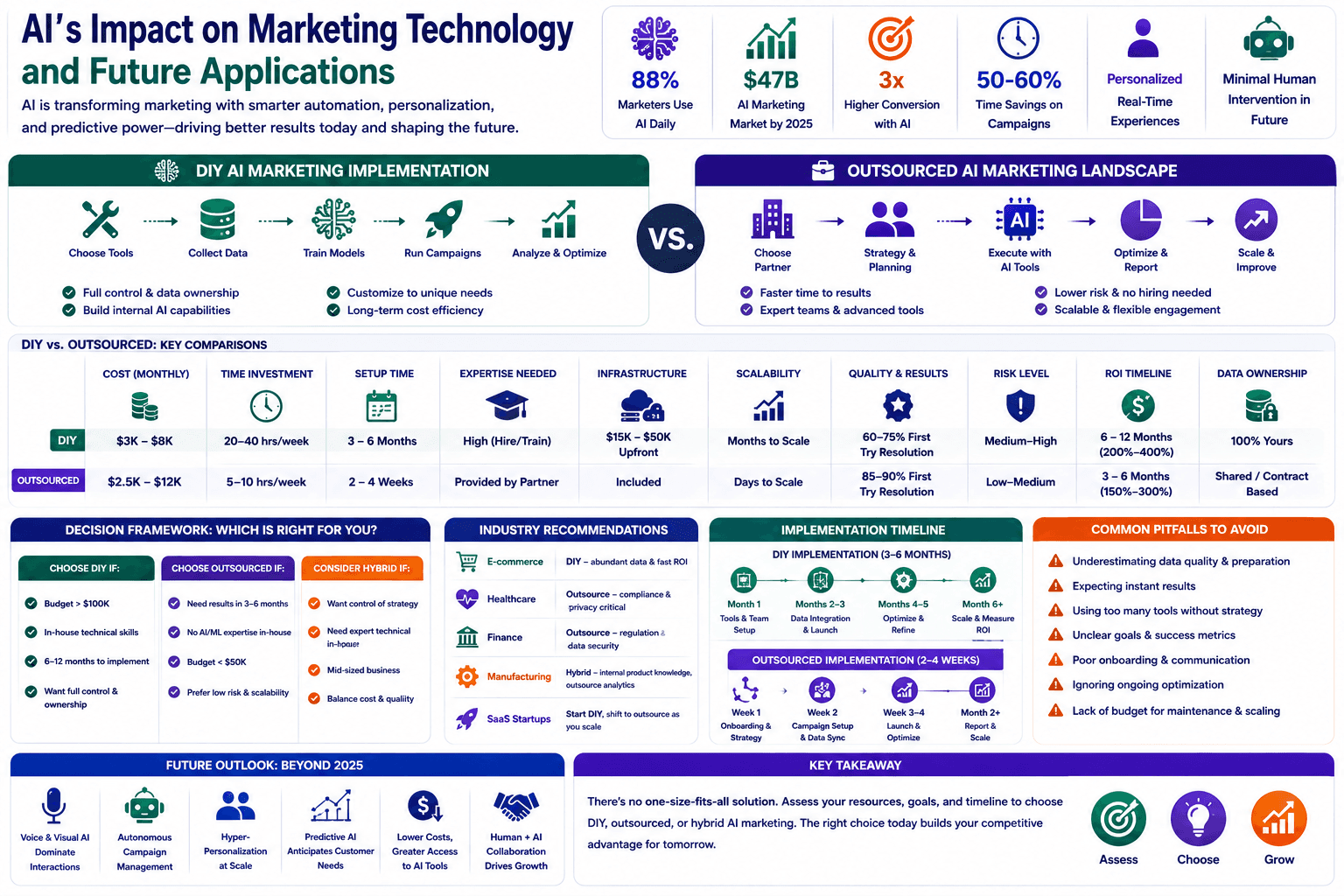
AI is revolutionizing marketing technology by automating customer segmentation, personalizing content, and accurately predicting consumer behavior. Marketing teams leverage machine learning to optimize ad spending, automate emails, and personalize interactions in real time. Predictive analytics allows marketers to identify high-value prospects, while chatbots equipped with natural language processing provide 24/7 customer support. For more on how AI can enhance customer interactions, check out our page on AI in Customer Experience.
Looking ahead, AI will further personalize marketing through advanced behavior modeling and real-time decision-making. Future applications include autonomous campaign optimization, enhancements in voice and visual search, and predictions of customer lifetime value. AI will also integrate with augmented reality and enable marketers to forecast market trends months in advance, solidifying its role as a strategic partner in driving business growth. Learn more about Future Trends in AI.
Understanding AI as a Strategic Growth Partner
An AI growth partner prioritizes business outcomes over technical tasks, working closely with you to align AI initiatives with your growth and efficiency goals. Unlike traditional tech vendors, an AI growth partner becomes an integral part of your team, facilitating ongoing transformation by identifying where AI can truly benefit your business. For insights on selecting the right partner, visit our guide on Choosing an AI Partner.
Key differences include:
Emphasis on business results over technical features
Long-term partnership rather than one-off projects
Expertise in strategy, technology, and change management
Focus on clear ROI and sustainable competitive advantage
This approach ensures AI is a catalyst for business growth, not just an unused tool.
The Five-Phase Framework for AI Business Transformation
This framework guides the successful integration of AI into your business, transforming AI tools into essential business assets.
Phase 1: Assessment and Vision Setting
Evaluate your current processes to identify areas where AI can make a significant impact. Target problem areas and data-rich environments for quick wins. For more on assessment techniques, see our page on Business Process Evaluation.
Phase 2: Strategy Formulation and Technology Selection
Develop a strategic approach and select appropriate technologies, such as Microsoft Azure or Langchain. Establish clear timelines and risk management plans. Explore our resources on AI Technology Selection for more details.
Phase 3: Solution Design and Development
Design AI solutions that seamlessly integrate with existing systems. Employ agile methodologies and cross-functional teams for continuous feedback. Check out our article on Agile Development for AI for best practices.
Phase 4: Implementation and Adoption Management
Start with pilot programs to test solutions before scaling. Promote user adoption through targeted training and manage change to address workforce concerns. For strategies on change management, refer to our section on Managing Change in AI Projects.
Phase 5: Monitoring and Continuous Optimization
Track success using key metrics like processing time and customer satisfaction. Continuously refine based on feedback and evolving business needs. Learn more about Key Metrics for AI Success to ensure effective monitoring.
Why Traditional AI Implementations Fail to Deliver ROI
Many AI projects fail to deliver tangible business value, with 95% of enterprise AI pilots not yielding measurable returns. Several factors contribute to these failures:
Undefined Strategy: Lack of clear plans leads to stalled projects.
Talent Gaps: Insufficient internal AI expertise and siloed teams hinder collaboration.
Integration Challenges: Existing systems often resist AI integration, causing technical setbacks.
Lack of Governance: Overlooking ethical and compliance needs erodes trust and poses legal risks.
Execution Gap: Transitioning from successful pilots to full deployment is challenging.
Tool-First Mentality: Focusing on AI tools rather than strategies results in costly solutions that don't address real business problems.
Core Characteristics of an Effective AI Growth Partner
An effective AI growth partner acts as a strategic collaborator, not just a technical consultant. They possess qualities that distinguish them from typical development teams.
Strategic Advisor: Identifies where AI adds value, reviews processes, and aligns tech efforts with business goals.
Technical Expert: Builds custom AI solutions and automates data flows within your organization.
Change Enabler: Guides cultural shifts needed for AI adoption, training teams, and addressing resistance.
Ongoing Partner: Continuously improves AI systems as technology and business needs evolve.
Business Outcome Focus: Prioritizes measurable outcomes, ensuring AI investments drive efficiency and revenue growth.
Governance Champion: Establishes responsible AI frameworks, ensuring ethical use and compliance with regulations.
When Your Business Needs an AI Transformation Partner
Consider engaging an AI transformation partner when your business exhibits signs of needing expert AI assistance beyond your team's capabilities.
Your team can't handle big AI projects: Staff excels at daily tasks but struggles with large AI initiatives.
AI projects have hit a roadblock: Attempts to leverage AI tools haven't translated into business results.
Leaders see AI as key but need a plan: Leadership recognizes AI's potential for growth but lacks a clear roadmap. For guidance on developing a roadmap, see our AI Strategy Development page.
You want more than just new tools: Aim to transform business operations and customer service, not just add AI software.
Competition forces quick AI action: Market pressures necessitate rapid AI adoption to stay competitive.
Building a Collaborative AI Environment for Sustainable Growth
Successful AI transformation involves more than adopting new technology; it requires collaborative efforts where human skills complement AI to drive sustainable growth.
Form cross-functional teams including business leaders, tech experts, and users to ensure AI meets real business needs.
Establish clear communication channels to share AI insights and best practices across departments. Regular workshops demonstrate AI's impact on specific roles.
Create feedback loops for employees to report AI issues and suggest improvements, enhancing systems and user acceptance.
Develop change management processes to address concerns about AI replacing jobs, emphasizing AI's role in augmenting human capabilities.
Build governance frameworks to ensure ethical AI use and compliance with industry regulations and data protection laws.
Measuring Success: Key Metrics for AI-Driven Business Transformation
Track the right metrics to determine whether your AI partner delivers real value or merely technical features. Focus on business outcomes, not just technical performance.
Revenue impact metrics include increased sales conversion rates, improved customer lifetime value, and new revenue streams from AI products or services.
Operational efficiency indicators assess reduced processing times, cost savings from automation, and productivity gains. Monitor how AI reduces manual work hours and eliminates bottlenecks.
Customer experience metrics evaluate satisfaction scores, response times, and personalization success. AI should enhance customer interactions and service quality.
ROI calculations compare AI costs to measurable benefits over time, including both direct savings and indirect value.
Adoption rates reflect successful change management. High user engagement with AI tools indicates effective implementation and training.
The Future of AI Partnership: Beyond 2026
AI partnerships will evolve from single projects to ongoing strategic alliances. Companies will need AI partners who adapt to rapidly changing technology.
Autonomous AI agents will handle complex tasks independently. Partners must understand how to govern and deploy these agents ethically and at scale.
Industry-specific AI solutions will replace generic tools. Partners need deep sector knowledge in areas like healthcare, finance, manufacturing, and retail to achieve meaningful results. For more on industry-specific applications, visit our AI in Industry page.
Real-time optimization will become standard as AI systems enhance operations autonomously. Partners must monitor systems live and make swift adjustments.
Hybrid human-AI workflows will enhance workplace productivity. Effective partners will augment human skills rather than replace workers.
Regulatory compliance will become more intricate as governments regulate AI. Partners must stay abreast of legal changes while fostering innovation.
The best AI partnerships will blend strategic vision, technical expertise, and the ability to learn and adapt.
Partner with AI experts who deliver measurable ROI. Our 5-phase framework transforms marketing technology and drives sustainable business growth.
AI's Impact on Marketing Technology and Future Applications
AI is revolutionizing marketing technology by automating customer segmentation, personalizing content, and accurately predicting consumer behavior. Marketing teams leverage machine learning to optimize ad spending, automate emails, and personalize interactions in real time. Predictive analytics allows marketers to identify high-value prospects, while chatbots equipped with natural language processing provide 24/7 customer support. For more on how AI can enhance customer interactions, check out our page on AI in Customer Experience.
Looking ahead, AI will further personalize marketing through advanced behavior modeling and real-time decision-making. Future applications include autonomous campaign optimization, enhancements in voice and visual search, and predictions of customer lifetime value. AI will also integrate with augmented reality and enable marketers to forecast market trends months in advance, solidifying its role as a strategic partner in driving business growth. Learn more about Future Trends in AI.
Understanding AI as a Strategic Growth Partner
An AI growth partner prioritizes business outcomes over technical tasks, working closely with you to align AI initiatives with your growth and efficiency goals. Unlike traditional tech vendors, an AI growth partner becomes an integral part of your team, facilitating ongoing transformation by identifying where AI can truly benefit your business. For insights on selecting the right partner, visit our guide on Choosing an AI Partner.
Key differences include:
Emphasis on business results over technical features
Long-term partnership rather than one-off projects
Expertise in strategy, technology, and change management
Focus on clear ROI and sustainable competitive advantage
This approach ensures AI is a catalyst for business growth, not just an unused tool.
The Five-Phase Framework for AI Business Transformation
This framework guides the successful integration of AI into your business, transforming AI tools into essential business assets.
Phase 1: Assessment and Vision Setting
Evaluate your current processes to identify areas where AI can make a significant impact. Target problem areas and data-rich environments for quick wins. For more on assessment techniques, see our page on Business Process Evaluation.
Phase 2: Strategy Formulation and Technology Selection
Develop a strategic approach and select appropriate technologies, such as Microsoft Azure or Langchain. Establish clear timelines and risk management plans. Explore our resources on AI Technology Selection for more details.
Phase 3: Solution Design and Development
Design AI solutions that seamlessly integrate with existing systems. Employ agile methodologies and cross-functional teams for continuous feedback. Check out our article on Agile Development for AI for best practices.
Phase 4: Implementation and Adoption Management
Start with pilot programs to test solutions before scaling. Promote user adoption through targeted training and manage change to address workforce concerns. For strategies on change management, refer to our section on Managing Change in AI Projects.
Phase 5: Monitoring and Continuous Optimization
Track success using key metrics like processing time and customer satisfaction. Continuously refine based on feedback and evolving business needs. Learn more about Key Metrics for AI Success to ensure effective monitoring.
Why Traditional AI Implementations Fail to Deliver ROI
Many AI projects fail to deliver tangible business value, with 95% of enterprise AI pilots not yielding measurable returns. Several factors contribute to these failures:
Undefined Strategy: Lack of clear plans leads to stalled projects.
Talent Gaps: Insufficient internal AI expertise and siloed teams hinder collaboration.
Integration Challenges: Existing systems often resist AI integration, causing technical setbacks.
Lack of Governance: Overlooking ethical and compliance needs erodes trust and poses legal risks.
Execution Gap: Transitioning from successful pilots to full deployment is challenging.
Tool-First Mentality: Focusing on AI tools rather than strategies results in costly solutions that don't address real business problems.
Core Characteristics of an Effective AI Growth Partner
An effective AI growth partner acts as a strategic collaborator, not just a technical consultant. They possess qualities that distinguish them from typical development teams.
Strategic Advisor: Identifies where AI adds value, reviews processes, and aligns tech efforts with business goals.
Technical Expert: Builds custom AI solutions and automates data flows within your organization.
Change Enabler: Guides cultural shifts needed for AI adoption, training teams, and addressing resistance.
Ongoing Partner: Continuously improves AI systems as technology and business needs evolve.
Business Outcome Focus: Prioritizes measurable outcomes, ensuring AI investments drive efficiency and revenue growth.
Governance Champion: Establishes responsible AI frameworks, ensuring ethical use and compliance with regulations.
When Your Business Needs an AI Transformation Partner
Consider engaging an AI transformation partner when your business exhibits signs of needing expert AI assistance beyond your team's capabilities.
Your team can't handle big AI projects: Staff excels at daily tasks but struggles with large AI initiatives.
AI projects have hit a roadblock: Attempts to leverage AI tools haven't translated into business results.
Leaders see AI as key but need a plan: Leadership recognizes AI's potential for growth but lacks a clear roadmap. For guidance on developing a roadmap, see our AI Strategy Development page.
You want more than just new tools: Aim to transform business operations and customer service, not just add AI software.
Competition forces quick AI action: Market pressures necessitate rapid AI adoption to stay competitive.
Building a Collaborative AI Environment for Sustainable Growth
Successful AI transformation involves more than adopting new technology; it requires collaborative efforts where human skills complement AI to drive sustainable growth.
Form cross-functional teams including business leaders, tech experts, and users to ensure AI meets real business needs.
Establish clear communication channels to share AI insights and best practices across departments. Regular workshops demonstrate AI's impact on specific roles.
Create feedback loops for employees to report AI issues and suggest improvements, enhancing systems and user acceptance.
Develop change management processes to address concerns about AI replacing jobs, emphasizing AI's role in augmenting human capabilities.
Build governance frameworks to ensure ethical AI use and compliance with industry regulations and data protection laws.
Measuring Success: Key Metrics for AI-Driven Business Transformation
Track the right metrics to determine whether your AI partner delivers real value or merely technical features. Focus on business outcomes, not just technical performance.
Revenue impact metrics include increased sales conversion rates, improved customer lifetime value, and new revenue streams from AI products or services.
Operational efficiency indicators assess reduced processing times, cost savings from automation, and productivity gains. Monitor how AI reduces manual work hours and eliminates bottlenecks.
Customer experience metrics evaluate satisfaction scores, response times, and personalization success. AI should enhance customer interactions and service quality.
ROI calculations compare AI costs to measurable benefits over time, including both direct savings and indirect value.
Adoption rates reflect successful change management. High user engagement with AI tools indicates effective implementation and training.
The Future of AI Partnership: Beyond 2026
AI partnerships will evolve from single projects to ongoing strategic alliances. Companies will need AI partners who adapt to rapidly changing technology.
Autonomous AI agents will handle complex tasks independently. Partners must understand how to govern and deploy these agents ethically and at scale.
Industry-specific AI solutions will replace generic tools. Partners need deep sector knowledge in areas like healthcare, finance, manufacturing, and retail to achieve meaningful results. For more on industry-specific applications, visit our AI in Industry page.
Real-time optimization will become standard as AI systems enhance operations autonomously. Partners must monitor systems live and make swift adjustments.
Hybrid human-AI workflows will enhance workplace productivity. Effective partners will augment human skills rather than replace workers.
Regulatory compliance will become more intricate as governments regulate AI. Partners must stay abreast of legal changes while fostering innovation.
The best AI partnerships will blend strategic vision, technical expertise, and the ability to learn and adapt.
Other Blogs
Other Blogs
Check our other project Blogs with useful insight and information for your businesses
Other Blogs
Other Blogs
Check our other project Blogs with useful insight and information for your businesses