Our Three Step Process
May 26, 2026
Best AI Marketing Companies 2026: Complete Guide & Case Studies
Our Three Step Process
May 26, 2026
Best AI Marketing Companies 2026: Complete Guide & Case Studies
Discover top AI marketing companies with proven ROI. Real case studies, implementation guides, and success stories from L'Oreal to BuzzFeed.
AI's Current Impact on Marketing Technology
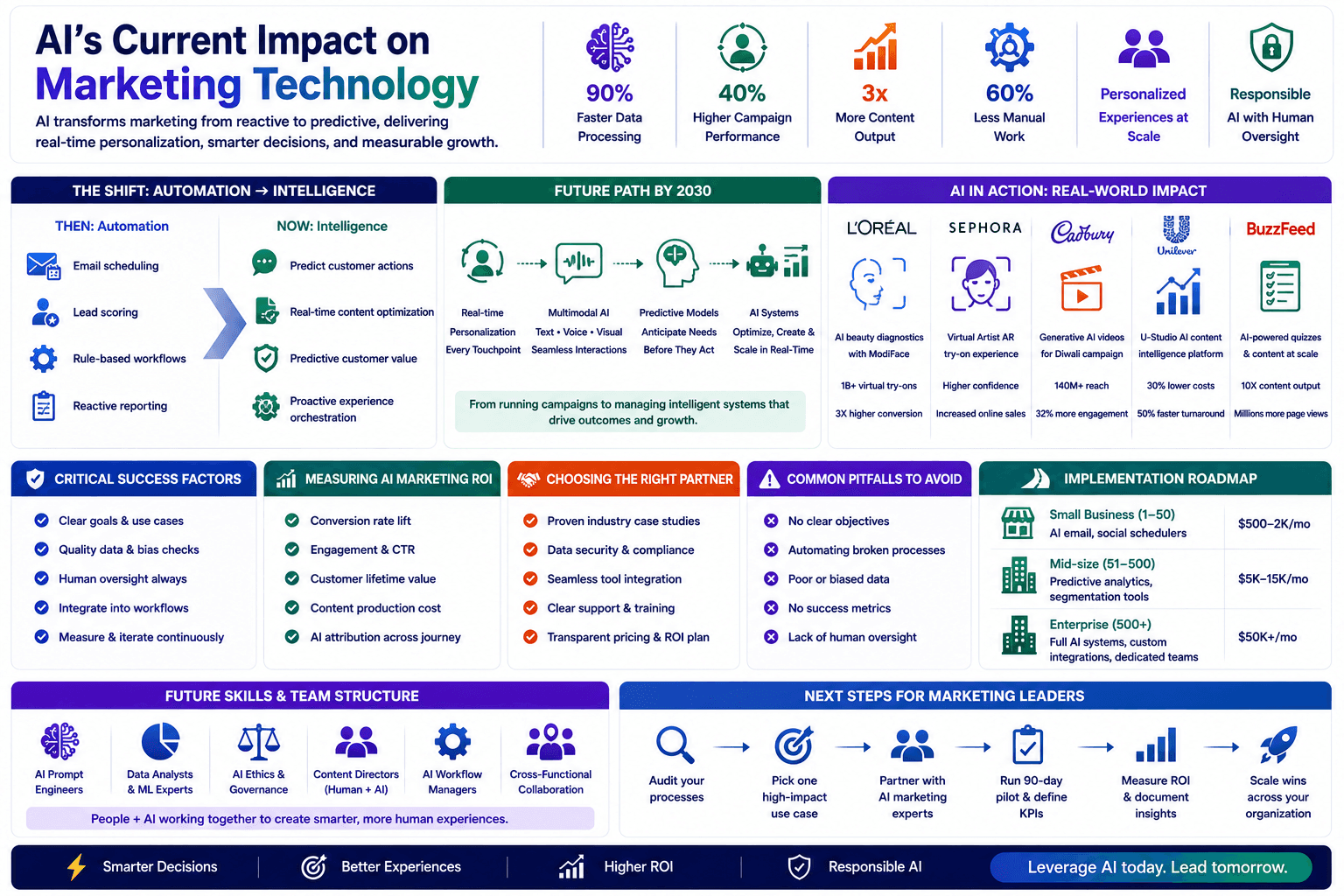
AI has transformed marketing technology from reactive tools to predictive powerhouses. Modern platforms now process customer data instantly, adjust campaign settings, and predict customer actions with remarkable accuracy. This evolution enables marketers to move beyond demographic targeting to behavior prediction, crafting personalized experiences on a large scale across multiple channels. For more on how AI is reshaping marketing strategies, visit our AI Marketing Strategies.
The Shift from Automation to Intelligence
Previously, marketing automation managed simple tasks like email scheduling and lead scoring. Today, AI makes strategic decisions, enhances content in real-time, and forecasts customer value. This shift transforms marketing from merely managing campaigns to actively shaping customer experiences, allowing brands to anticipate needs rather than just respond to actions. Learn more about the transition in our Marketing Automation Guide.
Future Path of AI Marketing Technology
By 2030, AI will seamlessly support personalized experiences at every touchpoint. Multimodal AI will integrate text, voice, and visual interactions, while predictive models will anticipate customer needs before they are even expressed. Marketing teams will transition from running campaigns to managing AI systems that optimize performance and generate creative variations autonomously in real-time. For insights on future trends, check out our Future of Marketing Technology.
Case Studies: AI in Action
L'Oréal's AI-Powered Beauty Diagnostics: L'Oréal leveraged ModiFace and SkinConsult AI to provide personalized beauty advice, analyzing skin conditions and recommending specific products. This innovation resulted in over 1 billion virtual try-ons globally and tripled conversion rates compared to standard product pages, demonstrating AI's potential to enhance customer experience and sales simultaneously. Explore more case studies in our AI Success Stories.
Sephora's Virtual Artist AR Integration: Sephora's Virtual Artist employs AI and augmented reality to allow customers to try makeup on their faces in real-time. By analyzing facial features and digitally applying products, customers can see how items look before purchasing, reducing hesitation and boosting confidence, ultimately increasing online sales. Discover how AR is changing retail in our Augmented Reality in Marketing.
Cadbury's Use of Generative AI for Local Market Campaigns: Cadbury utilized generative AI to create personalized video ads for small businesses during Diwali, tailoring content to different regions in India. This campaign reached over 140 million people and increased engagement by 32%, showcasing AI's ability to craft emotionally engaging and culturally relevant stories. For more on generative AI, visit our Generative AI Insights.
Unilever's AI Content Intelligence Platform: Unilever developed "U-Studio," an AI tool that evaluates creative assets and predicts their success pre-release. By analyzing visuals, messaging, and audience data, the platform enhanced content creation, reducing production costs by 30% and accelerating campaign turnaround by 50%, illustrating AI's role in boosting creative efficiency. Learn about content optimization in our Content Marketing Strategies.
BuzzFeed's Content Expansion with AI: BuzzFeed harnessed AI to produce quizzes and content at scale, generating unique quiz questions and interactive content for diverse audiences. This approach increased content output tenfold and boosted page views, highlighting AI's capacity to serve niche audiences profitably through automated content creation. For tips on scaling content, check our Content Scaling Techniques.
Small Business Success Stories with AI Marketing
Small businesses are achieving significant results with AI marketing tools. Jasper grew to $75 million in revenue from a $30,000 investment by addressing marketers' content needs. Local restaurants use AI chatbots for order management, enhancing efficiency by 40%. E-commerce stores employ AI-driven email personalization, increasing conversion rates by 25% without hefty budgets. For more small business insights, visit our Small Business Marketing Solutions.
Critical Failure Points and How to Avoid Them
AI marketing can falter when rushed without clear objectives. Failures often arise from automating poorly understood processes, using biased datasets, and lacking success metrics. IBM Watson for Oncology failed due to unsafe recommendations from hypothetical data, while Amazon's recruiting AI exhibited gender bias. Avoid these pitfalls by setting clear goals, thoroughly testing systems, and maintaining human oversight throughout deployment. For best practices, see our AI Implementation Best Practices.
Successful AI Marketing Implementation Patterns
Successful AI marketing initiatives share common traits. They integrate AI into workflows rather than treating it as a standalone tool, establish clear brand voice guidelines, create repeatable processes with human checks, and focus on specific use cases with defined goals. Structured oversight, allocated resources, and regular performance tracking are essential for effective AI management. For a deeper dive, check our AI Workflow Integration Guide.
Measuring ROI for AI Marketing
To ensure success in AI marketing, employ primary and secondary KPIs to evaluate performance. L'Oréal monitors conversion rates and engagement from virtual try-ons, while Starbucks tracks order frequency and customer lifetime value with Deep Brew. Establish baseline metrics, consider trade-offs between goals, and use attribution models to assess AI's impact on the customer journey. For more on measuring success, visit our Marketing ROI Measurement.
Choosing AI Marketing Companies: Key Factors
Select AI marketing partners with industry-specific case studies. Evaluate their data handling capabilities, integration with existing marketing tools, and post-setup support quality. Opt for partners who understand your business model rather than offering generic solutions. Request detailed timelines and clear success metrics before committing. For tips on selecting partners, see our Choosing Marketing Partners.
Implementation Roadmap for Different Business Sizes
Small Businesses (1-50 employees): Start with AI email tools and social media schedulers, budgeting $500-2000 monthly for basic automation.
Mid-size Companies (51-500 employees): Introduce predictive analytics and customer segmentation tools, allocating $5000-15000 monthly for various AI platforms.
Enterprise (500+ employees): Implement comprehensive AI systems with custom integrations, setting aside $50000+ monthly for advanced AI marketing infrastructure and dedicated teams. For tailored solutions, explore our Business Size Marketing Solutions.
Future Skills and Team Structure Requirements
By 2027, marketing teams will require AI prompt engineers, data analysts with machine learning expertise, and AI ethics specialists. Traditional roles will evolve: content creators will become AI content directors, and campaign managers will focus on AI workflow optimization. Collaboration among marketing, IT, and data science teams will be crucial for effective AI utilization and management. For more on team structures, visit our Future Marketing Roles.
Next Steps for Marketing Leaders
Audit your marketing processes to identify repetitive tasks suitable for AI automation. Select one task, such as email subject line optimization or customer segmentation, and collaborate with experienced AI marketing companies for initial setup. Define success metrics, conduct a 90-day pilot, measure ROI, and document insights. Scale successful initiatives across your organization. For a detailed action plan, check our Marketing Leaders Action Plan.
Discover top AI marketing companies with proven ROI. Real case studies, implementation guides, and success stories from L'Oreal to BuzzFeed.
AI's Current Impact on Marketing Technology
AI has transformed marketing technology from reactive tools to predictive powerhouses. Modern platforms now process customer data instantly, adjust campaign settings, and predict customer actions with remarkable accuracy. This evolution enables marketers to move beyond demographic targeting to behavior prediction, crafting personalized experiences on a large scale across multiple channels. For more on how AI is reshaping marketing strategies, visit our AI Marketing Strategies.
The Shift from Automation to Intelligence
Previously, marketing automation managed simple tasks like email scheduling and lead scoring. Today, AI makes strategic decisions, enhances content in real-time, and forecasts customer value. This shift transforms marketing from merely managing campaigns to actively shaping customer experiences, allowing brands to anticipate needs rather than just respond to actions. Learn more about the transition in our Marketing Automation Guide.
Future Path of AI Marketing Technology
By 2030, AI will seamlessly support personalized experiences at every touchpoint. Multimodal AI will integrate text, voice, and visual interactions, while predictive models will anticipate customer needs before they are even expressed. Marketing teams will transition from running campaigns to managing AI systems that optimize performance and generate creative variations autonomously in real-time. For insights on future trends, check out our Future of Marketing Technology.
Case Studies: AI in Action
L'Oréal's AI-Powered Beauty Diagnostics: L'Oréal leveraged ModiFace and SkinConsult AI to provide personalized beauty advice, analyzing skin conditions and recommending specific products. This innovation resulted in over 1 billion virtual try-ons globally and tripled conversion rates compared to standard product pages, demonstrating AI's potential to enhance customer experience and sales simultaneously. Explore more case studies in our AI Success Stories.
Sephora's Virtual Artist AR Integration: Sephora's Virtual Artist employs AI and augmented reality to allow customers to try makeup on their faces in real-time. By analyzing facial features and digitally applying products, customers can see how items look before purchasing, reducing hesitation and boosting confidence, ultimately increasing online sales. Discover how AR is changing retail in our Augmented Reality in Marketing.
Cadbury's Use of Generative AI for Local Market Campaigns: Cadbury utilized generative AI to create personalized video ads for small businesses during Diwali, tailoring content to different regions in India. This campaign reached over 140 million people and increased engagement by 32%, showcasing AI's ability to craft emotionally engaging and culturally relevant stories. For more on generative AI, visit our Generative AI Insights.
Unilever's AI Content Intelligence Platform: Unilever developed "U-Studio," an AI tool that evaluates creative assets and predicts their success pre-release. By analyzing visuals, messaging, and audience data, the platform enhanced content creation, reducing production costs by 30% and accelerating campaign turnaround by 50%, illustrating AI's role in boosting creative efficiency. Learn about content optimization in our Content Marketing Strategies.
BuzzFeed's Content Expansion with AI: BuzzFeed harnessed AI to produce quizzes and content at scale, generating unique quiz questions and interactive content for diverse audiences. This approach increased content output tenfold and boosted page views, highlighting AI's capacity to serve niche audiences profitably through automated content creation. For tips on scaling content, check our Content Scaling Techniques.
Small Business Success Stories with AI Marketing
Small businesses are achieving significant results with AI marketing tools. Jasper grew to $75 million in revenue from a $30,000 investment by addressing marketers' content needs. Local restaurants use AI chatbots for order management, enhancing efficiency by 40%. E-commerce stores employ AI-driven email personalization, increasing conversion rates by 25% without hefty budgets. For more small business insights, visit our Small Business Marketing Solutions.
Critical Failure Points and How to Avoid Them
AI marketing can falter when rushed without clear objectives. Failures often arise from automating poorly understood processes, using biased datasets, and lacking success metrics. IBM Watson for Oncology failed due to unsafe recommendations from hypothetical data, while Amazon's recruiting AI exhibited gender bias. Avoid these pitfalls by setting clear goals, thoroughly testing systems, and maintaining human oversight throughout deployment. For best practices, see our AI Implementation Best Practices.
Successful AI Marketing Implementation Patterns
Successful AI marketing initiatives share common traits. They integrate AI into workflows rather than treating it as a standalone tool, establish clear brand voice guidelines, create repeatable processes with human checks, and focus on specific use cases with defined goals. Structured oversight, allocated resources, and regular performance tracking are essential for effective AI management. For a deeper dive, check our AI Workflow Integration Guide.
Measuring ROI for AI Marketing
To ensure success in AI marketing, employ primary and secondary KPIs to evaluate performance. L'Oréal monitors conversion rates and engagement from virtual try-ons, while Starbucks tracks order frequency and customer lifetime value with Deep Brew. Establish baseline metrics, consider trade-offs between goals, and use attribution models to assess AI's impact on the customer journey. For more on measuring success, visit our Marketing ROI Measurement.
Choosing AI Marketing Companies: Key Factors
Select AI marketing partners with industry-specific case studies. Evaluate their data handling capabilities, integration with existing marketing tools, and post-setup support quality. Opt for partners who understand your business model rather than offering generic solutions. Request detailed timelines and clear success metrics before committing. For tips on selecting partners, see our Choosing Marketing Partners.
Implementation Roadmap for Different Business Sizes
Small Businesses (1-50 employees): Start with AI email tools and social media schedulers, budgeting $500-2000 monthly for basic automation.
Mid-size Companies (51-500 employees): Introduce predictive analytics and customer segmentation tools, allocating $5000-15000 monthly for various AI platforms.
Enterprise (500+ employees): Implement comprehensive AI systems with custom integrations, setting aside $50000+ monthly for advanced AI marketing infrastructure and dedicated teams. For tailored solutions, explore our Business Size Marketing Solutions.
Future Skills and Team Structure Requirements
By 2027, marketing teams will require AI prompt engineers, data analysts with machine learning expertise, and AI ethics specialists. Traditional roles will evolve: content creators will become AI content directors, and campaign managers will focus on AI workflow optimization. Collaboration among marketing, IT, and data science teams will be crucial for effective AI utilization and management. For more on team structures, visit our Future Marketing Roles.
Next Steps for Marketing Leaders
Audit your marketing processes to identify repetitive tasks suitable for AI automation. Select one task, such as email subject line optimization or customer segmentation, and collaborate with experienced AI marketing companies for initial setup. Define success metrics, conduct a 90-day pilot, measure ROI, and document insights. Scale successful initiatives across your organization. For a detailed action plan, check our Marketing Leaders Action Plan.
Other Blogs
Other Blogs
Check our other project Blogs with useful insight and information for your businesses
Other Blogs
Other Blogs
Check our other project Blogs with useful insight and information for your businesses