Our Three Step Process
May 26, 2026
AI Marketing Companies Investment Guide 2026 | Returns & ROI Analysis
Our Three Step Process
May 26, 2026
AI Marketing Companies Investment Guide 2026 | Returns & ROI Analysis
Discover investment returns from AI marketing companies in 2026. Compare startup, enterprise & mid-market firms with detailed ROI projections.
AI's Impact on Marketing Technology and Future Uses
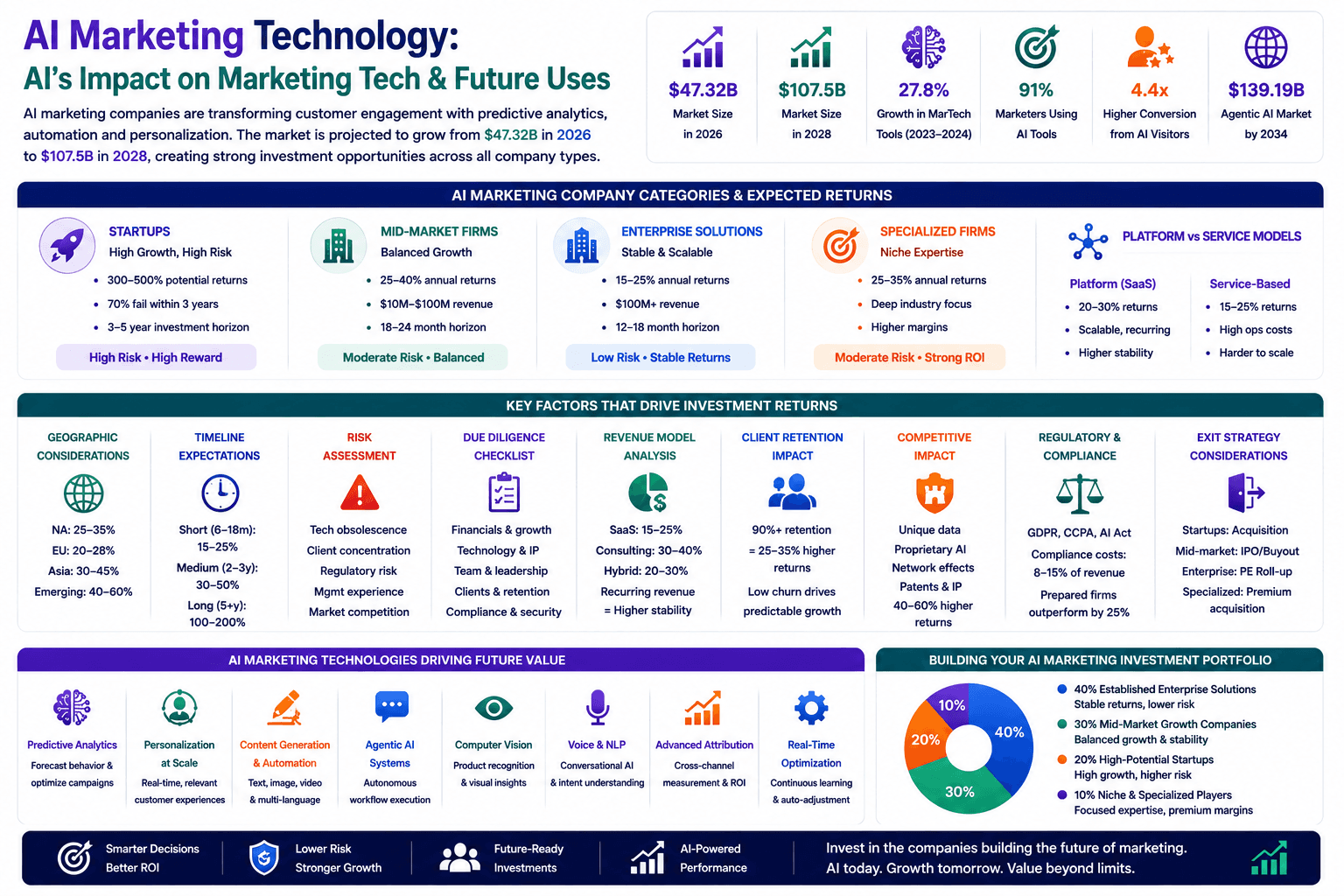
AI marketing firms have revolutionized how businesses attract, retain, and engage customers through predictive analytics, automated personalization, and real-time optimization. Machine learning now drives pricing strategies, content creation, and audience targeting on a large scale. Looking ahead, advancements in natural language processing, computer vision, and behavior prediction promise to deliver highly personalized customer experiences at every interaction. For more insights on the latest trends, check out our page on AI Marketing Trends.
Understanding AI Marketing Investment Returns Across Company Categories
AI marketing companies generate returns differently based on their size, focus, and market position. Returns on investments vary significantly among startups, mid-sized firms, and large enterprises, each presenting unique risks and rewards. Factors such as client acquisition costs, recurring revenue, proprietary technology, and market reach directly influence investor returns and long-term value. To learn more about investment strategies, visit our Investment Strategies page.
Startups in AI marketing can offer high returns but come with inherent risks. Successful ventures often grow 300-500% due to innovative technology and early market entry, yet 70% fail within three years due to funding challenges, competition, and scaling issues. Investors should anticipate a 3-5 year wait for returns, with the potential for substantial gains.
Mid-Market AI Marketing Firms: Balanced Growth and Stability
Mid-market AI marketing companies typically experience annual returns of 25-40%, presenting less risk than startups. With solid business models and established client bases, these firms earn between $10-100 million, offering a balanced mix of growth and stability. Investors usually see returns within 18-24 months, appealing to those seeking moderate risk. For a deeper dive into mid-market dynamics, check our Mid-Market Insights.
Enterprise AI Marketing Solutions: Reliable Returns with Scale Benefits
Enterprise AI marketing companies generally provide 15-25% yearly returns with reduced risk. Collaborating with Fortune 500 clients and generating over $100 million in revenue, these firms offer moderate growth but predictable cash flows and market strength, ensuring stability. Investors can expect returns in 12-18 months through dividends and steady value growth. Explore more about enterprise solutions on our Enterprise Solutions page.
Specialized AI Marketing Companies: Niche Expertise, Strong Returns
Specialized AI marketing companies focusing on specific industries or technologies often deliver 25-35% annual returns. Their deep expertise in areas like healthcare marketing automation or financial services personalization allows them to charge premium prices. Despite having fewer clients, they enjoy higher margins and face less competition, offering strong return potential for investors willing to accept market concentration risks. Learn more about niche markets on our Niche Market Strategies page.
Platform vs Service-Based AI Marketing Investment Models
Platform-based AI marketing companies typically achieve 20-30% yearly returns, leveraging scalable SaaS models with consistent revenue. In contrast, service-based firms offer 15-25% returns but face higher operational costs and scaling challenges. Platform models provide more stable long-term investments due to predictable revenue, while service-based companies initially grow faster but have limited scalability. For a comparison of revenue models, visit our Revenue Model Analysis page.
Geographic Considerations for AI Marketing Company Investments
AI marketing companies in North America generally provide 25-35% annual returns, benefiting from well-established markets and larger client budgets. European firms see 20-28% returns, supported by strong regulatory compliance. Asian markets, particularly China and India, offer 30-45% potential returns but come with higher risks. Emerging markets can yield 40-60% potential returns, though they also present significant regulatory and currency risks. For more on geographic trends, check our Global Market Insights page.
Timeline Expectations: Short vs Long-Term ROI Projections
Short-term AI marketing investments (6-18 months) typically yield 15-25% returns by enhancing operational efficiency. Medium-term investments (2-3 years) can achieve 30-50% returns as AI models improve and client bases expand. Long-term investments (5+ years) may result in 100-200% returns through market leadership and the development of proprietary technology in established AI marketing companies. For a detailed timeline analysis, see our ROI Timeline Expectations page.
Risk Assessment Framework for AI Marketing Investments
AI marketing companies face risks such as outdated technology, over-reliance on a few clients, and regulatory compliance. Evaluate their data protection measures, algorithm transparency, and competitive differentiation. Consider the management team's experience, financial stability, and market position. Assess sector-specific risks, including privacy regulations and platform dependencies. Diversify investments across different company stages, regions, and AI areas to mitigate risk and enhance potential returns. For more on risk management, visit our Risk Management Strategies page.
Due Diligence Checklist for AI Marketing Company Evaluation
Examine financial statements, revenue growth, and client acquisition costs. Assess technology patents, data sources, and algorithm performance. Evaluate the management team's experience, client retention, and competitive position. Review compliance with data privacy regulations, security measures, and ethical AI practices. Consider scalability, market size, and unique value propositions before making investment decisions. For a comprehensive checklist, refer to our Due Diligence Checklist page.
Portfolio Diversification Strategies Across AI Marketing Segments
Invest in a mix of startup, mid-market, and enterprise AI marketing companies to balance risk and returns. Allocate 20% to high-growth startups, 50% to stable mid-market firms, and 30% to established enterprise solutions. Diversify across North America, Europe, and Asia-Pacific markets. Include both platform-based and service-oriented companies, focusing on areas like predictive analytics and personalization technologies. For more on diversification, check our Portfolio Diversification Strategies page.
Market Maturity Impact on Investment Returns
Early-stage AI marketing markets can yield high returns but are more volatile. Mature markets in North America offer stable annual returns of 15-25% due to established customer bases. Emerging markets in Asia-Pacific have growth potential of 30-50%, though they face regulatory risks. European markets combine innovation with compliance, providing steady returns of 20-30%. Timing investments in these market cycles can significantly impact overall portfolio performance. For insights on market maturity, visit our Market Maturity Analysis page.
Technology Stack Evaluation for Investment Decisions
Modern AI marketing companies using cloud-based systems often achieve 20-30% higher returns than those with outdated systems. Companies with proprietary machine learning models tend to have stronger market positions and higher valuations. Open-source technology can reduce development costs but might limit uniqueness. When considering investments, evaluate API integrations, scalability, and data processing capabilities across different companies. For more on technology stacks, see our Technology Stack Evaluation page.
Revenue Model Analysis: SaaS vs Consulting vs Hybrid Approaches
SaaS-based AI marketing companies typically offer 15-25% yearly returns with steady recurring revenue. Consulting firms experience more volatility but can achieve 30-40% returns during growth periods. Hybrid models, combining software and services, often deliver balanced 20-30% returns, reducing risk and providing multiple revenue streams for steady growth. For a detailed analysis of revenue models, check our Revenue Model Insights page.
Client Retention Metrics and Their Impact on Returns
AI marketing companies with over 90% client retention often achieve 25-35% higher returns than those with 70-80% retention. High retention indicates a strong product-market fit and reduces customer acquisition costs. Companies prioritizing customer success teams and regular platform improvements tend to have better retention. Monthly churn rates under 2% signal steady revenue growth and attractive investment returns. For more on client retention, visit our Client Retention Strategies page.
Competitive Moat Assessment in AI Marketing Companies
AI marketing companies with strong competitive moats achieve better long-term results. Key moats include unique data sets, exclusive partnerships with major platforms, and advanced machine learning algorithms. Companies with network effects, where value increases as more users join, see 40-60% better returns. Patent portfolios and unique technology setups deter new competitors, safeguarding market share and pricing power. For insights on competitive moats, check our Competitive Moat Analysis page.
Regulatory and Compliance Factors Affecting Returns
AI marketing companies face increasing regulations impacting returns. GDPR, CCPA, and new AI laws result in compliance costs of 8-15% of revenue. Companies with robust privacy frameworks and transparent AI practices often have higher valuations. Firms prepared for regulatory changes perform 25% better during policy shifts, while non-compliant companies face significant fines and restricted market access. For more on regulatory factors, see our Regulatory Compliance Insights page.
Exit Strategy Considerations for Different Company Types
Exit strategies vary for AI marketing companies. Startups often aim for acquisition by larger tech firms or marketing agencies within 3-5 years. Mid-sized companies may pursue public offerings or strategic buyouts. Enterprise solutions frequently attract private equity rollups. Specialized firms can secure premium prices from industry players seeking specific expertise. Platform companies typically have higher exit values than service-based models. For more on exit strategies, visit our Exit Strategy Guide page.
Building Your AI Marketing Investment Portfolio
Create a diverse AI marketing portfolio by allocating 40% to established enterprise solutions, 30% to mid-market growth companies, 20% to promising startups, and 10% to niche players. Include both platform and service models across various regions. Monitor performance quarterly and adjust annually based on market trends and company growth. For portfolio building tips, check our Investment Portfolio Building page.
Discover investment returns from AI marketing companies in 2026. Compare startup, enterprise & mid-market firms with detailed ROI projections.
AI's Impact on Marketing Technology and Future Uses
AI marketing firms have revolutionized how businesses attract, retain, and engage customers through predictive analytics, automated personalization, and real-time optimization. Machine learning now drives pricing strategies, content creation, and audience targeting on a large scale. Looking ahead, advancements in natural language processing, computer vision, and behavior prediction promise to deliver highly personalized customer experiences at every interaction. For more insights on the latest trends, check out our page on AI Marketing Trends.
Understanding AI Marketing Investment Returns Across Company Categories
AI marketing companies generate returns differently based on their size, focus, and market position. Returns on investments vary significantly among startups, mid-sized firms, and large enterprises, each presenting unique risks and rewards. Factors such as client acquisition costs, recurring revenue, proprietary technology, and market reach directly influence investor returns and long-term value. To learn more about investment strategies, visit our Investment Strategies page.
Startups in AI marketing can offer high returns but come with inherent risks. Successful ventures often grow 300-500% due to innovative technology and early market entry, yet 70% fail within three years due to funding challenges, competition, and scaling issues. Investors should anticipate a 3-5 year wait for returns, with the potential for substantial gains.
Mid-Market AI Marketing Firms: Balanced Growth and Stability
Mid-market AI marketing companies typically experience annual returns of 25-40%, presenting less risk than startups. With solid business models and established client bases, these firms earn between $10-100 million, offering a balanced mix of growth and stability. Investors usually see returns within 18-24 months, appealing to those seeking moderate risk. For a deeper dive into mid-market dynamics, check our Mid-Market Insights.
Enterprise AI Marketing Solutions: Reliable Returns with Scale Benefits
Enterprise AI marketing companies generally provide 15-25% yearly returns with reduced risk. Collaborating with Fortune 500 clients and generating over $100 million in revenue, these firms offer moderate growth but predictable cash flows and market strength, ensuring stability. Investors can expect returns in 12-18 months through dividends and steady value growth. Explore more about enterprise solutions on our Enterprise Solutions page.
Specialized AI Marketing Companies: Niche Expertise, Strong Returns
Specialized AI marketing companies focusing on specific industries or technologies often deliver 25-35% annual returns. Their deep expertise in areas like healthcare marketing automation or financial services personalization allows them to charge premium prices. Despite having fewer clients, they enjoy higher margins and face less competition, offering strong return potential for investors willing to accept market concentration risks. Learn more about niche markets on our Niche Market Strategies page.
Platform vs Service-Based AI Marketing Investment Models
Platform-based AI marketing companies typically achieve 20-30% yearly returns, leveraging scalable SaaS models with consistent revenue. In contrast, service-based firms offer 15-25% returns but face higher operational costs and scaling challenges. Platform models provide more stable long-term investments due to predictable revenue, while service-based companies initially grow faster but have limited scalability. For a comparison of revenue models, visit our Revenue Model Analysis page.
Geographic Considerations for AI Marketing Company Investments
AI marketing companies in North America generally provide 25-35% annual returns, benefiting from well-established markets and larger client budgets. European firms see 20-28% returns, supported by strong regulatory compliance. Asian markets, particularly China and India, offer 30-45% potential returns but come with higher risks. Emerging markets can yield 40-60% potential returns, though they also present significant regulatory and currency risks. For more on geographic trends, check our Global Market Insights page.
Timeline Expectations: Short vs Long-Term ROI Projections
Short-term AI marketing investments (6-18 months) typically yield 15-25% returns by enhancing operational efficiency. Medium-term investments (2-3 years) can achieve 30-50% returns as AI models improve and client bases expand. Long-term investments (5+ years) may result in 100-200% returns through market leadership and the development of proprietary technology in established AI marketing companies. For a detailed timeline analysis, see our ROI Timeline Expectations page.
Risk Assessment Framework for AI Marketing Investments
AI marketing companies face risks such as outdated technology, over-reliance on a few clients, and regulatory compliance. Evaluate their data protection measures, algorithm transparency, and competitive differentiation. Consider the management team's experience, financial stability, and market position. Assess sector-specific risks, including privacy regulations and platform dependencies. Diversify investments across different company stages, regions, and AI areas to mitigate risk and enhance potential returns. For more on risk management, visit our Risk Management Strategies page.
Due Diligence Checklist for AI Marketing Company Evaluation
Examine financial statements, revenue growth, and client acquisition costs. Assess technology patents, data sources, and algorithm performance. Evaluate the management team's experience, client retention, and competitive position. Review compliance with data privacy regulations, security measures, and ethical AI practices. Consider scalability, market size, and unique value propositions before making investment decisions. For a comprehensive checklist, refer to our Due Diligence Checklist page.
Portfolio Diversification Strategies Across AI Marketing Segments
Invest in a mix of startup, mid-market, and enterprise AI marketing companies to balance risk and returns. Allocate 20% to high-growth startups, 50% to stable mid-market firms, and 30% to established enterprise solutions. Diversify across North America, Europe, and Asia-Pacific markets. Include both platform-based and service-oriented companies, focusing on areas like predictive analytics and personalization technologies. For more on diversification, check our Portfolio Diversification Strategies page.
Market Maturity Impact on Investment Returns
Early-stage AI marketing markets can yield high returns but are more volatile. Mature markets in North America offer stable annual returns of 15-25% due to established customer bases. Emerging markets in Asia-Pacific have growth potential of 30-50%, though they face regulatory risks. European markets combine innovation with compliance, providing steady returns of 20-30%. Timing investments in these market cycles can significantly impact overall portfolio performance. For insights on market maturity, visit our Market Maturity Analysis page.
Technology Stack Evaluation for Investment Decisions
Modern AI marketing companies using cloud-based systems often achieve 20-30% higher returns than those with outdated systems. Companies with proprietary machine learning models tend to have stronger market positions and higher valuations. Open-source technology can reduce development costs but might limit uniqueness. When considering investments, evaluate API integrations, scalability, and data processing capabilities across different companies. For more on technology stacks, see our Technology Stack Evaluation page.
Revenue Model Analysis: SaaS vs Consulting vs Hybrid Approaches
SaaS-based AI marketing companies typically offer 15-25% yearly returns with steady recurring revenue. Consulting firms experience more volatility but can achieve 30-40% returns during growth periods. Hybrid models, combining software and services, often deliver balanced 20-30% returns, reducing risk and providing multiple revenue streams for steady growth. For a detailed analysis of revenue models, check our Revenue Model Insights page.
Client Retention Metrics and Their Impact on Returns
AI marketing companies with over 90% client retention often achieve 25-35% higher returns than those with 70-80% retention. High retention indicates a strong product-market fit and reduces customer acquisition costs. Companies prioritizing customer success teams and regular platform improvements tend to have better retention. Monthly churn rates under 2% signal steady revenue growth and attractive investment returns. For more on client retention, visit our Client Retention Strategies page.
Competitive Moat Assessment in AI Marketing Companies
AI marketing companies with strong competitive moats achieve better long-term results. Key moats include unique data sets, exclusive partnerships with major platforms, and advanced machine learning algorithms. Companies with network effects, where value increases as more users join, see 40-60% better returns. Patent portfolios and unique technology setups deter new competitors, safeguarding market share and pricing power. For insights on competitive moats, check our Competitive Moat Analysis page.
Regulatory and Compliance Factors Affecting Returns
AI marketing companies face increasing regulations impacting returns. GDPR, CCPA, and new AI laws result in compliance costs of 8-15% of revenue. Companies with robust privacy frameworks and transparent AI practices often have higher valuations. Firms prepared for regulatory changes perform 25% better during policy shifts, while non-compliant companies face significant fines and restricted market access. For more on regulatory factors, see our Regulatory Compliance Insights page.
Exit Strategy Considerations for Different Company Types
Exit strategies vary for AI marketing companies. Startups often aim for acquisition by larger tech firms or marketing agencies within 3-5 years. Mid-sized companies may pursue public offerings or strategic buyouts. Enterprise solutions frequently attract private equity rollups. Specialized firms can secure premium prices from industry players seeking specific expertise. Platform companies typically have higher exit values than service-based models. For more on exit strategies, visit our Exit Strategy Guide page.
Building Your AI Marketing Investment Portfolio
Create a diverse AI marketing portfolio by allocating 40% to established enterprise solutions, 30% to mid-market growth companies, 20% to promising startups, and 10% to niche players. Include both platform and service models across various regions. Monitor performance quarterly and adjust annually based on market trends and company growth. For portfolio building tips, check our Investment Portfolio Building page.
Other Blogs
Other Blogs
Check our other project Blogs with useful insight and information for your businesses
Other Blogs
Other Blogs
Check our other project Blogs with useful insight and information for your businesses