
Our Three Step Process
May 26, 2026
AI Marketing Companies: Top Platforms Transforming Digital Marketing in 2026
Our Three Step Process
May 26, 2026
AI Marketing Companies: Top Platforms Transforming Digital Marketing in 2026
Discover leading AI marketing companies revolutionizing digital campaigns. From content generation to predictive analytics - find the right platform.
AI Marketing Companies Transforming Technology Infrastructure
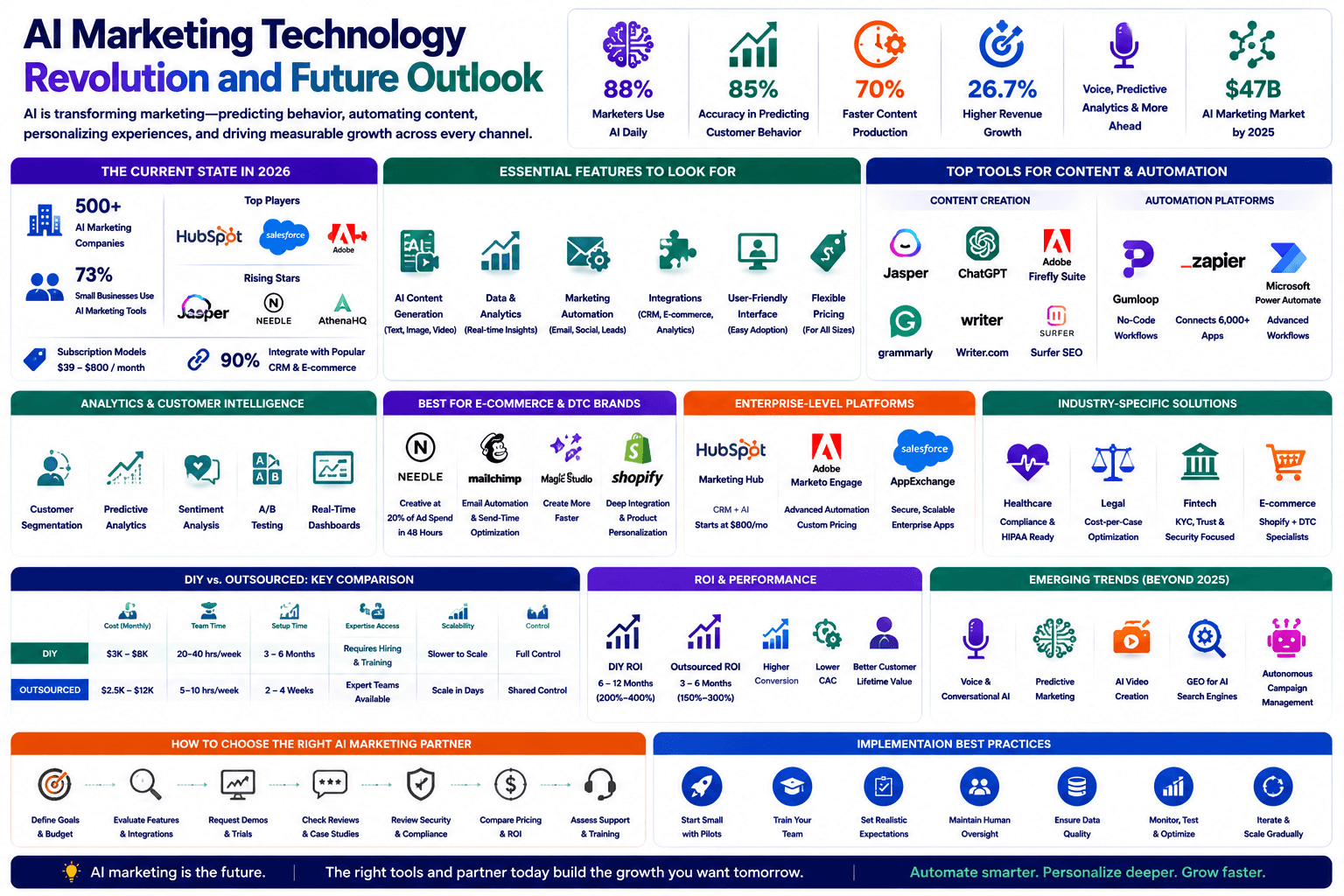
AI marketing companies have revolutionized how businesses engage with customers and manage campaigns. The shift from basic keyword strategies to AI-driven personalization has created a market projected to grow from $47.32 billion in 2026 to $107.5 billion by 2028. These platforms predict customer behavior, optimize campaigns in real-time, and generate content from various sources. Companies like AthenaHQ, Jasper.ai, and agentic AI systems are automating workflows, fundamentally altering marketing technology infrastructure.
The Surge of AI Marketing Tools
The AI marketing landscape saw rapid expansion in 2025, with a 27.8% increase in marketing tech tools from 2023 to 2024. New entrants focused on generative engine optimization, multimodal content creation, and agentic workflow management. This growth introduced both opportunities and challenges as marketers navigated a crowded market. The global agentic AI market alone reached $7.29 billion in 2025, with projections of $139.19 billion by 2034, intensifying competition among AI marketing firms. For more insights on the latest tools, visit our AI Marketing Tools page.
Categories of AI Marketing Companies
AI marketing companies are categorized by their focus areas. Content generation platforms like Jasper.ai produce vast amounts of content, while GEO specialists such as AthenaHQ oversee brand perception in AI-generated content. Analytics-driven companies offer predictive insights, and automation platforms streamline workflows. Multimodal specialists create text, video, and audio content. Each category addresses specific marketing challenges, from real-time personalization to cross-platform optimization, offering a diverse range of specialized solutions.
Disruption of Traditional Marketing Technology Stacks
Traditional marketing systems are being disrupted by AI marketing companies. Marketing budgets have decreased from 11% to 7.7% of revenue, necessitating consolidation. Legacy systems struggle with fragmented data and manual tasks. AI platforms now integrate multiple functions into a single solution, reducing the need for numerous tools. Companies save costs by replacing several standalone tools with AI platforms that manage content creation, analytics, and automation collectively. Learn more about marketing budget strategies to adapt to these changes.
The Rise of Agentic AI Systems
Agentic AI represents a significant shift from reactive tools to those that autonomously manage marketing tasks. In 2025, the global agentic AI market was valued at $7.29 billion, with expectations to reach $139.19 billion by 2034. These systems go beyond responding to prompts; they understand objectives, analyze data, and create custom content independently. By 2028, 60% of brands will use agentic AI for personalized customer interactions, signaling a departure from traditional marketing methods. For a deeper dive into agentic AI, check our Agentic AI Overview.
Generative Engine Optimization: Beyond SEO
SEO is becoming less effective as AI tools like ChatGPT transform search behaviors. Generative Engine Optimization (GEO) enhances content compatibility with AI, ensuring it meets user needs and achieves favorable brand mentions in AI responses. Companies must optimize for both search engines and AI, as visitors from AI convert 4.4 times more than traditional visitors. Explore our SEO Strategies for adapting to these changes.
Platform Consolidation vs. Specialized AI Tools
Companies often manage over 130 applications but utilize only 33% of them. With marketing budgets shrinking from 11% to 7.7% of revenue, there's a push towards comprehensive AI marketing platforms over numerous specialized tools. Budget constraints and the need for agility favor integrated solutions offering content creation, analytics, and automation. However, some businesses still find specialized AI tools valuable for tasks like brand monitoring or technical SEO optimization. For more on this topic, visit our Platform Consolidation Guide.
Multimodal Marketing Capabilities
In 2024, the multimodal AI market surpassed $1.6 billion, with video content comprising 53.7% of internet traffic. Modern AI marketing companies integrate text, images, video, and audio into cohesive content strategies. Successful brands develop concepts that work across all formats from the outset. AI platforms like Jasper.ai and multimodal systems enable marketers to craft unified campaigns across social media, email, video, and interactive experiences, enhancing engagement across diverse audience preferences. Check out our Multimodal Marketing Strategies for more insights.
Real-Time Personalization and Predictive Analytics
AI marketing companies now offer real-time personalization by adjusting interactions based on live data. These platforms analyze customer behavior instantly, predicting next actions and personalizing content. AI-driven personalization boosts engagement and conversion rates, with some companies experiencing 4.4 times higher conversions from AI-optimized visitors. However, many marketers underutilize predictive analytics. Modern platforms leverage machine learning with behavioral data to create personalized experiences, transforming generic campaigns into targeted, relevant communications. Learn more about Predictive Analytics in our dedicated section.
Human-AI Collaboration in Marketing Teams
Teams that integrate AI with human expertise outperform those relying on one alone. AI provides rapid data processing and content creation, while humans contribute strategic thinking and creativity. Currently, 65% of marketing teams incorporate AI roles, though many require additional training. Successful teams establish clear workflows, with AI handling tasks and humans focusing on strategy, brand voice, and relationship building for optimal results. For tips on building effective teams, visit our Human-AI Collaboration page.
Evaluating AI Marketing Companies
When selecting AI marketing companies, prioritize real-time brand perception monitoring. Look for tools that identify content gaps and support cross-platform optimization across various AI engines. Seek actionable recommendations over generic reports. Competitive intelligence features are crucial for analyzing competitor positioning in AI-generated content. Ensure platforms cover everything from strategy to execution. Companies like AthenaHQ, Jasper.ai, and SurferSEO offer distinct strengths for specific marketing needs.
Cost Considerations and ROI Metrics
AI marketing should account for at least 5% of your total marketing budget to achieve a positive return on investment (ROI). The AI marketing market is projected to grow from $47.32 billion in 2026 to $107.5 billion by 2028. Despite a 91% adoption rate, the percentage of marketers seeing ROI has declined from 49% to 41%. Focus on financial outcomes, efficiency, and quality improvements rather than vanity metrics. Consolidating platforms can significantly reduce costs compared to managing over 130 separate applications, which often have only a 33% usage rate. For more on budgeting, check our Cost Management Strategies.
Strategies for Adopting AI Marketing Technologies
Start by using AI tools to assess your current brand presence. Evaluate how AI platforms mention your company and identify gaps where AI systems lack details about your brand or industry. Organize content with clear headings and comprehensive coverage to enhance AI readability. Prioritize entity authority over traditional keyword optimization. Train your team on AI tools progressively and assign specific AI roles within marketing. Continuously monitor performance and adjust strategies based on real-time data from AI platforms. For a step-by-step guide, visit our AI Adoption Strategies page.
Future Predictions for AI Marketing
By 2027, AI systems will autonomously handle 60% of marketing tasks. The AI marketing sector will surpass $150 billion, driven by its ability to utilize diverse media and personalize in real-time. Traditional SEO will diminish as AI-driven search prevails. The market will see fewer but stronger platforms due to consolidation. Human-AI teams will become standard, with marketers focusing on strategy while AI manages execution and optimization across all channels.
Choosing AI Marketing Partners
To select the right AI marketing company, evaluate their technical expertise, integration ease, and proven ROI. Look for platforms that generate diverse content, offer real-time analytics, and integrate seamlessly with your CRM. Choose vendors with robust customer support, transparent pricing, and industry expertise. Consider scalability, data security, and adaptability to new AI technologies. The best partners combine advanced automation with human oversight, keeping your marketing strategy flexible and competitive in the rapidly evolving AI landscape. For more tips, check our Choosing AI Partners Guide.
Discover leading AI marketing companies revolutionizing digital campaigns. From content generation to predictive analytics - find the right platform.
AI Marketing Companies Transforming Technology Infrastructure
AI marketing companies have revolutionized how businesses engage with customers and manage campaigns. The shift from basic keyword strategies to AI-driven personalization has created a market projected to grow from $47.32 billion in 2026 to $107.5 billion by 2028. These platforms predict customer behavior, optimize campaigns in real-time, and generate content from various sources. Companies like AthenaHQ, Jasper.ai, and agentic AI systems are automating workflows, fundamentally altering marketing technology infrastructure.
The Surge of AI Marketing Tools
The AI marketing landscape saw rapid expansion in 2025, with a 27.8% increase in marketing tech tools from 2023 to 2024. New entrants focused on generative engine optimization, multimodal content creation, and agentic workflow management. This growth introduced both opportunities and challenges as marketers navigated a crowded market. The global agentic AI market alone reached $7.29 billion in 2025, with projections of $139.19 billion by 2034, intensifying competition among AI marketing firms. For more insights on the latest tools, visit our AI Marketing Tools page.
Categories of AI Marketing Companies
AI marketing companies are categorized by their focus areas. Content generation platforms like Jasper.ai produce vast amounts of content, while GEO specialists such as AthenaHQ oversee brand perception in AI-generated content. Analytics-driven companies offer predictive insights, and automation platforms streamline workflows. Multimodal specialists create text, video, and audio content. Each category addresses specific marketing challenges, from real-time personalization to cross-platform optimization, offering a diverse range of specialized solutions.
Disruption of Traditional Marketing Technology Stacks
Traditional marketing systems are being disrupted by AI marketing companies. Marketing budgets have decreased from 11% to 7.7% of revenue, necessitating consolidation. Legacy systems struggle with fragmented data and manual tasks. AI platforms now integrate multiple functions into a single solution, reducing the need for numerous tools. Companies save costs by replacing several standalone tools with AI platforms that manage content creation, analytics, and automation collectively. Learn more about marketing budget strategies to adapt to these changes.
The Rise of Agentic AI Systems
Agentic AI represents a significant shift from reactive tools to those that autonomously manage marketing tasks. In 2025, the global agentic AI market was valued at $7.29 billion, with expectations to reach $139.19 billion by 2034. These systems go beyond responding to prompts; they understand objectives, analyze data, and create custom content independently. By 2028, 60% of brands will use agentic AI for personalized customer interactions, signaling a departure from traditional marketing methods. For a deeper dive into agentic AI, check our Agentic AI Overview.
Generative Engine Optimization: Beyond SEO
SEO is becoming less effective as AI tools like ChatGPT transform search behaviors. Generative Engine Optimization (GEO) enhances content compatibility with AI, ensuring it meets user needs and achieves favorable brand mentions in AI responses. Companies must optimize for both search engines and AI, as visitors from AI convert 4.4 times more than traditional visitors. Explore our SEO Strategies for adapting to these changes.
Platform Consolidation vs. Specialized AI Tools
Companies often manage over 130 applications but utilize only 33% of them. With marketing budgets shrinking from 11% to 7.7% of revenue, there's a push towards comprehensive AI marketing platforms over numerous specialized tools. Budget constraints and the need for agility favor integrated solutions offering content creation, analytics, and automation. However, some businesses still find specialized AI tools valuable for tasks like brand monitoring or technical SEO optimization. For more on this topic, visit our Platform Consolidation Guide.
Multimodal Marketing Capabilities
In 2024, the multimodal AI market surpassed $1.6 billion, with video content comprising 53.7% of internet traffic. Modern AI marketing companies integrate text, images, video, and audio into cohesive content strategies. Successful brands develop concepts that work across all formats from the outset. AI platforms like Jasper.ai and multimodal systems enable marketers to craft unified campaigns across social media, email, video, and interactive experiences, enhancing engagement across diverse audience preferences. Check out our Multimodal Marketing Strategies for more insights.
Real-Time Personalization and Predictive Analytics
AI marketing companies now offer real-time personalization by adjusting interactions based on live data. These platforms analyze customer behavior instantly, predicting next actions and personalizing content. AI-driven personalization boosts engagement and conversion rates, with some companies experiencing 4.4 times higher conversions from AI-optimized visitors. However, many marketers underutilize predictive analytics. Modern platforms leverage machine learning with behavioral data to create personalized experiences, transforming generic campaigns into targeted, relevant communications. Learn more about Predictive Analytics in our dedicated section.
Human-AI Collaboration in Marketing Teams
Teams that integrate AI with human expertise outperform those relying on one alone. AI provides rapid data processing and content creation, while humans contribute strategic thinking and creativity. Currently, 65% of marketing teams incorporate AI roles, though many require additional training. Successful teams establish clear workflows, with AI handling tasks and humans focusing on strategy, brand voice, and relationship building for optimal results. For tips on building effective teams, visit our Human-AI Collaboration page.
Evaluating AI Marketing Companies
When selecting AI marketing companies, prioritize real-time brand perception monitoring. Look for tools that identify content gaps and support cross-platform optimization across various AI engines. Seek actionable recommendations over generic reports. Competitive intelligence features are crucial for analyzing competitor positioning in AI-generated content. Ensure platforms cover everything from strategy to execution. Companies like AthenaHQ, Jasper.ai, and SurferSEO offer distinct strengths for specific marketing needs.
Cost Considerations and ROI Metrics
AI marketing should account for at least 5% of your total marketing budget to achieve a positive return on investment (ROI). The AI marketing market is projected to grow from $47.32 billion in 2026 to $107.5 billion by 2028. Despite a 91% adoption rate, the percentage of marketers seeing ROI has declined from 49% to 41%. Focus on financial outcomes, efficiency, and quality improvements rather than vanity metrics. Consolidating platforms can significantly reduce costs compared to managing over 130 separate applications, which often have only a 33% usage rate. For more on budgeting, check our Cost Management Strategies.
Strategies for Adopting AI Marketing Technologies
Start by using AI tools to assess your current brand presence. Evaluate how AI platforms mention your company and identify gaps where AI systems lack details about your brand or industry. Organize content with clear headings and comprehensive coverage to enhance AI readability. Prioritize entity authority over traditional keyword optimization. Train your team on AI tools progressively and assign specific AI roles within marketing. Continuously monitor performance and adjust strategies based on real-time data from AI platforms. For a step-by-step guide, visit our AI Adoption Strategies page.
Future Predictions for AI Marketing
By 2027, AI systems will autonomously handle 60% of marketing tasks. The AI marketing sector will surpass $150 billion, driven by its ability to utilize diverse media and personalize in real-time. Traditional SEO will diminish as AI-driven search prevails. The market will see fewer but stronger platforms due to consolidation. Human-AI teams will become standard, with marketers focusing on strategy while AI manages execution and optimization across all channels.
Choosing AI Marketing Partners
To select the right AI marketing company, evaluate their technical expertise, integration ease, and proven ROI. Look for platforms that generate diverse content, offer real-time analytics, and integrate seamlessly with your CRM. Choose vendors with robust customer support, transparent pricing, and industry expertise. Consider scalability, data security, and adaptability to new AI technologies. The best partners combine advanced automation with human oversight, keeping your marketing strategy flexible and competitive in the rapidly evolving AI landscape. For more tips, check our Choosing AI Partners Guide.
Other Blogs
Other Blogs
Check our other project Blogs with useful insight and information for your businesses
Other Blogs
Other Blogs
Check our other project Blogs with useful insight and information for your businesses