Our Three Step Process
February 27, 2026
AI Marketing Guide 2026: Complete Implementation Strategy & Best Practices
Our Three Step Process
February 27, 2026
AI Marketing Guide 2026: Complete Implementation Strategy & Best Practices
Master AI marketing in 2026 with LLMs, workflows & agents. Get implementation phases, ROI expectations & tool selection frameworks.
Understanding AI Marketing Components in 2026
In 2026, AI marketing consists of three integral components that work in harmony: Large Language Models (LLMs), AI workflows, and AI agents. Mastery of LLMs is the starting point for successful projects, followed by the integration of workflows and agents to create scalable and effective marketing systems.
Large Language Models: Your Content Creation Tool
LLMs are versatile tools for various marketing tasks, offering different costs and capabilities. Text-to-text models range from THB 30 to THB 40 per million tokens for ad copy and blogs. Text-to-image generation costs THB 3 to THB 4 per image for social media graphics, while video creation is approximately $0.10 per second for short promotional content. Audio generation costs THB 1 per 1,000 characters for voiceovers. Selecting the right model for each task can optimize costs while maintaining high-quality marketing campaigns. .
AI Workflows: Building Marketing Automation Systems
AI workflows automate marketing tasks by linking tools, eliminating the need for manual effort. Platforms like Zapier AI and Make.com enable marketers to sync leads from social media to CRM, initiate email sequences based on user actions, and instantly update customer segments. These workflows eliminate repetitive tasks and ensure a seamless data flow, allowing marketing teams to focus on strategy.
AI Agents: Autonomous Marketing Operations
AI agents autonomously manage complex marketing tasks, from analyzing campaign performance to adjusting ad spending and email timing based on user behavior. Unlike fixed-rule workflows, AI agents make real-time decisions using machine learning, continuously learning from outcomes to refine strategies. This autonomy allows marketing teams to concentrate on strategic planning while agents handle execution and optimization.
How AI Improves Marketing Performance
AI enhances marketing by tailoring content through customer data analysis, improving segmentation accuracy, and enabling precise targeting. Campaigns benefit from AI's ability to adjust budgets and creative elements based on performance. Predictive analytics forecast customer retention and churn, guiding retention efforts. AI-driven lead scoring improves conversion rates, helping sales teams focus on high-potential prospects for better ROI.
Cost Analysis and ROI Expectations for 2026
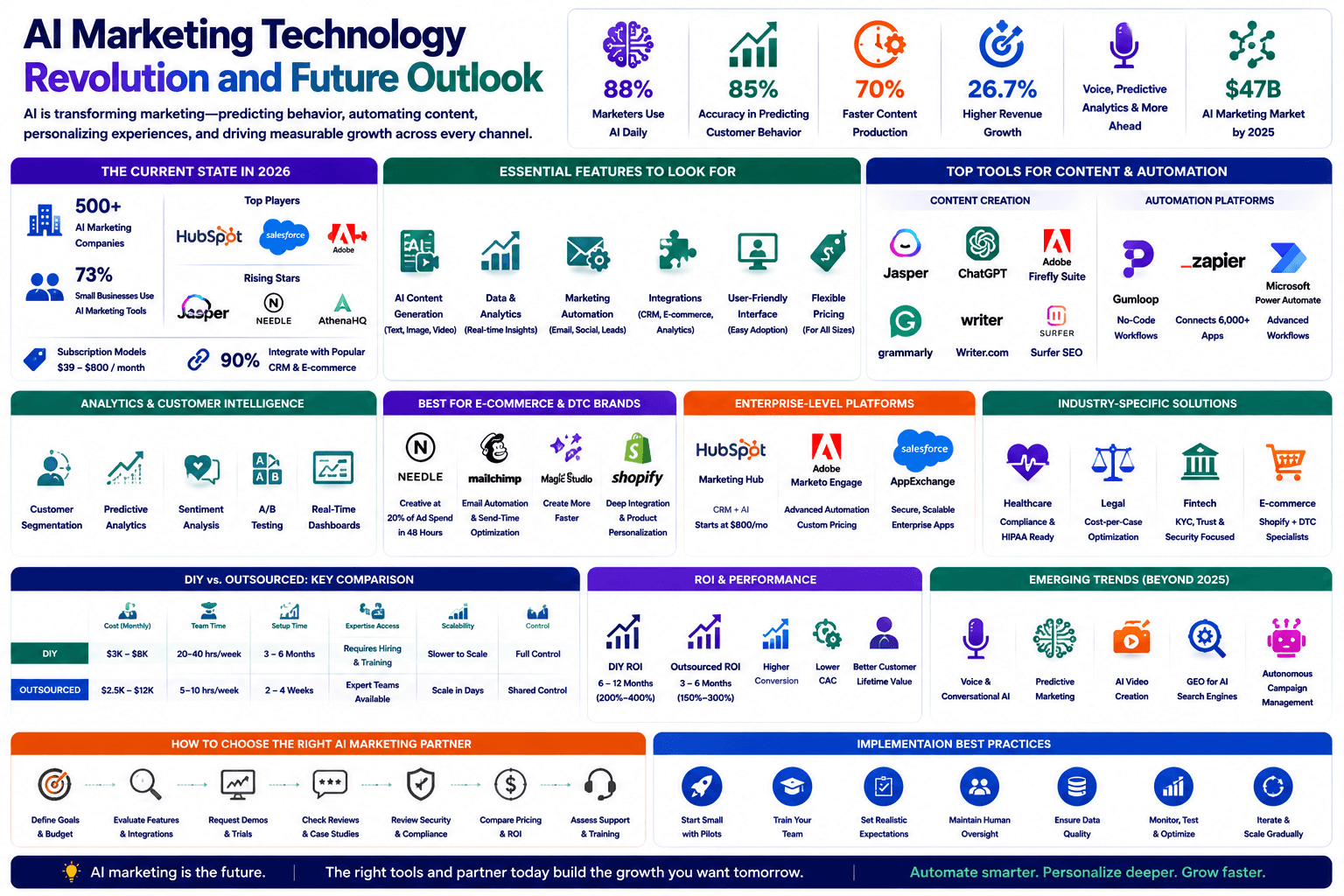
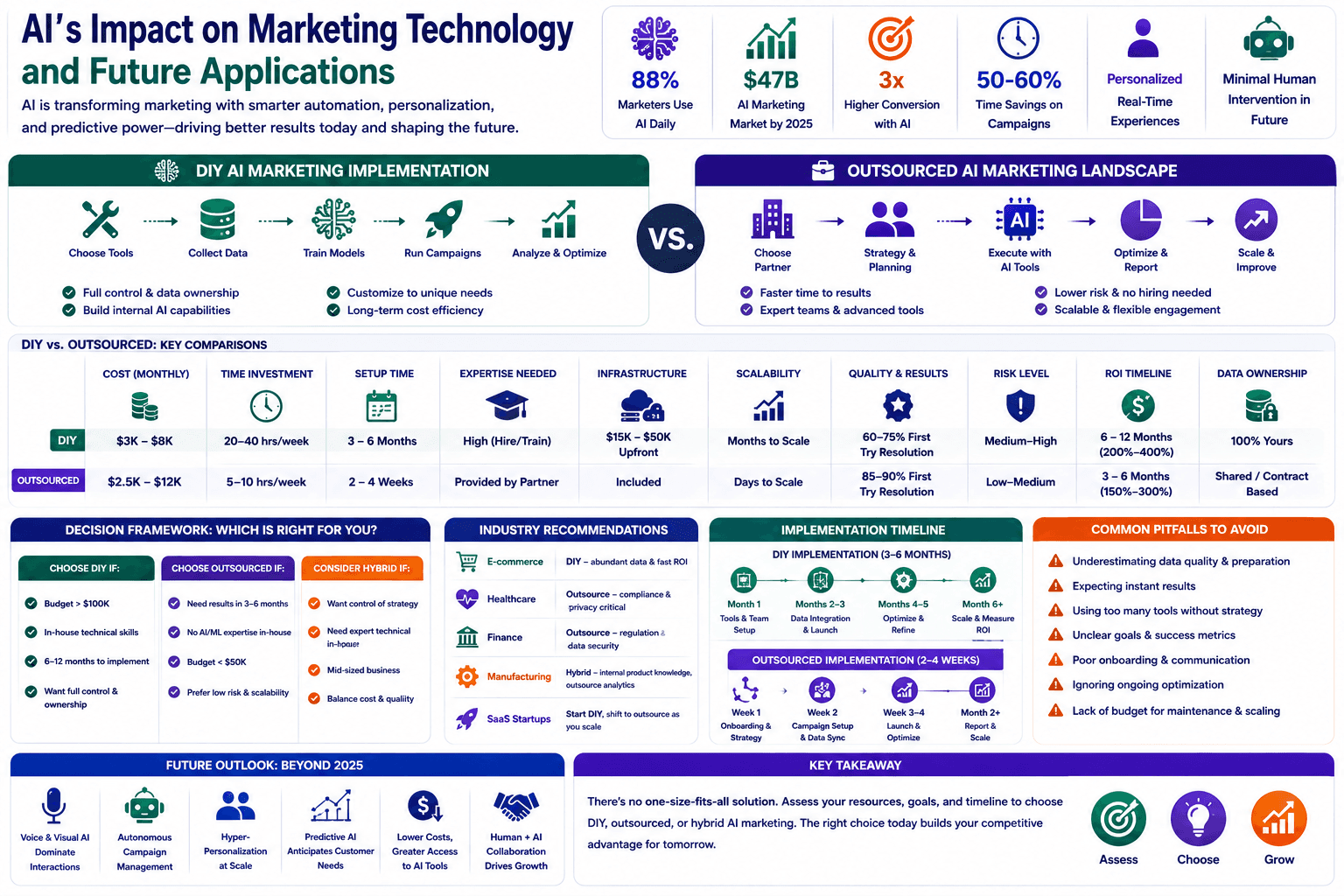
AI marketing tools cost between THB 23,000 and THB 77,000 per month, with initial setup costs ranging from THB 2,33,000 to THB 6,20,000. Most companies achieve ROI within 6 to 12 months due to time savings and improved campaign performance. Content creation costs can decrease by 60 to 70% while maintaining quality, and customer acquisition costs may drop by 25 to 40% with enhanced targeting. Email marketing automation can increase revenue by 15 to 20%. Plan to allocate 20 to 30% of your marketing budget for AI tools and training in 2026.
Phase 1: Foundation Building (Months 1-3)
Start by focusing on one AI tool, such as content creation or email automation. Identify three time-consuming routine tasks and train your team in prompt engineering and basic AI workflows. Document current processes before automating and set up systems to track performance improvements. Define clear success metrics and set timeline expectations, focusing on foundational learning rather than complex integrations.
Phase 2: Infrastructure Development (Months 3-12)
Develop robust data pipelines to connect CRM, email platforms, and analytics tools. Establish clear workflows for content approval and campaign management, and use AI for lead scoring and customer segmentation. Implement quality checks for AI-generated content and train your team on advanced AI features. Create automated dashboards to track AI performance metrics and develop backup plans for AI tool failures. Expand successful Phase 1 implementations across more channels and campaigns. For insights on data management, see our Data Management Best Practices.
Phase 3: Full AI Integration (Months 12+)
Deploy AI agents to manage entire campaigns autonomously. Utilize predictive analytics to understand customer value and prevent churn. Develop content systems that adapt messages based on live data. Establish AI governance with clear ethical guidelines and create workflows that integrate marketing, sales, and customer service through AI. Focus on strategic planning, allowing AI to handle routine tasks like optimization and reporting.
Tool Selection Framework for Different Marketing Functions
Select tools based on specific marketing needs rather than popularity. For content creation, use models with strong writing skills like GPT-4 or Claude. Email marketing benefits from platforms with AI personalization like Mailchimp or HubSpot. For social media management, use tools like Hootsuite AI or Buffer for automated scheduling and engagement. For analytics, opt for specialized platforms like Google Analytics Intelligence or Adobe Analytics AI. Test tools with small campaigns to ensure compatibility with existing systems.
Data Quality and Integration Requirements
Effective AI marketing in 2026 relies on clean, structured data. Verify data sources for accuracy, completeness, and consistency before using AI tools. Ensure CRM, email platforms, and analytics tools can easily share data through APIs or integration platforms like Zapier. Poor data quality leads to inaccurate AI recommendations and wasted resources. Implement data governance protocols, regular cleaning schedules, and standardized naming conventions across all marketing platforms for optimal AI performance.
Common Implementation Mistakes to Avoid
Avoid chasing every new AI tool; focus on mastering one platform before expanding. Begin automation with low-risk, repetitive tasks and ensure data quality to prevent poor AI outputs. Do not rely solely on AI for creative strategy decisions; human judgment remains essential. Set realistic expectations—AI enhances marketing but doesn't replace strategic thinking. Maintain human oversight and establish clear governance before full implementation.
Measuring Success: KPIs and Performance Metrics
Measure the time savings from AI automation by tracking hours reduced per campaign. Monitor content production speed and quality, lead generation, and conversion rate improvements. Calculate changes in cost per acquisition and track customer engagement with AI-generated content. Measure the speed of campaign optimization and frequency of A/B testing. Assess data processing accuracy and reporting efficiency. Establish baseline metrics before AI implementation to demonstrate clear ROI improvements through 2026.
Future-Proofing Your AI Marketing Strategy
Develop systems that can adapt to rapid AI advancements in 2026 and beyond. Utilize AI that integrates text, images, and video for comprehensive campaigns. Invest in tools that predict customer behavior changes and learn to integrate across platforms as AI tools converge. Train teams in emerging technologies like voice AI and augmented reality marketing. Establish guidelines for responsible AI use and stay informed about privacy laws affecting AI marketing. Collaborate with AI vendors for early access to new features.
FAQ
Q: What budget do I need to start AI marketing in 2026?
A: Small businesses can begin with THB 6,000 to THB 15,000 per month for basic AI tools like content creation and social media automation.
Q: How soon can I see returns from AI marketing?
A: Most companies see initial returns in 3-6 months, with full returns typically by 8-12 months.
Q: Which AI marketing tools should beginners use first?
A: Start with tools for content creation, email automation, and basic analytics before advancing to more complex systems.
Q: How can I ensure data privacy with AI marketing tools?
A: Choose vendors that comply with GDPR, establish data governance policies, and regularly review AI tool permissions and data usage.
Q: Will AI replace human marketers by 2026?
A: No, AI enhances creativity and efficiency but cannot replace strategic thinking, relationship building, and creative problem-solving.
Master AI marketing in 2026 with LLMs, workflows & agents. Get implementation phases, ROI expectations & tool selection frameworks.
Understanding AI Marketing Components in 2026
In 2026, AI marketing consists of three integral components that work in harmony: Large Language Models (LLMs), AI workflows, and AI agents. Mastery of LLMs is the starting point for successful projects, followed by the integration of workflows and agents to create scalable and effective marketing systems.
Large Language Models: Your Content Creation Tool
LLMs are versatile tools for various marketing tasks, offering different costs and capabilities. Text-to-text models range from THB 30 to THB 40 per million tokens for ad copy and blogs. Text-to-image generation costs THB 3 to THB 4 per image for social media graphics, while video creation is approximately $0.10 per second for short promotional content. Audio generation costs THB 1 per 1,000 characters for voiceovers. Selecting the right model for each task can optimize costs while maintaining high-quality marketing campaigns. .
AI Workflows: Building Marketing Automation Systems
AI workflows automate marketing tasks by linking tools, eliminating the need for manual effort. Platforms like Zapier AI and Make.com enable marketers to sync leads from social media to CRM, initiate email sequences based on user actions, and instantly update customer segments. These workflows eliminate repetitive tasks and ensure a seamless data flow, allowing marketing teams to focus on strategy.
AI Agents: Autonomous Marketing Operations
AI agents autonomously manage complex marketing tasks, from analyzing campaign performance to adjusting ad spending and email timing based on user behavior. Unlike fixed-rule workflows, AI agents make real-time decisions using machine learning, continuously learning from outcomes to refine strategies. This autonomy allows marketing teams to concentrate on strategic planning while agents handle execution and optimization.
How AI Improves Marketing Performance
AI enhances marketing by tailoring content through customer data analysis, improving segmentation accuracy, and enabling precise targeting. Campaigns benefit from AI's ability to adjust budgets and creative elements based on performance. Predictive analytics forecast customer retention and churn, guiding retention efforts. AI-driven lead scoring improves conversion rates, helping sales teams focus on high-potential prospects for better ROI.
Cost Analysis and ROI Expectations for 2026
AI marketing tools cost between THB 23,000 and THB 77,000 per month, with initial setup costs ranging from THB 2,33,000 to THB 6,20,000. Most companies achieve ROI within 6 to 12 months due to time savings and improved campaign performance. Content creation costs can decrease by 60 to 70% while maintaining quality, and customer acquisition costs may drop by 25 to 40% with enhanced targeting. Email marketing automation can increase revenue by 15 to 20%. Plan to allocate 20 to 30% of your marketing budget for AI tools and training in 2026.
Phase 1: Foundation Building (Months 1-3)
Start by focusing on one AI tool, such as content creation or email automation. Identify three time-consuming routine tasks and train your team in prompt engineering and basic AI workflows. Document current processes before automating and set up systems to track performance improvements. Define clear success metrics and set timeline expectations, focusing on foundational learning rather than complex integrations.
Phase 2: Infrastructure Development (Months 3-12)
Develop robust data pipelines to connect CRM, email platforms, and analytics tools. Establish clear workflows for content approval and campaign management, and use AI for lead scoring and customer segmentation. Implement quality checks for AI-generated content and train your team on advanced AI features. Create automated dashboards to track AI performance metrics and develop backup plans for AI tool failures. Expand successful Phase 1 implementations across more channels and campaigns. For insights on data management, see our Data Management Best Practices.
Phase 3: Full AI Integration (Months 12+)
Deploy AI agents to manage entire campaigns autonomously. Utilize predictive analytics to understand customer value and prevent churn. Develop content systems that adapt messages based on live data. Establish AI governance with clear ethical guidelines and create workflows that integrate marketing, sales, and customer service through AI. Focus on strategic planning, allowing AI to handle routine tasks like optimization and reporting.
Tool Selection Framework for Different Marketing Functions
Select tools based on specific marketing needs rather than popularity. For content creation, use models with strong writing skills like GPT-4 or Claude. Email marketing benefits from platforms with AI personalization like Mailchimp or HubSpot. For social media management, use tools like Hootsuite AI or Buffer for automated scheduling and engagement. For analytics, opt for specialized platforms like Google Analytics Intelligence or Adobe Analytics AI. Test tools with small campaigns to ensure compatibility with existing systems.
Data Quality and Integration Requirements
Effective AI marketing in 2026 relies on clean, structured data. Verify data sources for accuracy, completeness, and consistency before using AI tools. Ensure CRM, email platforms, and analytics tools can easily share data through APIs or integration platforms like Zapier. Poor data quality leads to inaccurate AI recommendations and wasted resources. Implement data governance protocols, regular cleaning schedules, and standardized naming conventions across all marketing platforms for optimal AI performance.
Common Implementation Mistakes to Avoid
Avoid chasing every new AI tool; focus on mastering one platform before expanding. Begin automation with low-risk, repetitive tasks and ensure data quality to prevent poor AI outputs. Do not rely solely on AI for creative strategy decisions; human judgment remains essential. Set realistic expectations—AI enhances marketing but doesn't replace strategic thinking. Maintain human oversight and establish clear governance before full implementation.
Measuring Success: KPIs and Performance Metrics
Measure the time savings from AI automation by tracking hours reduced per campaign. Monitor content production speed and quality, lead generation, and conversion rate improvements. Calculate changes in cost per acquisition and track customer engagement with AI-generated content. Measure the speed of campaign optimization and frequency of A/B testing. Assess data processing accuracy and reporting efficiency. Establish baseline metrics before AI implementation to demonstrate clear ROI improvements through 2026.
Future-Proofing Your AI Marketing Strategy
Develop systems that can adapt to rapid AI advancements in 2026 and beyond. Utilize AI that integrates text, images, and video for comprehensive campaigns. Invest in tools that predict customer behavior changes and learn to integrate across platforms as AI tools converge. Train teams in emerging technologies like voice AI and augmented reality marketing. Establish guidelines for responsible AI use and stay informed about privacy laws affecting AI marketing. Collaborate with AI vendors for early access to new features.
FAQ
Q: What budget do I need to start AI marketing in 2026?
A: Small businesses can begin with THB 6,000 to THB 15,000 per month for basic AI tools like content creation and social media automation.
Q: How soon can I see returns from AI marketing?
A: Most companies see initial returns in 3-6 months, with full returns typically by 8-12 months.
Q: Which AI marketing tools should beginners use first?
A: Start with tools for content creation, email automation, and basic analytics before advancing to more complex systems.
Q: How can I ensure data privacy with AI marketing tools?
A: Choose vendors that comply with GDPR, establish data governance policies, and regularly review AI tool permissions and data usage.
Q: Will AI replace human marketers by 2026?
A: No, AI enhances creativity and efficiency but cannot replace strategic thinking, relationship building, and creative problem-solving.
Other Blogs
Other Blogs
Check our other project Blogs with useful insight and information for your businesses
Other Blogs
Other Blogs
Check our other project Blogs with useful insight and information for your businesses