Our Three Step Process
May 21, 2026
Video Maker AI: Complete Guide to AI Video Creation in 2026
Our Three Step Process
May 21, 2026
Video Maker AI: Complete Guide to AI Video Creation in 2026
Learn how video maker AI tools cut production time by 70% and boost engagement. Complete guide to AI video creation workflows and tools.
Transforming Marketing Technology with AI Video Creation
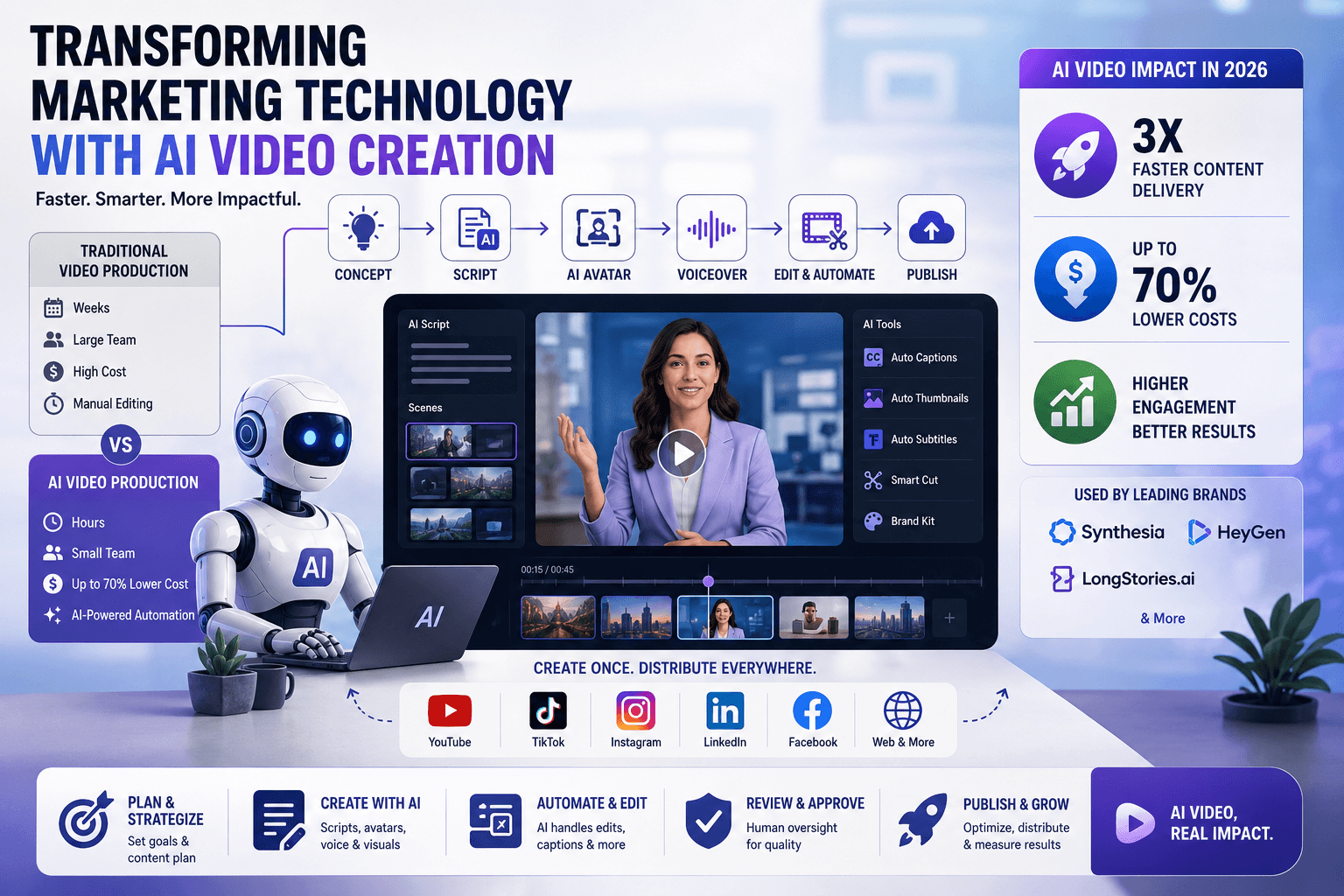
Artificial intelligence is revolutionizing how marketing teams produce video content, significantly reducing production time from weeks to mere hours and cutting costs by up to 70%. AI video platforms streamline tasks such as script writing and editing, enabling brands to create personalized content on a large scale. By 2026, companies leveraging AI video processes will deliver content three times faster and achieve better audience engagement compared to those relying on traditional methods. For more insights on AI's impact on marketing, check out our AI Marketing Trends.
The Role of AI Video in 2026
AI video platforms now oversee the entire production process, from concept to final product. Leading brands utilize tools like Synthesia, HeyGen, and LongStories.ai in their content operations. These platforms generate realistic avatars, automated voiceovers, and custom animations at scale. Companies experience a 60% increase in content delivery speed and a 40% reduction in costs compared to traditional video production. AI video creation has become a standard practice for social media, training materials, and marketing campaigns across various industries. Learn more about AI Tools for Content Creation.
Assessing Your Current Content Workflow
Evaluate your existing video production process to identify areas where AI tools can be beneficial. Document each step from concept to publication, including time spent on scripting, filming, editing, and distribution. Consider your team's skills, resources, and content requirements. Identify bottlenecks where AI video tools could alleviate manual work. Review your brand guidelines, quality standards, and approval processes to determine what requires human oversight and what can be automated. For a deeper dive into workflow optimization, visit our Content Workflow Best Practices.
Selecting the Right AI Video Tools
Choose AI video tools based on your specific needs and technical capabilities. Compare options like Synthesia for realistic avatars, LongStories.ai for animated content, and HeyGen for professional presentations. Assess features such as video length limits, custom character creation, voiceover quality, and pricing. Ensure they integrate well with your existing software, offer API access for automation, and support compatible file formats to seamlessly fit into your workflow. Explore our guide on Choosing the Right Marketing Tools for more information.
Phase 1: Planning and Strategy Integration
Begin by reviewing your content calendar to identify videos suitable for AI production. Set clear objectives for each video, whether educational, promotional, or entertaining. Establish measurable targets like engagement rates, completion rates, and conversion figures. Develop a content plan that combines AI-generated videos with traditional ones. Set timelines that incorporate AI processing and human review to maintain a consistent publishing schedule. For strategic planning tips, check out our Content Strategy Framework.
Phase 2: Content Development and Scripting
AI can assist in creating scripts by automating brainstorming and outline creation. Use AI video maker tools to generate various script versions and test different hooks to engage the audience. Develop structured templates with introduction, main content, and call-to-action sections. Utilize AI writing assistants to refine tone and messaging while maintaining brand voice consistency. Build script libraries with effective formats that can be easily adapted for different topics and platforms. For more on content development, see our Content Creation Techniques.
Phase 3: AI Video Production Setup
Establish your AI video production by selecting video maker AI platforms compatible with your current tools. Set up automated rendering pipelines and create clear file naming conventions for organized asset management. Develop standard project templates with brand colors, fonts, and logos pre-included. Establish API connections between AI tools and your content management system. Test processing capabilities and set up backup workflows to ensure steady production quality and minimize downtime during peak periods. Learn about Video Production Best Practices for additional insights.
Phase 4: Post-Production and Quality Control
Implement quality checkpoints for AI-generated content before final approval. Create standard review processes covering color correction, audio sync, and brand checks. Set up automated workflows to optimize videos for different platforms while maintaining consistent quality. Establish feedback loops within the team and document common issues with solutions. Use analytics tools to monitor output quality and set clear approval criteria for all video content before publication. For quality assurance strategies, refer to our Quality Control Guidelines.
Building Automated Workflow Templates
Develop templates for various video types such as product demos, social media posts, and educational content. Set up automated steps for script writing, voice creation, and visuals with minimal manual effort. Build libraries with consistent branding, colors, and messaging. Establish automated publishing times and rules for each platform. Document template variations for different campaigns and use version control to track performance and updates. For more on automation, check our Automation in Marketing.
Team Training and Role Adaptation
Train your team on AI video tools and new workflow processes. Assign clear roles for AI content creation, quality control, and traditional editing tasks. Conduct hands-on training with platforms like Synthesia and LongStories.ai. Update job descriptions to include AI tool proficiency. Create internal guides for best practices and troubleshooting. Establish clear communication channels between AI operators and creative directors to maintain quality standards. Explore our Team Training Resources for further assistance.
Ensuring Quality Standards and Brand Consistency
Set clear quality standards for AI-generated videos that align with your brand guidelines. Document visual standards like color schemes, fonts, and animation styles. Create approval processes with multiple review stages before publishing. Use AI video tools that support custom brand templates and character consistency. Maintain style guides for tone, pacing, and storytelling. Implement quality control checklists to cover technical details, brand alignment, and audience suitability to ensure consistent results in all AI-generated content. For brand consistency tips, visit our Branding Guidelines.
Performance Tracking and Optimization
Monitor key metrics such as engagement rates, completion rates, and conversion data for AI-generated videos. Use analytics tools to compare the performance of AI and traditional content. Track production time savings and cost reductions. Conduct A/B testing on different AI video styles, lengths, and formats. Analyze audience feedback to refine your AI video strategy. Set up automated dashboards to measure ROI and identify top-performing content patterns for future improvement. For performance tracking tools, see our Analytics and Reporting.
Cost Analysis and ROI Measurement
Compare the costs of traditional video production with AI video maker tools to identify savings. Track production speed improvements, typically 60-80% faster. Measure subscription costs against savings on studio rentals, equipment, and talent fees. Evaluate conversion rates and engagement to assess content effectiveness. Note changes in resource utilization and team productivity. Establish baseline metrics before implementing AI to measure financial impact and support ongoing investment in AI video technology. For ROI measurement techniques, refer to our ROI Analysis Guide.
Scaling Your AI Video Operations
Start with small pilot projects to test workflows before scaling production. Develop templates and processes that teams can consistently replicate. Use automation in your AI video platform to manage bulk content creation. Set quality checkpoints to maintain standards as you scale. Train more team members on AI tools and workflows. Monitor system performance and upgrade infrastructure when necessary. Document successful processes for future use and team training. For scaling strategies, check our Scaling Marketing Operations.
Overcoming Integration Challenges
Teams may face challenges with inconsistent video quality when combining AI-generated content with traditional footage. Address this by setting clear quality standards and using color grading tools to ensure consistency. Workflow disruptions during initial implementation can be mitigated by starting with non-critical projects. Technical issues like format compatibility can delay production; choose AI platforms that support standard formats. Budget concerns arise from tool subscriptions; calculate ROI by comparing time savings against costs. For integration tips, see our Integration Strategies.
Future-Proofing Your Video Workflow
By 2027, AI technology for video creation will support real-time generation and realistic avatars. To prepare, select platforms with API access and regular updates. Develop workflows that can adapt to new features without requiring a complete overhaul. Train your team on new technologies and keep your hardware up to date. Document successful processes for easy adaptation. Stay engaged with AI development communities and participate in beta testing programs to access new tools early. For future trends, explore our Future of Marketing Technology.
Learn how video maker AI tools cut production time by 70% and boost engagement. Complete guide to AI video creation workflows and tools.
Transforming Marketing Technology with AI Video Creation
Artificial intelligence is revolutionizing how marketing teams produce video content, significantly reducing production time from weeks to mere hours and cutting costs by up to 70%. AI video platforms streamline tasks such as script writing and editing, enabling brands to create personalized content on a large scale. By 2026, companies leveraging AI video processes will deliver content three times faster and achieve better audience engagement compared to those relying on traditional methods. For more insights on AI's impact on marketing, check out our AI Marketing Trends.
The Role of AI Video in 2026
AI video platforms now oversee the entire production process, from concept to final product. Leading brands utilize tools like Synthesia, HeyGen, and LongStories.ai in their content operations. These platforms generate realistic avatars, automated voiceovers, and custom animations at scale. Companies experience a 60% increase in content delivery speed and a 40% reduction in costs compared to traditional video production. AI video creation has become a standard practice for social media, training materials, and marketing campaigns across various industries. Learn more about AI Tools for Content Creation.
Assessing Your Current Content Workflow
Evaluate your existing video production process to identify areas where AI tools can be beneficial. Document each step from concept to publication, including time spent on scripting, filming, editing, and distribution. Consider your team's skills, resources, and content requirements. Identify bottlenecks where AI video tools could alleviate manual work. Review your brand guidelines, quality standards, and approval processes to determine what requires human oversight and what can be automated. For a deeper dive into workflow optimization, visit our Content Workflow Best Practices.
Selecting the Right AI Video Tools
Choose AI video tools based on your specific needs and technical capabilities. Compare options like Synthesia for realistic avatars, LongStories.ai for animated content, and HeyGen for professional presentations. Assess features such as video length limits, custom character creation, voiceover quality, and pricing. Ensure they integrate well with your existing software, offer API access for automation, and support compatible file formats to seamlessly fit into your workflow. Explore our guide on Choosing the Right Marketing Tools for more information.
Phase 1: Planning and Strategy Integration
Begin by reviewing your content calendar to identify videos suitable for AI production. Set clear objectives for each video, whether educational, promotional, or entertaining. Establish measurable targets like engagement rates, completion rates, and conversion figures. Develop a content plan that combines AI-generated videos with traditional ones. Set timelines that incorporate AI processing and human review to maintain a consistent publishing schedule. For strategic planning tips, check out our Content Strategy Framework.
Phase 2: Content Development and Scripting
AI can assist in creating scripts by automating brainstorming and outline creation. Use AI video maker tools to generate various script versions and test different hooks to engage the audience. Develop structured templates with introduction, main content, and call-to-action sections. Utilize AI writing assistants to refine tone and messaging while maintaining brand voice consistency. Build script libraries with effective formats that can be easily adapted for different topics and platforms. For more on content development, see our Content Creation Techniques.
Phase 3: AI Video Production Setup
Establish your AI video production by selecting video maker AI platforms compatible with your current tools. Set up automated rendering pipelines and create clear file naming conventions for organized asset management. Develop standard project templates with brand colors, fonts, and logos pre-included. Establish API connections between AI tools and your content management system. Test processing capabilities and set up backup workflows to ensure steady production quality and minimize downtime during peak periods. Learn about Video Production Best Practices for additional insights.
Phase 4: Post-Production and Quality Control
Implement quality checkpoints for AI-generated content before final approval. Create standard review processes covering color correction, audio sync, and brand checks. Set up automated workflows to optimize videos for different platforms while maintaining consistent quality. Establish feedback loops within the team and document common issues with solutions. Use analytics tools to monitor output quality and set clear approval criteria for all video content before publication. For quality assurance strategies, refer to our Quality Control Guidelines.
Building Automated Workflow Templates
Develop templates for various video types such as product demos, social media posts, and educational content. Set up automated steps for script writing, voice creation, and visuals with minimal manual effort. Build libraries with consistent branding, colors, and messaging. Establish automated publishing times and rules for each platform. Document template variations for different campaigns and use version control to track performance and updates. For more on automation, check our Automation in Marketing.
Team Training and Role Adaptation
Train your team on AI video tools and new workflow processes. Assign clear roles for AI content creation, quality control, and traditional editing tasks. Conduct hands-on training with platforms like Synthesia and LongStories.ai. Update job descriptions to include AI tool proficiency. Create internal guides for best practices and troubleshooting. Establish clear communication channels between AI operators and creative directors to maintain quality standards. Explore our Team Training Resources for further assistance.
Ensuring Quality Standards and Brand Consistency
Set clear quality standards for AI-generated videos that align with your brand guidelines. Document visual standards like color schemes, fonts, and animation styles. Create approval processes with multiple review stages before publishing. Use AI video tools that support custom brand templates and character consistency. Maintain style guides for tone, pacing, and storytelling. Implement quality control checklists to cover technical details, brand alignment, and audience suitability to ensure consistent results in all AI-generated content. For brand consistency tips, visit our Branding Guidelines.
Performance Tracking and Optimization
Monitor key metrics such as engagement rates, completion rates, and conversion data for AI-generated videos. Use analytics tools to compare the performance of AI and traditional content. Track production time savings and cost reductions. Conduct A/B testing on different AI video styles, lengths, and formats. Analyze audience feedback to refine your AI video strategy. Set up automated dashboards to measure ROI and identify top-performing content patterns for future improvement. For performance tracking tools, see our Analytics and Reporting.
Cost Analysis and ROI Measurement
Compare the costs of traditional video production with AI video maker tools to identify savings. Track production speed improvements, typically 60-80% faster. Measure subscription costs against savings on studio rentals, equipment, and talent fees. Evaluate conversion rates and engagement to assess content effectiveness. Note changes in resource utilization and team productivity. Establish baseline metrics before implementing AI to measure financial impact and support ongoing investment in AI video technology. For ROI measurement techniques, refer to our ROI Analysis Guide.
Scaling Your AI Video Operations
Start with small pilot projects to test workflows before scaling production. Develop templates and processes that teams can consistently replicate. Use automation in your AI video platform to manage bulk content creation. Set quality checkpoints to maintain standards as you scale. Train more team members on AI tools and workflows. Monitor system performance and upgrade infrastructure when necessary. Document successful processes for future use and team training. For scaling strategies, check our Scaling Marketing Operations.
Overcoming Integration Challenges
Teams may face challenges with inconsistent video quality when combining AI-generated content with traditional footage. Address this by setting clear quality standards and using color grading tools to ensure consistency. Workflow disruptions during initial implementation can be mitigated by starting with non-critical projects. Technical issues like format compatibility can delay production; choose AI platforms that support standard formats. Budget concerns arise from tool subscriptions; calculate ROI by comparing time savings against costs. For integration tips, see our Integration Strategies.
Future-Proofing Your Video Workflow
By 2027, AI technology for video creation will support real-time generation and realistic avatars. To prepare, select platforms with API access and regular updates. Develop workflows that can adapt to new features without requiring a complete overhaul. Train your team on new technologies and keep your hardware up to date. Document successful processes for easy adaptation. Stay engaged with AI development communities and participate in beta testing programs to access new tools early. For future trends, explore our Future of Marketing Technology.
Other Blogs
Other Blogs
Check our other project Blogs with useful insight and information for your businesses
Other Blogs
Other Blogs
Check our other project Blogs with useful insight and information for your businesses