Our Three Step Process
November 28, 2025
Marketing Attribution with MarTech: A Beginner’s Guide
Our Three Step Process
November 28, 2025
Marketing Attribution with MarTech: A Beginner’s Guide
Learn the basics of marketing attribution and how MarTech tools can help you track, analyze, and optimize campaigns across the customer journey in 2025.
Attribution is the missing link between marketing effort and business results. In 2025, as customer journeys stretch across more channels and devices, getting attribution right is essential — and MarTech is what makes it possible.
This beginner-friendly guide breaks down what marketing attribution is, why it matters, and how to use MarTech to track and optimize every step of the funnel.
What is Marketing Attribution?
Marketing attribution is the process of identifying which touchpoints in the customer journey contributed to a conversion — and how much credit each one deserves.
In other words: Which parts of your marketing are actually working?
Why Attribution Matters
Optimize budgets: See which channels drive ROI
Refine messaging: Understand which campaigns resonate
Improve targeting: Focus on the highest-performing segments
Prove value: Show leadership how marketing contributes to revenue
Common Attribution Models
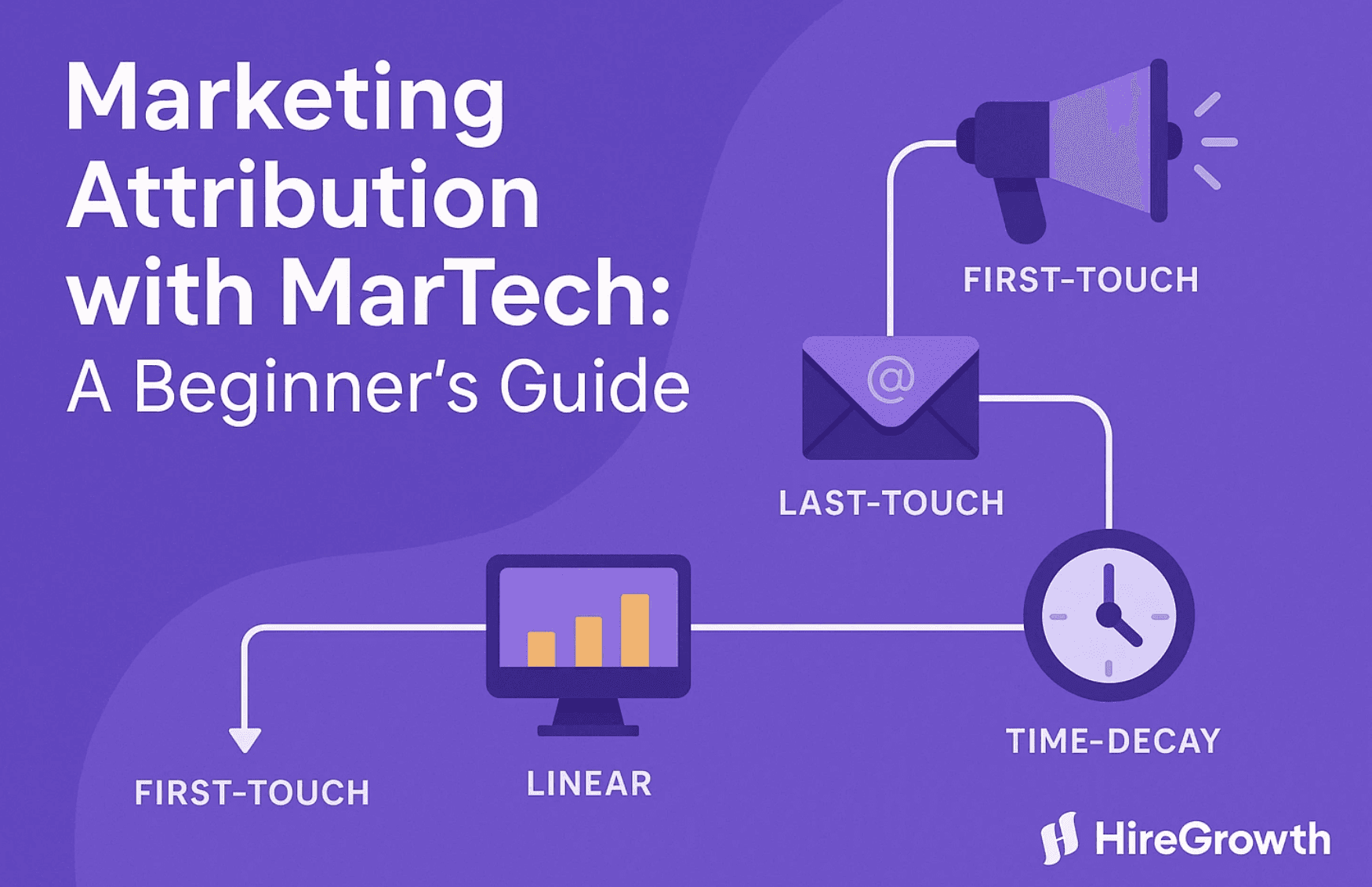
1. First-Touch Attribution
Gives 100% credit to the first interaction (e.g., an ad click or blog visit)
Best for: Identifying top-of-funnel drivers
2. Last-Touch Attribution
Gives full credit to the final action before conversion (e.g., email click)
Best for: Understanding closing activities
3. Linear Attribution
Spreads credit evenly across all touchpoints
Best for: Balanced journey tracking
4. Time-Decay Attribution
Gives more credit to recent touchpoints
Best for: Long, complex funnels
5. Data-Driven Attribution
Uses machine learning to assign credit based on real impact
Best for: Advanced teams with integrated MarTech
How MarTech Enables Better Attribution
Multi-Channel Tracking
Track interactions across paid ads, email, social, SEO, direct traffic, and more.
Cross-Device Journeys
Connect web, mobile, app, and offline touchpoints into a single user view.
Conversion Path Visualization
Visual tools show how users moved through the funnel — and where they dropped off.
Real-Time Dashboards
Dynamic reports help teams make faster decisions and iterate on performance.
Top Tools for Attribution in 2025
Google Analytics 4
free, solid for small teams
Northbeam
great for post-iOS14 paid media tracking
Triple Whale
DTC-focused attribution for eComm
Wicked Reports
built for multi-channel B2C
Dreamdata
B2B pipeline attribution
Key Metrics to Watch
CAC (Customer Acquisition Cost)
ROAS (Return on Ad Spend)
LTV (Customer Lifetime Value)
Time to Conversion
Assisted Conversions
Common Mistakes to Avoid
Relying on last-click only
Tracking only vanity metrics (like impressions or clicks)
Not connecting offline or call center data
Skipping proper UTM tagging on campaigns
Tip: Attribution improves with clean data. Ensure consistent tracking setup across all platforms.
Final Thoughts
Attribution isn’t just a report — it’s a roadmap to better marketing. With the right MarTech tools and mindset, even small teams can gain deep insights into what’s working and double down on impact.
HireGrowth helps brands implement attribution frameworks and tools that connect the dots between marketing and revenue — clearly, confidently, and at scale.
Learn the basics of marketing attribution and how MarTech tools can help you track, analyze, and optimize campaigns across the customer journey in 2025.
Attribution is the missing link between marketing effort and business results. In 2025, as customer journeys stretch across more channels and devices, getting attribution right is essential — and MarTech is what makes it possible.
This beginner-friendly guide breaks down what marketing attribution is, why it matters, and how to use MarTech to track and optimize every step of the funnel.
What is Marketing Attribution?
Marketing attribution is the process of identifying which touchpoints in the customer journey contributed to a conversion — and how much credit each one deserves.
In other words: Which parts of your marketing are actually working?
Why Attribution Matters
Optimize budgets: See which channels drive ROI
Refine messaging: Understand which campaigns resonate
Improve targeting: Focus on the highest-performing segments
Prove value: Show leadership how marketing contributes to revenue
Common Attribution Models
1. First-Touch Attribution
Gives 100% credit to the first interaction (e.g., an ad click or blog visit)
Best for: Identifying top-of-funnel drivers
2. Last-Touch Attribution
Gives full credit to the final action before conversion (e.g., email click)
Best for: Understanding closing activities
3. Linear Attribution
Spreads credit evenly across all touchpoints
Best for: Balanced journey tracking
4. Time-Decay Attribution
Gives more credit to recent touchpoints
Best for: Long, complex funnels
5. Data-Driven Attribution
Uses machine learning to assign credit based on real impact
Best for: Advanced teams with integrated MarTech
How MarTech Enables Better Attribution
Multi-Channel Tracking
Track interactions across paid ads, email, social, SEO, direct traffic, and more.
Cross-Device Journeys
Connect web, mobile, app, and offline touchpoints into a single user view.
Conversion Path Visualization
Visual tools show how users moved through the funnel — and where they dropped off.
Real-Time Dashboards
Dynamic reports help teams make faster decisions and iterate on performance.
Top Tools for Attribution in 2025
Google Analytics 4
free, solid for small teams
Northbeam
great for post-iOS14 paid media tracking
Triple Whale
DTC-focused attribution for eComm
Wicked Reports
built for multi-channel B2C
Dreamdata
B2B pipeline attribution
Key Metrics to Watch
CAC (Customer Acquisition Cost)
ROAS (Return on Ad Spend)
LTV (Customer Lifetime Value)
Time to Conversion
Assisted Conversions
Common Mistakes to Avoid
Relying on last-click only
Tracking only vanity metrics (like impressions or clicks)
Not connecting offline or call center data
Skipping proper UTM tagging on campaigns
Tip: Attribution improves with clean data. Ensure consistent tracking setup across all platforms.
Final Thoughts
Attribution isn’t just a report — it’s a roadmap to better marketing. With the right MarTech tools and mindset, even small teams can gain deep insights into what’s working and double down on impact.
HireGrowth helps brands implement attribution frameworks and tools that connect the dots between marketing and revenue — clearly, confidently, and at scale.
Other Blogs
Other Blogs
Check our other project Blogs with useful insight and information for your businesses
Other Blogs
Other Blogs
Check our other project Blogs with useful insight and information for your businesses