Our Three Step Process
26 พฤษภาคม 2568
AI Dynamic Pricing Strategy 2025: Complete Implementation Cost Guide
Our Three Step Process
26 พฤษภาคม 2568
AI Dynamic Pricing Strategy 2025: Complete Implementation Cost Guide
Comprehensive guide to AI dynamic pricing costs in 2025. From $250K-$2.5M implementation to ROI analysis and hidden expenses.
AI Dynamic Pricing Implementation Costs
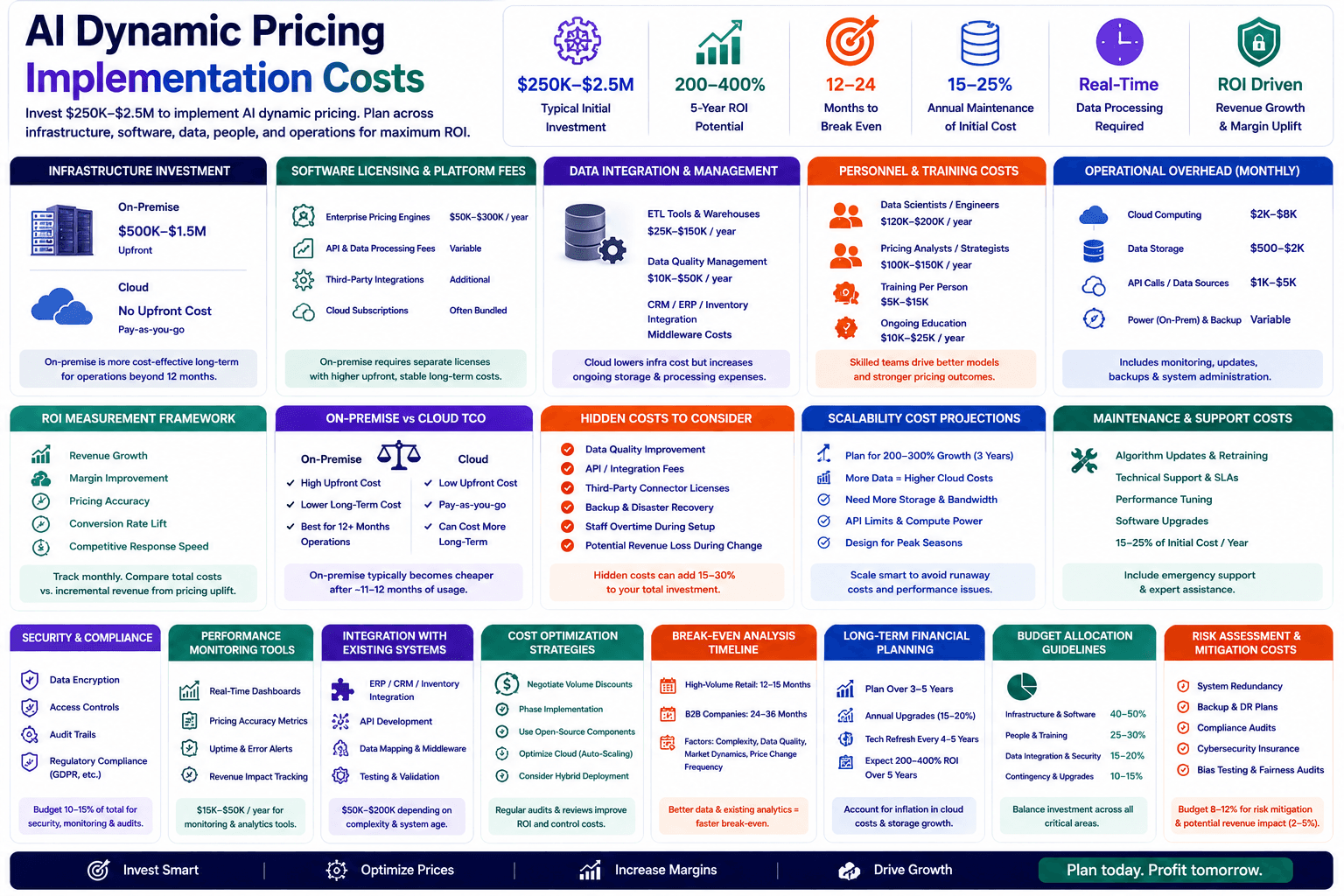
Implementing AI dynamic pricing solutions requires meticulous cost planning across various areas. Key expenses include machine learning infrastructure, real-time data processing, and algorithm development. Companies typically invest between $250,000 and $2.5 million for initial setup, depending on the size and specific needs of the business. Understanding these foundational costs is crucial for calculating the total cost of ownership and making informed decisions. For a deeper dive into the financial implications, check out our ROI Measurement Framework.
Infrastructure Investment Analysis
Infrastructure costs vary significantly between on-premise and cloud setups. On-premise solutions demand an upfront investment of $500,000 to $1.5 million for GPU clusters and servers. In contrast, cloud options start with no initial cost but incur ongoing expenses. For AI dynamic pricing operations extending beyond 12 months, on-premise infrastructure often offers better long-term cost efficiency. Explore more about On-Premise vs Cloud Deployment TCO to understand the trade-offs.
Software Licensing and Platform Fees
Software licensing is a significant component of the total cost for AI pricing solutions. Enterprise platforms charge between $50,000 and $300,000 annually for core pricing engines. Additional costs may include API fees, data processing charges, and third-party integrations. While cloud solutions often bundle licensing into subscription models, on-premise deployments require separate licensing agreements, resulting in higher initial costs but stable long-term expenses. Learn more about Cost Optimization Strategies to manage these expenses effectively.
Data Integration and Management Costs
Data integration costs range from $25,000 to $150,000 annually, depending on system complexity. Companies need ETL tools, data warehouses, and real-time processing capabilities. Integrating with CRM, ERP, and inventory systems necessitates specific middleware. Data quality management tools add $10,000 to $50,000 yearly. Although cloud solutions reduce infrastructure costs, they increase ongoing expenses for data storage and processing. For insights on integration, refer to our page on Integration with Existing Systems.
Personnel and Training Costs
AI dynamic pricing requires skilled professionals. Data scientists and pricing analysts earn between $120,000 and $200,000 annually. Training existing staff costs $5,000 to $15,000 per person. Companies need teams of machine learning engineers, business analysts, and pricing strategists. Ongoing education and certification cost $10,000 to $25,000 annually to maintain expertise. To understand the importance of training, visit our Long-Term Financial Planning section.
Operational Overhead Calculations
AI pricing systems require regular monitoring, data handling, and algorithm updates. Monthly costs include cloud computing ($2,000-$8,000), data storage ($500-$2,000), and API calls to data sources ($1,000-$5,000). Additionally, consider electricity for on-site servers and backup infrastructure costs in the total operational overhead. For a comprehensive overview of ongoing costs, see our Maintenance and Support Costs page.
ROI Measurement Framework
Measure the ROI of AI dynamic pricing by tracking revenue growth, improved margins, and pricing accuracy. Focus on metrics such as changes in conversion rates, speed of competitive response, and customer retention. Establish a baseline before implementation and monitor improvements monthly. Determine the payback period by comparing total costs with additional revenue from enhanced pricing strategies. For more details, check our Break-Even Analysis Timeline.
On-Premise vs Cloud Deployment TCO
On-premise AI pricing solutions require a larger initial investment but tend to cost less over time with regular use. Cloud options offer flexibility with pay-as-you-go plans but may become more expensive in the long run. Typically, after about 11-12 months, on-premise solutions become more cost-effective for ongoing pricing tasks. For further insights, refer to our Hidden Costs in AI Pricing Solutions.
Hidden Costs in AI Pricing Solutions
AI dynamic pricing often incurs costs beyond the initial software. Enhancing data quality, API integration fees, third-party connector licenses, and compliance checks are significant hidden costs. Additional expenses include backup systems, disaster recovery, staff overtime during setup, and potential revenue loss during system changes, which organizations often overlook. To mitigate these risks, explore our Risk Assessment and Mitigation Costs section.
Scalability Cost Projections
AI pricing systems require careful planning as transaction volumes increase. Cloud costs can escalate quickly with more data, while on-site solutions may need enhanced hardware. Consider API limits, increased storage, bandwidth needs, and additional computing power. Plan for 200-300% growth over three years to effectively manage peak times. For strategies on managing growth, see our Future-Proofing Your Investment page.
Maintenance and Support Costs
AI pricing systems necessitate regular maintenance, including algorithm updates, model retraining, and technical support. Allocate 15-25% of initial costs annually for maintenance. This includes software updates, performance tuning, bug fixes, vendor support, and system checks. Plan for additional costs for emergency support and expert assistance during peak periods. For more on this topic, refer to our Performance Monitoring Tools.
Security and Compliance Investments
AI pricing systems require robust cybersecurity and compliance frameworks. Plan for data encryption, access controls, audit trails, and privacy tools. Compliance involves GDPR, financial regulations, and industry standards. Allocate 10-15% of your budget for security, monitoring, testing, and compliance audits. For a detailed look at compliance, check our Budget Allocation Guidelines.
Performance Monitoring Tools
AI dynamic pricing systems need regular performance checks to ensure optimal functionality. Key tools include real-time analytics dashboards, pricing accuracy metrics, system uptime monitors, and revenue impact trackers. Plan to spend approximately $15,000-$50,000 annually for comprehensive monitoring solutions. These tools identify pricing errors, track competitor actions, and measure changes in customer behavior, ensuring your AI pricing strategy remains effective and meets expected returns.
Integration with Existing Systems
Integrating AI dynamic pricing tools with ERP, CRM, and inventory systems requires careful planning. Integration costs typically range from $50,000 to $200,000, depending on system complexity. Main costs include API development, data mapping, middleware licensing, and testing. Older systems often incur higher integration costs, while newer cloud-based platforms simplify and reduce expenses.
Cost Optimization Strategies
Optimize AI dynamic pricing costs with strategic approaches. Negotiate volume discounts with vendors. Implement changes in phases to distribute costs. Utilize open-source components where possible. Optimize cloud usage with auto-scaling. Consider hybrid solutions combining on-premise and cloud options. Regular cost audits and performance reviews help identify inefficiencies and ensure maximum return on your pricing technology investment.
Break-Even Analysis Timeline
AI dynamic pricing solutions typically break even within 18-24 months. High-volume retailers often see returns in 12-15 months, while B2B companies may require 24-36 months. Factors influencing this timeline include implementation complexity, data quality, market changes, and frequency of price adjustments. Companies with existing analytics systems generally achieve profitability 6-8 months sooner than those starting from scratch.
Long-Term Financial Planning
Plan AI dynamic pricing investments over 3-5 years. Budget for annual software upgrades (15-20% of initial costs), increased data storage, and additional computing power. Update technology every 4-5 years and account for inflation in cloud service costs. With effective planning, expect a 200-400% return on investment over five years.
Budget Allocation Guidelines
Allocate 40-50% of your AI pricing budget for infrastructure and software licenses. Set aside 25-30% for training staff and support costs. Allocate 15-20% for data integration and security. Reserve 10-15% for unforeseen expenses and system upgrades.
Risk Assessment and Mitigation Costs
Allocate 8-12% of the total cost for risk mitigation. This includes system redundancy, backup solutions, and compliance audits. Consider potential revenue losses during implementation, estimated at 2-5% of related revenue. Include costs for cybersecurity insurance, data breach response, and regulatory compliance. Plan for expenses related to algorithm bias testing and fairness audits.
Future-Proofing Your Investment
Reserve 15-20% of your budget annually for technology upgrades and algorithm updates. Plan for new AI model costs, ranging from $50,000 to $200,000 per major update. As your business grows, consider the need for increased computing power and data storage. Allocate funds for training staff on new features and staying current with regulations to maintain competitiveness.
Comprehensive guide to AI dynamic pricing costs in 2025. From $250K-$2.5M implementation to ROI analysis and hidden expenses.
AI Dynamic Pricing Implementation Costs
Implementing AI dynamic pricing solutions requires meticulous cost planning across various areas. Key expenses include machine learning infrastructure, real-time data processing, and algorithm development. Companies typically invest between $250,000 and $2.5 million for initial setup, depending on the size and specific needs of the business. Understanding these foundational costs is crucial for calculating the total cost of ownership and making informed decisions. For a deeper dive into the financial implications, check out our ROI Measurement Framework.
Infrastructure Investment Analysis
Infrastructure costs vary significantly between on-premise and cloud setups. On-premise solutions demand an upfront investment of $500,000 to $1.5 million for GPU clusters and servers. In contrast, cloud options start with no initial cost but incur ongoing expenses. For AI dynamic pricing operations extending beyond 12 months, on-premise infrastructure often offers better long-term cost efficiency. Explore more about On-Premise vs Cloud Deployment TCO to understand the trade-offs.
Software Licensing and Platform Fees
Software licensing is a significant component of the total cost for AI pricing solutions. Enterprise platforms charge between $50,000 and $300,000 annually for core pricing engines. Additional costs may include API fees, data processing charges, and third-party integrations. While cloud solutions often bundle licensing into subscription models, on-premise deployments require separate licensing agreements, resulting in higher initial costs but stable long-term expenses. Learn more about Cost Optimization Strategies to manage these expenses effectively.
Data Integration and Management Costs
Data integration costs range from $25,000 to $150,000 annually, depending on system complexity. Companies need ETL tools, data warehouses, and real-time processing capabilities. Integrating with CRM, ERP, and inventory systems necessitates specific middleware. Data quality management tools add $10,000 to $50,000 yearly. Although cloud solutions reduce infrastructure costs, they increase ongoing expenses for data storage and processing. For insights on integration, refer to our page on Integration with Existing Systems.
Personnel and Training Costs
AI dynamic pricing requires skilled professionals. Data scientists and pricing analysts earn between $120,000 and $200,000 annually. Training existing staff costs $5,000 to $15,000 per person. Companies need teams of machine learning engineers, business analysts, and pricing strategists. Ongoing education and certification cost $10,000 to $25,000 annually to maintain expertise. To understand the importance of training, visit our Long-Term Financial Planning section.
Operational Overhead Calculations
AI pricing systems require regular monitoring, data handling, and algorithm updates. Monthly costs include cloud computing ($2,000-$8,000), data storage ($500-$2,000), and API calls to data sources ($1,000-$5,000). Additionally, consider electricity for on-site servers and backup infrastructure costs in the total operational overhead. For a comprehensive overview of ongoing costs, see our Maintenance and Support Costs page.
ROI Measurement Framework
Measure the ROI of AI dynamic pricing by tracking revenue growth, improved margins, and pricing accuracy. Focus on metrics such as changes in conversion rates, speed of competitive response, and customer retention. Establish a baseline before implementation and monitor improvements monthly. Determine the payback period by comparing total costs with additional revenue from enhanced pricing strategies. For more details, check our Break-Even Analysis Timeline.
On-Premise vs Cloud Deployment TCO
On-premise AI pricing solutions require a larger initial investment but tend to cost less over time with regular use. Cloud options offer flexibility with pay-as-you-go plans but may become more expensive in the long run. Typically, after about 11-12 months, on-premise solutions become more cost-effective for ongoing pricing tasks. For further insights, refer to our Hidden Costs in AI Pricing Solutions.
Hidden Costs in AI Pricing Solutions
AI dynamic pricing often incurs costs beyond the initial software. Enhancing data quality, API integration fees, third-party connector licenses, and compliance checks are significant hidden costs. Additional expenses include backup systems, disaster recovery, staff overtime during setup, and potential revenue loss during system changes, which organizations often overlook. To mitigate these risks, explore our Risk Assessment and Mitigation Costs section.
Scalability Cost Projections
AI pricing systems require careful planning as transaction volumes increase. Cloud costs can escalate quickly with more data, while on-site solutions may need enhanced hardware. Consider API limits, increased storage, bandwidth needs, and additional computing power. Plan for 200-300% growth over three years to effectively manage peak times. For strategies on managing growth, see our Future-Proofing Your Investment page.
Maintenance and Support Costs
AI pricing systems necessitate regular maintenance, including algorithm updates, model retraining, and technical support. Allocate 15-25% of initial costs annually for maintenance. This includes software updates, performance tuning, bug fixes, vendor support, and system checks. Plan for additional costs for emergency support and expert assistance during peak periods. For more on this topic, refer to our Performance Monitoring Tools.
Security and Compliance Investments
AI pricing systems require robust cybersecurity and compliance frameworks. Plan for data encryption, access controls, audit trails, and privacy tools. Compliance involves GDPR, financial regulations, and industry standards. Allocate 10-15% of your budget for security, monitoring, testing, and compliance audits. For a detailed look at compliance, check our Budget Allocation Guidelines.
Performance Monitoring Tools
AI dynamic pricing systems need regular performance checks to ensure optimal functionality. Key tools include real-time analytics dashboards, pricing accuracy metrics, system uptime monitors, and revenue impact trackers. Plan to spend approximately $15,000-$50,000 annually for comprehensive monitoring solutions. These tools identify pricing errors, track competitor actions, and measure changes in customer behavior, ensuring your AI pricing strategy remains effective and meets expected returns.
Integration with Existing Systems
Integrating AI dynamic pricing tools with ERP, CRM, and inventory systems requires careful planning. Integration costs typically range from $50,000 to $200,000, depending on system complexity. Main costs include API development, data mapping, middleware licensing, and testing. Older systems often incur higher integration costs, while newer cloud-based platforms simplify and reduce expenses.
Cost Optimization Strategies
Optimize AI dynamic pricing costs with strategic approaches. Negotiate volume discounts with vendors. Implement changes in phases to distribute costs. Utilize open-source components where possible. Optimize cloud usage with auto-scaling. Consider hybrid solutions combining on-premise and cloud options. Regular cost audits and performance reviews help identify inefficiencies and ensure maximum return on your pricing technology investment.
Break-Even Analysis Timeline
AI dynamic pricing solutions typically break even within 18-24 months. High-volume retailers often see returns in 12-15 months, while B2B companies may require 24-36 months. Factors influencing this timeline include implementation complexity, data quality, market changes, and frequency of price adjustments. Companies with existing analytics systems generally achieve profitability 6-8 months sooner than those starting from scratch.
Long-Term Financial Planning
Plan AI dynamic pricing investments over 3-5 years. Budget for annual software upgrades (15-20% of initial costs), increased data storage, and additional computing power. Update technology every 4-5 years and account for inflation in cloud service costs. With effective planning, expect a 200-400% return on investment over five years.
Budget Allocation Guidelines
Allocate 40-50% of your AI pricing budget for infrastructure and software licenses. Set aside 25-30% for training staff and support costs. Allocate 15-20% for data integration and security. Reserve 10-15% for unforeseen expenses and system upgrades.
Risk Assessment and Mitigation Costs
Allocate 8-12% of the total cost for risk mitigation. This includes system redundancy, backup solutions, and compliance audits. Consider potential revenue losses during implementation, estimated at 2-5% of related revenue. Include costs for cybersecurity insurance, data breach response, and regulatory compliance. Plan for expenses related to algorithm bias testing and fairness audits.
Future-Proofing Your Investment
Reserve 15-20% of your budget annually for technology upgrades and algorithm updates. Plan for new AI model costs, ranging from $50,000 to $200,000 per major update. As your business grows, consider the need for increased computing power and data storage. Allocate funds for training staff on new features and staying current with regulations to maintain competitiveness.
บล็อกอื่น ๆ
บล็อกอื่น ๆ
ตรวจสอบบล็อกโครงการอื่น ๆ ของเราที่มีข้อมูลเชิงลึกและข้อมูลที่เป็นประโยชน์สำหรับธุรกิจของคุณ
บล็อกอื่น ๆ
บล็อกอื่น ๆ
ตรวจสอบบล็อกโครงการอื่น ๆ ของเราที่มีข้อมูลเชิงลึกและข้อมูลที่เป็นประโยชน์สำหรับธุรกิจของคุณ