Our Three Step Process
26 พฤษภาคม 2569
AI Marketing Companies vs DIY: Complete 2026 Guide & Cost Comparison
Our Three Step Process
26 พฤษภาคม 2569
AI Marketing Companies vs DIY: Complete 2026 Guide & Cost Comparison
Compare AI marketing companies vs DIY solutions. Get cost breakdowns, ROI analysis, and expert recommendations for 2026.
AI's Impact on Marketing Technology and Future Applications
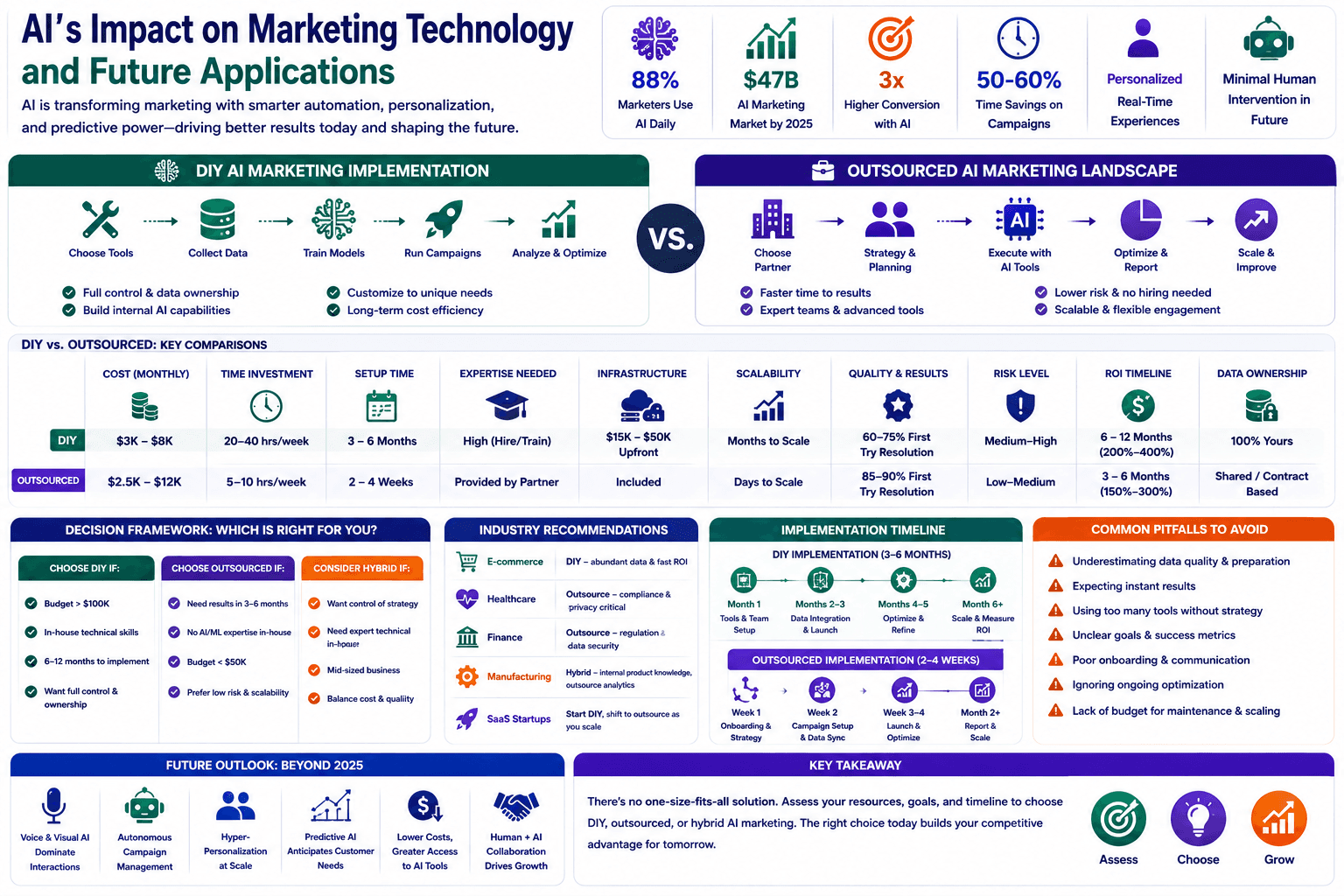
AI has revolutionized marketing technology, with 88% of marketers now utilizing AI daily. The AI marketing market is projected to reach $47 billion by 2025. Machine learning algorithms autonomously manage content creation, customer segmentation, and campaign optimization. Looking ahead, AI is set to map customer journeys, personalize experiences in real-time, and execute campaigns with minimal human intervention. For more insights on AI's role in marketing, check out our AI Marketing Trends.
DIY AI Marketing Implementation
DIY AI marketing empowers businesses to develop and manage their own AI marketing systems. Companies select AI software, train models, generate content, and analyze performance data. Teams acquire skills in AI platforms, integrate various tools, and build expertise in machine learning, data analysis, and automated campaign management. This approach allows businesses to maintain complete control over their marketing operations. Learn more about the best AI tools for DIY marketing.
The Outsourced AI Marketing Landscape
Outsourced AI marketing involves collaborating with agencies or platforms that manage AI tools and strategies. These providers offer ready-made AI solutions, trained models, and expert teams to execute campaigns. Companies can leverage advanced AI features without investing in in-house development. Options include full-service AI marketing firms, specialized automation platforms, and hybrid consulting models that combine strategy with execution. Explore our guide to choosing an AI marketing agency for more information.
Cost Breakdown: DIY vs. Outsourced AI Marketing
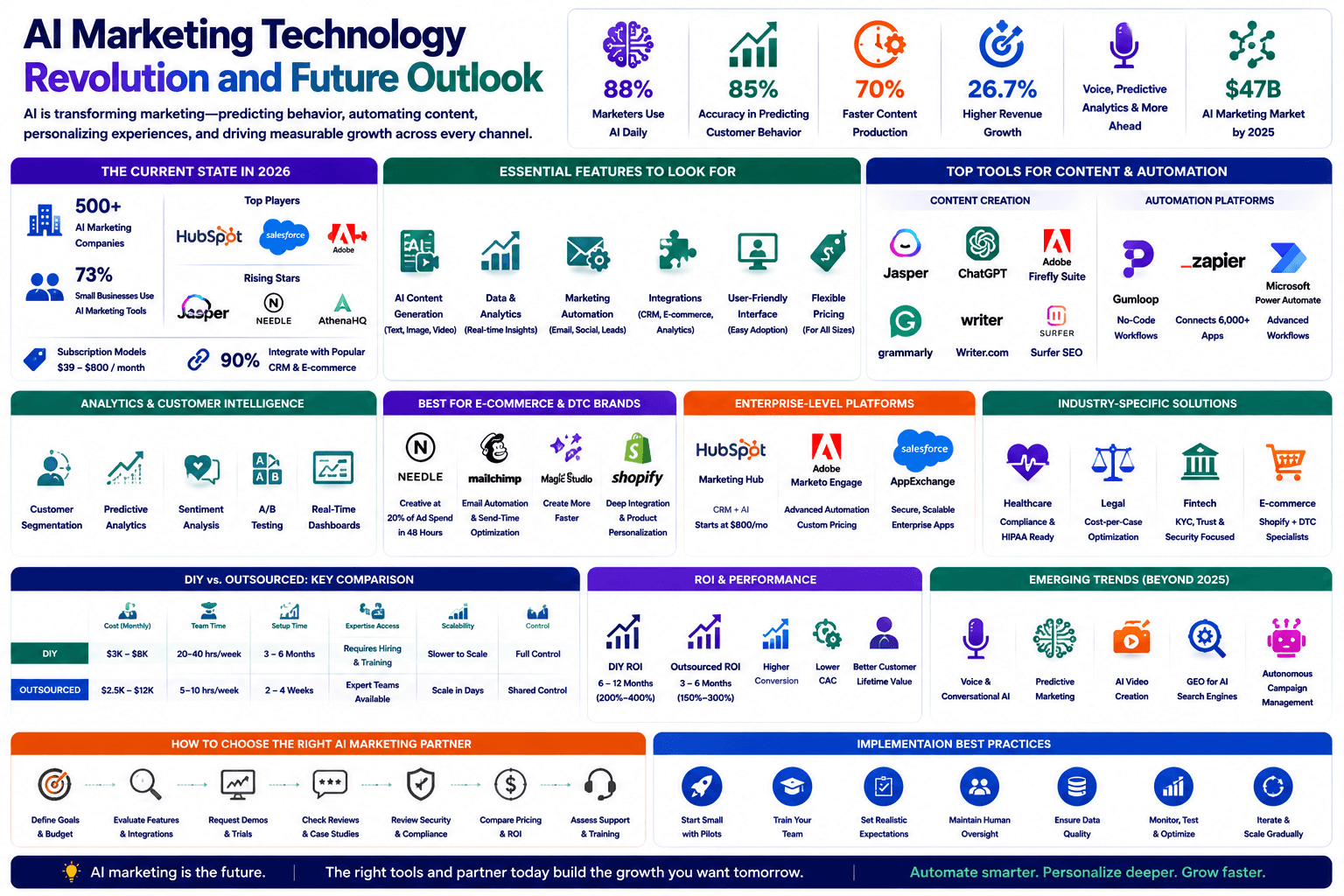
DIY AI marketing expenses encompass software subscriptions ($200-$800 per month), training ($5,000-$15,000), and staff time (20-40 hours weekly). The total monthly cost ranges from $3,000 to $8,000. Outsourcing costs $2,500 to $12,000 monthly for agency fees, with companies handling the setup. DIY also incurs hidden costs, such as staff time and the learning curve. Outsourcing eliminates infrastructure needs but involves ongoing fees and potential setup costs. For a detailed comparison, visit our cost analysis page.
Time Investment and Resource Requirements
DIY AI marketing demands 20-40 hours weekly from internal teams, including 15 hours for campaign management, 10 hours for data analysis, and 15 hours for task optimization. Setup requires 3-6 months of focused effort. Outsourcing reduces internal time to 5-10 hours weekly for communication and oversight, allowing teams to concentrate on core business activities while agencies handle execution and technical tasks. Check out our resource management strategies for optimizing your team's time.
Talent and Expertise Considerations
In-house AI marketing requires specialists with salaries ranging from $80,000 to $150,000 annually, plus training costs of $10,000 to $15,000 per person. Finding skilled AI marketing talent is challenging, with 65% of companies struggling to fill these roles. Outsourcing provides immediate access to certified experts and specialized teams without the hiring costs. AI marketing firms employ data scientists, machine learning engineers, and campaign strategists skilled in the latest technologies and best practices. For tips on hiring AI talent, see our talent acquisition guide.
Technology Infrastructure and Tool Requirements
Establishing DIY AI marketing necessitates significant infrastructure investment, including cloud computing, data storage, and specialized software licenses costing $15,000 to $50,000 upfront, plus $5,000 to $15,000 annually. Machine learning platforms, customer data platforms, and analytics tools are also required. Outsourcing can reduce these costs, as AI marketing companies provide ready-made infrastructure, advanced tools, and technical support in their service packages. Learn more about the essential tools for AI marketing.
Scalability and Flexibility Analysis
Building an in-house AI marketing system requires months and substantial investments as you scale. Adding new features necessitates hiring experts and purchasing additional software. Outsourced AI marketing firms can scale quickly, often within days, adjusting team size and services based on demand. They offer flexible contracts and adapt to market changes without the fixed costs of maintaining internal teams during slower periods. For more on scalability, visit our scalability strategies page.
Quality and Performance Metrics Comparison
The quality of DIY AI marketing depends on your team's skills and time. Internal teams resolve 60-75% of issues on the first attempt, with customer satisfaction scores between 70-85%. Outsourced AI marketing companies achieve 85-90% resolution rates and over 90% satisfaction scores. They utilize structured processes, advanced tools, and specialized expertise. Professional agencies maintain quality controls and performance standards that many internal teams find challenging to consistently match. For performance metrics, see our performance measurement guide.
Risk Assessment for Both Approaches
DIY AI marketing carries risks such as skill gaps, technology failures, and compliance issues. Internal teams may lack knowledge of data privacy regulations or handling advanced AI models. Outsourcing introduces risks like vendor reliance, data security concerns, and potential service interruptions. AI marketing companies typically manage risks better with established protocols, backup systems, and compliance plans. However, businesses relinquish some control over customer data and marketing strategies when outsourcing. For a deeper dive into risk management, check our risk assessment resources.
ROI Analysis and Financial Projections for 2025
DIY AI marketing typically yields a return on investment within 6 to 12 months. Initial investments of $50,000 to $200,000 can result in returns of 200% to 400% by enhancing conversion rates and reducing manual labor costs. Outsourced solutions often deliver returns faster, within 3 to 6 months, requiring a lower initial spend of $20,000 to $100,000 and yielding returns of 150% to 300%. AI marketing companies often promise specific performance metrics, making financial outcomes more predictable for planning and reporting. For more on ROI, visit our financial projections page.
Decision Framework: Choosing the Right Approach
Opt for DIY AI marketing if you have a budget over $100,000, in-house technical skills, and 6-12 months for implementation. Choose outsourced solutions if you need results in 3-6 months, lack AI experts, or have a budget under $50,000. Consider hybrid approaches if you are a mid-sized company wanting to manage strategy but outsource technical tasks to AI marketing specialists. For a detailed decision-making framework, see our decision-making guide.
Hybrid Models: Combining DIY and Outsourced Elements
Hybrid models effectively blend in-house strategy with external AI expertise. Companies manage brand messaging and customer insights internally while outsourcing tasks like technical setup, model training, and automation. This approach reduces costs by 30-40% compared to full outsourcing while maintaining high quality. Many successful businesses use hybrid models, controlling core strategy internally and partnering with AI marketing firms for technical tasks and advanced analytics. Learn more about hybrid marketing strategies.
Industry-Specific Recommendations
E-commerce businesses should adopt DIY AI marketing due to their ability to track returns and access abundant customer data. Healthcare and financial services should engage AI marketing companies to ensure regulatory compliance. Manufacturing companies should use a mix of in-house and outsourced services, retaining product knowledge internally while outsourcing customer analytics. SaaS startups should start with DIY to manage costs, transitioning to outsourced solutions as they grow and require more advanced tools. For tailored recommendations, visit our industry insights page.
Implementation Timeline and Milestones
DIY AI marketing takes approximately 3-6 months to fully deploy. In the first month, select tools and train your team. In months 2-3, integrate data and set up initial campaigns. In months 4-6, focus on optimization and scaling. Outsourced solutions can launch in 2-4 weeks but require 1-2 months for full customization. Key milestones include data integration, launching the first campaign, benchmarking performance, and establishing ROI measurement. For a detailed timeline, check our implementation timeline guide.
Common Pitfalls and How to Avoid Them
DIY teams often underestimate the importance of quality data and expect quick results. Avoid rushing into implementation without adequate training or starting with too many tools. When outsourcing, pitfalls include unclear goals, insufficient onboarding time, and lack of clear performance metrics. Both methods fail if businesses do not budget for ongoing optimization and maintenance. For more on avoiding pitfalls, see our common pitfalls guide.
Future Outlook: What to Expect Beyond 2025
AI marketing tools will become increasingly sophisticated, managing and optimizing campaigns in real-time. DIY tools will become more affordable as competition intensifies, while AI marketing firms will focus on niche services. Voice and visual AI will dominate customer interactions. Businesses will leverage a blend of human creativity and AI to achieve optimal results and manage costs effectively. For future trends, visit our future of AI marketing page.
Compare AI marketing companies vs DIY solutions. Get cost breakdowns, ROI analysis, and expert recommendations for 2026.
AI's Impact on Marketing Technology and Future Applications
AI has revolutionized marketing technology, with 88% of marketers now utilizing AI daily. The AI marketing market is projected to reach $47 billion by 2025. Machine learning algorithms autonomously manage content creation, customer segmentation, and campaign optimization. Looking ahead, AI is set to map customer journeys, personalize experiences in real-time, and execute campaigns with minimal human intervention. For more insights on AI's role in marketing, check out our AI Marketing Trends.
DIY AI Marketing Implementation
DIY AI marketing empowers businesses to develop and manage their own AI marketing systems. Companies select AI software, train models, generate content, and analyze performance data. Teams acquire skills in AI platforms, integrate various tools, and build expertise in machine learning, data analysis, and automated campaign management. This approach allows businesses to maintain complete control over their marketing operations. Learn more about the best AI tools for DIY marketing.
The Outsourced AI Marketing Landscape
Outsourced AI marketing involves collaborating with agencies or platforms that manage AI tools and strategies. These providers offer ready-made AI solutions, trained models, and expert teams to execute campaigns. Companies can leverage advanced AI features without investing in in-house development. Options include full-service AI marketing firms, specialized automation platforms, and hybrid consulting models that combine strategy with execution. Explore our guide to choosing an AI marketing agency for more information.
Cost Breakdown: DIY vs. Outsourced AI Marketing
DIY AI marketing expenses encompass software subscriptions ($200-$800 per month), training ($5,000-$15,000), and staff time (20-40 hours weekly). The total monthly cost ranges from $3,000 to $8,000. Outsourcing costs $2,500 to $12,000 monthly for agency fees, with companies handling the setup. DIY also incurs hidden costs, such as staff time and the learning curve. Outsourcing eliminates infrastructure needs but involves ongoing fees and potential setup costs. For a detailed comparison, visit our cost analysis page.
Time Investment and Resource Requirements
DIY AI marketing demands 20-40 hours weekly from internal teams, including 15 hours for campaign management, 10 hours for data analysis, and 15 hours for task optimization. Setup requires 3-6 months of focused effort. Outsourcing reduces internal time to 5-10 hours weekly for communication and oversight, allowing teams to concentrate on core business activities while agencies handle execution and technical tasks. Check out our resource management strategies for optimizing your team's time.
Talent and Expertise Considerations
In-house AI marketing requires specialists with salaries ranging from $80,000 to $150,000 annually, plus training costs of $10,000 to $15,000 per person. Finding skilled AI marketing talent is challenging, with 65% of companies struggling to fill these roles. Outsourcing provides immediate access to certified experts and specialized teams without the hiring costs. AI marketing firms employ data scientists, machine learning engineers, and campaign strategists skilled in the latest technologies and best practices. For tips on hiring AI talent, see our talent acquisition guide.
Technology Infrastructure and Tool Requirements
Establishing DIY AI marketing necessitates significant infrastructure investment, including cloud computing, data storage, and specialized software licenses costing $15,000 to $50,000 upfront, plus $5,000 to $15,000 annually. Machine learning platforms, customer data platforms, and analytics tools are also required. Outsourcing can reduce these costs, as AI marketing companies provide ready-made infrastructure, advanced tools, and technical support in their service packages. Learn more about the essential tools for AI marketing.
Scalability and Flexibility Analysis
Building an in-house AI marketing system requires months and substantial investments as you scale. Adding new features necessitates hiring experts and purchasing additional software. Outsourced AI marketing firms can scale quickly, often within days, adjusting team size and services based on demand. They offer flexible contracts and adapt to market changes without the fixed costs of maintaining internal teams during slower periods. For more on scalability, visit our scalability strategies page.
Quality and Performance Metrics Comparison
The quality of DIY AI marketing depends on your team's skills and time. Internal teams resolve 60-75% of issues on the first attempt, with customer satisfaction scores between 70-85%. Outsourced AI marketing companies achieve 85-90% resolution rates and over 90% satisfaction scores. They utilize structured processes, advanced tools, and specialized expertise. Professional agencies maintain quality controls and performance standards that many internal teams find challenging to consistently match. For performance metrics, see our performance measurement guide.
Risk Assessment for Both Approaches
DIY AI marketing carries risks such as skill gaps, technology failures, and compliance issues. Internal teams may lack knowledge of data privacy regulations or handling advanced AI models. Outsourcing introduces risks like vendor reliance, data security concerns, and potential service interruptions. AI marketing companies typically manage risks better with established protocols, backup systems, and compliance plans. However, businesses relinquish some control over customer data and marketing strategies when outsourcing. For a deeper dive into risk management, check our risk assessment resources.
ROI Analysis and Financial Projections for 2025
DIY AI marketing typically yields a return on investment within 6 to 12 months. Initial investments of $50,000 to $200,000 can result in returns of 200% to 400% by enhancing conversion rates and reducing manual labor costs. Outsourced solutions often deliver returns faster, within 3 to 6 months, requiring a lower initial spend of $20,000 to $100,000 and yielding returns of 150% to 300%. AI marketing companies often promise specific performance metrics, making financial outcomes more predictable for planning and reporting. For more on ROI, visit our financial projections page.
Decision Framework: Choosing the Right Approach
Opt for DIY AI marketing if you have a budget over $100,000, in-house technical skills, and 6-12 months for implementation. Choose outsourced solutions if you need results in 3-6 months, lack AI experts, or have a budget under $50,000. Consider hybrid approaches if you are a mid-sized company wanting to manage strategy but outsource technical tasks to AI marketing specialists. For a detailed decision-making framework, see our decision-making guide.
Hybrid Models: Combining DIY and Outsourced Elements
Hybrid models effectively blend in-house strategy with external AI expertise. Companies manage brand messaging and customer insights internally while outsourcing tasks like technical setup, model training, and automation. This approach reduces costs by 30-40% compared to full outsourcing while maintaining high quality. Many successful businesses use hybrid models, controlling core strategy internally and partnering with AI marketing firms for technical tasks and advanced analytics. Learn more about hybrid marketing strategies.
Industry-Specific Recommendations
E-commerce businesses should adopt DIY AI marketing due to their ability to track returns and access abundant customer data. Healthcare and financial services should engage AI marketing companies to ensure regulatory compliance. Manufacturing companies should use a mix of in-house and outsourced services, retaining product knowledge internally while outsourcing customer analytics. SaaS startups should start with DIY to manage costs, transitioning to outsourced solutions as they grow and require more advanced tools. For tailored recommendations, visit our industry insights page.
Implementation Timeline and Milestones
DIY AI marketing takes approximately 3-6 months to fully deploy. In the first month, select tools and train your team. In months 2-3, integrate data and set up initial campaigns. In months 4-6, focus on optimization and scaling. Outsourced solutions can launch in 2-4 weeks but require 1-2 months for full customization. Key milestones include data integration, launching the first campaign, benchmarking performance, and establishing ROI measurement. For a detailed timeline, check our implementation timeline guide.
Common Pitfalls and How to Avoid Them
DIY teams often underestimate the importance of quality data and expect quick results. Avoid rushing into implementation without adequate training or starting with too many tools. When outsourcing, pitfalls include unclear goals, insufficient onboarding time, and lack of clear performance metrics. Both methods fail if businesses do not budget for ongoing optimization and maintenance. For more on avoiding pitfalls, see our common pitfalls guide.
Future Outlook: What to Expect Beyond 2025
AI marketing tools will become increasingly sophisticated, managing and optimizing campaigns in real-time. DIY tools will become more affordable as competition intensifies, while AI marketing firms will focus on niche services. Voice and visual AI will dominate customer interactions. Businesses will leverage a blend of human creativity and AI to achieve optimal results and manage costs effectively. For future trends, visit our future of AI marketing page.
บล็อกอื่น ๆ
บล็อกอื่น ๆ
ตรวจสอบบล็อกโครงการอื่น ๆ ของเราที่มีข้อมูลเชิงลึกและข้อมูลที่เป็นประโยชน์สำหรับธุรกิจของคุณ
บล็อกอื่น ๆ
บล็อกอื่น ๆ
ตรวจสอบบล็อกโครงการอื่น ๆ ของเราที่มีข้อมูลเชิงลึกและข้อมูลที่เป็นประโยชน์สำหรับธุรกิจของคุณ