
Our Three Step Process
26 พฤษภาคม 2569
AI Marketing Companies: Leaders, Technologies & Future Trends 2026
Our Three Step Process
26 พฤษภาคม 2569
AI Marketing Companies: Leaders, Technologies & Future Trends 2026
Discover top AI marketing companies, breakthrough technologies, and implementation strategies. Expert insights on predictive analytics.
AI Marketing Technology: Current State and Future Path
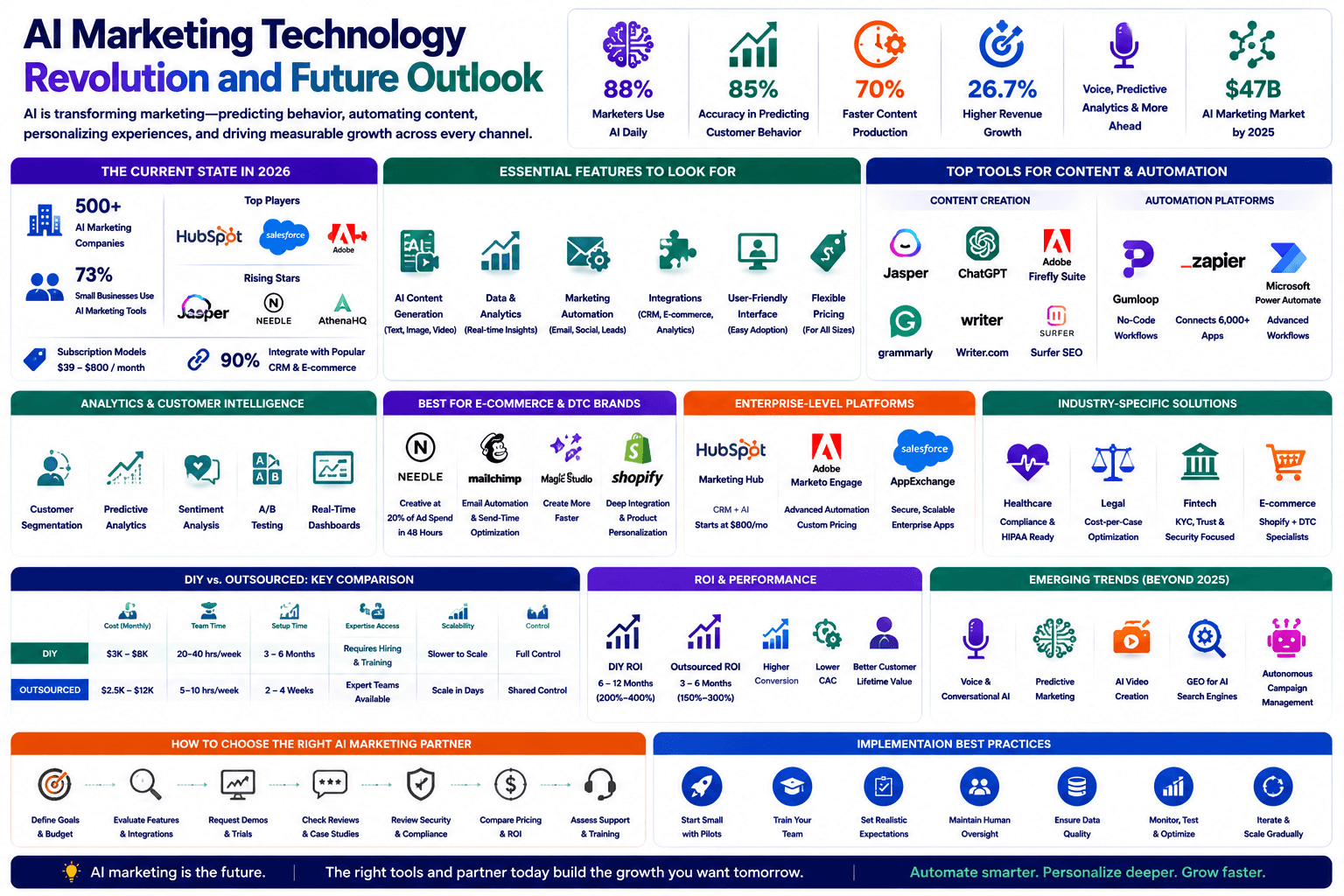
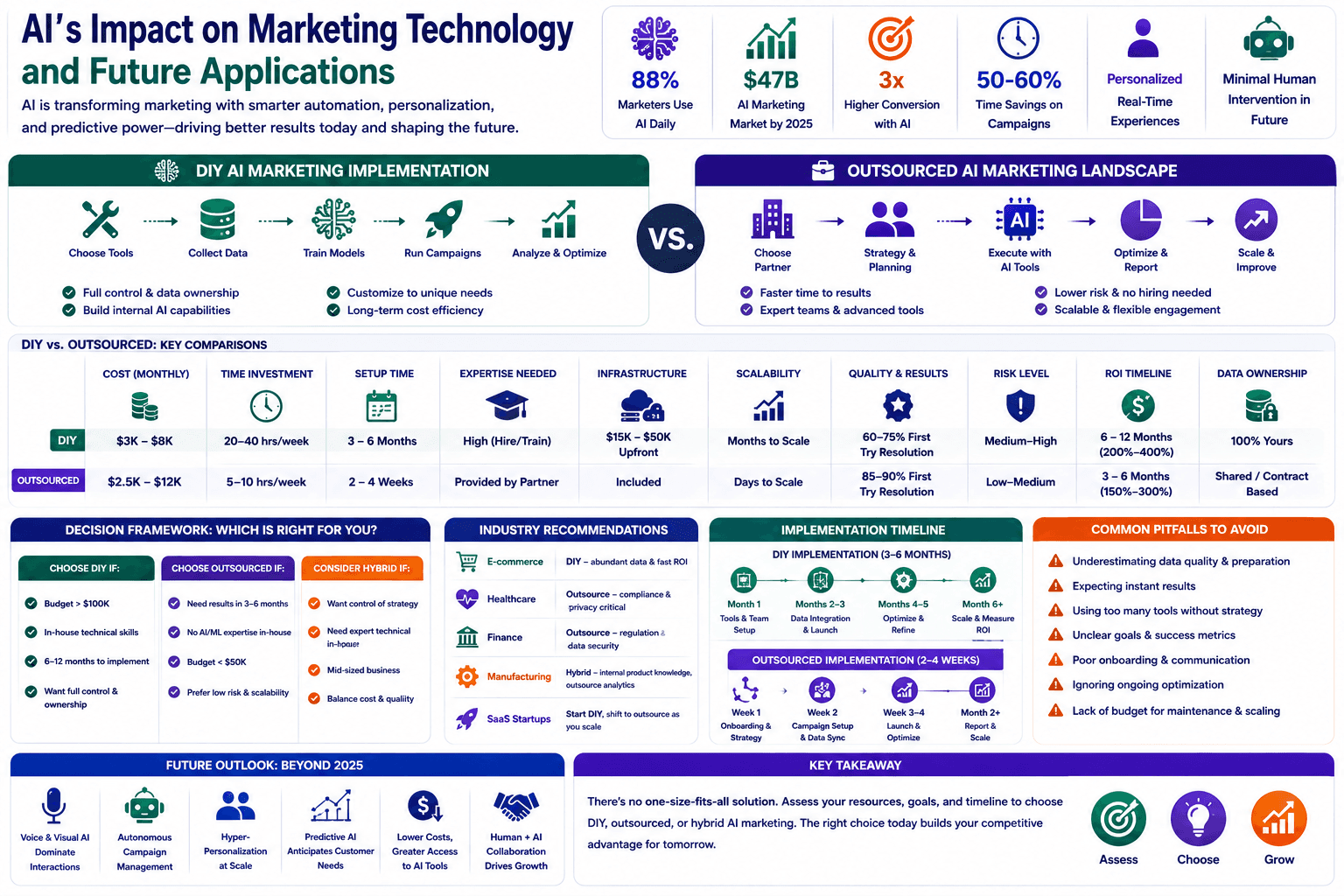
AI marketing technology has revolutionized how businesses attract and retain customers. Predictive analytics now instantly examines consumer behavior patterns, while automated tools create personalized experiences across various platforms. Machine learning continuously enhances campaign performance, rendering manual A/B testing obsolete. Looking ahead, quantum computing and advanced neural networks promise to deliver deep customer insights, enabling marketers to predict buying decisions with high accuracy while adhering to privacy regulations. For more on the implications of these technologies, check out our page on Emerging Challenges and Ethical Considerations.
Leading AI Marketing Companies Shaping the Industry
Several AI marketing companies are at the forefront of industry transformation. Pecan AI leverages machine learning for predictive analytics, empowering businesses to make informed decisions. Appier provides solutions for cross-screen targeting and automated testing, while Oolo AI focuses on automating customer service and enhancing revenue. Lemon AI offers CRM solutions using natural language processing. These companies exemplify how AI tools are transforming marketing, from data analysis to customer engagement, setting new standards for automation and personalization. Learn more about these innovations on our Breakthrough Technologies in Development page.
Breakthrough Technologies in Development
AI marketing companies are developing groundbreaking technologies to redefine customer connections. Machine learning now predicts consumer behavior with 90% accuracy, while neural networks generate personalized content swiftly and at scale. Real-time sentiment analysis tools gauge brand perception across various online interactions. Computer vision technology enables instant product recognition in photos. Advances in natural language processing empower chatbots to handle complex customer inquiries autonomously. These innovations represent the future of marketing automation and customer intelligence. For insights on how these technologies can be implemented, visit our Implementation Strategies for Marketing Teams page.
Predictive Analytics and Customer Intelligence Platforms
AI marketing companies are creating platforms that accurately predict customer behavior. These systems analyze purchase patterns, browsing history, and engagement data to forecast lifetime value and churn risk. Machine learning identifies niche segments within customer bases for targeted actions. Real-time scoring evaluates lead quality instantly, and behavioral models suggest optimal next steps for each customer, revolutionizing customer relationship management. Explore more about these platforms on our AI-Powered Content Generation and Creative Automation page.
Tailored Experiences for Large Businesses
AI marketing firms are crafting unique experiences for millions of customers simultaneously. Intelligent systems utilize real-time behavior, past purchases, and context to personalize every interaction. They dynamically update website content, emails, and product recommendations for each individual. Machine learning predicts the optimal time, message, and method to engage customers while maintaining brand consistency. Large-scale platforms manage vast data volumes, ensuring personalization feels genuine and unobtrusive. For a deeper dive into customer engagement technologies, check out our page on Real-Time Customer Engagement Technologies.
AI-Powered Content Generation and Creative Automation
AI marketing firms develop platforms that rapidly generate custom content, including text, images, and videos. These tools ensure brand messages remain consistent across channels, adapting tone and style for diverse audiences. Advanced language processing crafts headlines, product descriptions, and social media posts. Visual AI produces unique graphics and videos, reducing production time from weeks to hours while maintaining quality and brand standards. To learn more about the impact of these tools, visit our Advanced Attribution and Performance Measurement page.
Real-Time Customer Engagement Technologies
AI marketing firms create platforms that swiftly respond to customer actions across all channels. These systems monitor user behavior, anticipate needs, and deliver tailored messages instantly. Advanced chatbots handle detailed conversations, while sentiment analysis tools track brand mentions and feedback. Real-time recommendation engines adjust product suggestions based on browsing habits, past purchases, and current contexts, enabling brands to connect with customers at the right moment with relevant content, enhancing conversion rates and satisfaction. For insights on privacy-focused solutions, see our page on Privacy-First AI Marketing Solutions.
Advanced Attribution and Performance Measurement
AI marketing companies develop sophisticated models to track customer journeys across channels and devices. These platforms use machine learning to accurately attribute credit to each marketing channel, beyond just the last click. Advanced tools analyze cross-device behavior, offline sales, and long-term customer value. Real-time dashboards provide actionable insights, while predictive models forecast campaign outcomes. These technologies enable marketers to allocate budgets more effectively, measure ROI accurately, and make precise, data-driven decisions. For future market predictions, check out our Future Market Predictions and Investment Trends page.
Privacy-First AI Marketing Solutions
AI marketing firms design tools that respect user privacy while delivering personalized experiences. These tools employ federated learning to analyze data without central storage, apply differential privacy to protect individual identities, and utilize cookieless targeting with first-party data. Companies like Apple and Google lead in privacy-focused ad technologies. Startups develop consent management platforms and privacy-compliant analytics tools to help marketers comply with regulations such as GDPR and CCPA. For more on voice and conversational AI, visit our page on Voice and Conversational AI Marketing Platforms.
Voice and Conversational AI Marketing Platforms
AI marketing firms create voice and chat platforms that facilitate natural interactions between brands and customers. These systems use language processing to understand context, emotions, and intent in voice assistants, chatbots, and messaging apps. Leading companies offer voice shopping, chat-based ads, and AI customer service tools available 24/7. They also gather valuable customer data for future marketing initiatives. To explore augmented reality technologies, see our page on Augmented Reality and Immersive Marketing Technologies.
Augmented Reality and Immersive Marketing Technologies
AI marketing companies develop AR platforms that blend digital content with real-world environments for interactive brand experiences. These tools enable virtual product trials, storytelling, and location-based marketing. Leading firms design AI-powered AR filters, virtual showrooms, and mixed reality ads to boost customer engagement. Computer vision and machine learning track user interactions, providing marketers with data to refine campaigns and measure the impact of immersive brand experiences across channels. For insights on cross-platform integration, visit our page on Cross-Platform AI Integration and Orchestration.
Cross-Platform AI Integration and Orchestration
AI marketing companies build platforms that seamlessly integrate data and campaigns across channels. These systems coordinate customer journeys across email, social media, mobile apps, and websites using centralized AI engines. Leading firms develop APIs and middleware for real-time data sharing between marketing tools, ensuring consistent messaging and personalized experiences. Advanced platforms employ machine learning to automate budget allocation, timing, and content delivery across all touchpoints. For a discussion on ethical considerations, check out our page on Emerging Challenges and Ethical Considerations.
Emerging Challenges and Ethical Considerations
AI marketing companies face growing scrutiny over data privacy, algorithmic bias, and consumer manipulation. Regulations like GDPR and new AI laws require transparent data usage and explainable AI decisions. Companies establish ethical AI guidelines to manage consent, detect bias, and target responsibly. Key challenges include balancing personalization with privacy, preventing biased algorithms, and maintaining human oversight in automated systems. Leading firms invest in AI ethics teams and audit tools to ensure compliant and responsible marketing practices. For future market predictions, see our page on Future Market Predictions and Investment Trends.
Future Market Predictions and Investment Trends
By 2028, the AI marketing technology sector is projected to attract $107 billion in investment. This growth is driven by the rise of generative AI and the demand for real-time personalization. Venture capital is focusing on startups developing privacy-preserving AI, cross-platform attribution, and autonomous campaign management. Major companies are acquiring firms with unique data models and advanced customer intelligence platforms. Emerging markets are adopting AI marketing at a 40% annual growth rate. Key investment areas include AI for voice commerce, platforms predicting customer lifetime value, and AI tools for creative automation for large enterprises.
Implementation Strategies for Marketing Teams
Marketing teams should initiate pilot programs with established AI marketing companies like Appier or Pecan AI for predictive analytics. Begin with single-use cases such as email personalization or customer segmentation before expanding. Train teams on AI tools and establish clear data governance policies. Foster collaboration between marketing, IT, and data science teams. Set measurable KPIs for AI projects and allocate 15-20% of the marketing budget for AI trials. Focus on collecting first-party data to effectively power AI algorithms. For more detailed strategies, refer to our page on Tailored Experiences for Large Businesses.
Discover top AI marketing companies, breakthrough technologies, and implementation strategies. Expert insights on predictive analytics.
AI Marketing Technology: Current State and Future Path
AI marketing technology has revolutionized how businesses attract and retain customers. Predictive analytics now instantly examines consumer behavior patterns, while automated tools create personalized experiences across various platforms. Machine learning continuously enhances campaign performance, rendering manual A/B testing obsolete. Looking ahead, quantum computing and advanced neural networks promise to deliver deep customer insights, enabling marketers to predict buying decisions with high accuracy while adhering to privacy regulations. For more on the implications of these technologies, check out our page on Emerging Challenges and Ethical Considerations.
Leading AI Marketing Companies Shaping the Industry
Several AI marketing companies are at the forefront of industry transformation. Pecan AI leverages machine learning for predictive analytics, empowering businesses to make informed decisions. Appier provides solutions for cross-screen targeting and automated testing, while Oolo AI focuses on automating customer service and enhancing revenue. Lemon AI offers CRM solutions using natural language processing. These companies exemplify how AI tools are transforming marketing, from data analysis to customer engagement, setting new standards for automation and personalization. Learn more about these innovations on our Breakthrough Technologies in Development page.
Breakthrough Technologies in Development
AI marketing companies are developing groundbreaking technologies to redefine customer connections. Machine learning now predicts consumer behavior with 90% accuracy, while neural networks generate personalized content swiftly and at scale. Real-time sentiment analysis tools gauge brand perception across various online interactions. Computer vision technology enables instant product recognition in photos. Advances in natural language processing empower chatbots to handle complex customer inquiries autonomously. These innovations represent the future of marketing automation and customer intelligence. For insights on how these technologies can be implemented, visit our Implementation Strategies for Marketing Teams page.
Predictive Analytics and Customer Intelligence Platforms
AI marketing companies are creating platforms that accurately predict customer behavior. These systems analyze purchase patterns, browsing history, and engagement data to forecast lifetime value and churn risk. Machine learning identifies niche segments within customer bases for targeted actions. Real-time scoring evaluates lead quality instantly, and behavioral models suggest optimal next steps for each customer, revolutionizing customer relationship management. Explore more about these platforms on our AI-Powered Content Generation and Creative Automation page.
Tailored Experiences for Large Businesses
AI marketing firms are crafting unique experiences for millions of customers simultaneously. Intelligent systems utilize real-time behavior, past purchases, and context to personalize every interaction. They dynamically update website content, emails, and product recommendations for each individual. Machine learning predicts the optimal time, message, and method to engage customers while maintaining brand consistency. Large-scale platforms manage vast data volumes, ensuring personalization feels genuine and unobtrusive. For a deeper dive into customer engagement technologies, check out our page on Real-Time Customer Engagement Technologies.
AI-Powered Content Generation and Creative Automation
AI marketing firms develop platforms that rapidly generate custom content, including text, images, and videos. These tools ensure brand messages remain consistent across channels, adapting tone and style for diverse audiences. Advanced language processing crafts headlines, product descriptions, and social media posts. Visual AI produces unique graphics and videos, reducing production time from weeks to hours while maintaining quality and brand standards. To learn more about the impact of these tools, visit our Advanced Attribution and Performance Measurement page.
Real-Time Customer Engagement Technologies
AI marketing firms create platforms that swiftly respond to customer actions across all channels. These systems monitor user behavior, anticipate needs, and deliver tailored messages instantly. Advanced chatbots handle detailed conversations, while sentiment analysis tools track brand mentions and feedback. Real-time recommendation engines adjust product suggestions based on browsing habits, past purchases, and current contexts, enabling brands to connect with customers at the right moment with relevant content, enhancing conversion rates and satisfaction. For insights on privacy-focused solutions, see our page on Privacy-First AI Marketing Solutions.
Advanced Attribution and Performance Measurement
AI marketing companies develop sophisticated models to track customer journeys across channels and devices. These platforms use machine learning to accurately attribute credit to each marketing channel, beyond just the last click. Advanced tools analyze cross-device behavior, offline sales, and long-term customer value. Real-time dashboards provide actionable insights, while predictive models forecast campaign outcomes. These technologies enable marketers to allocate budgets more effectively, measure ROI accurately, and make precise, data-driven decisions. For future market predictions, check out our Future Market Predictions and Investment Trends page.
Privacy-First AI Marketing Solutions
AI marketing firms design tools that respect user privacy while delivering personalized experiences. These tools employ federated learning to analyze data without central storage, apply differential privacy to protect individual identities, and utilize cookieless targeting with first-party data. Companies like Apple and Google lead in privacy-focused ad technologies. Startups develop consent management platforms and privacy-compliant analytics tools to help marketers comply with regulations such as GDPR and CCPA. For more on voice and conversational AI, visit our page on Voice and Conversational AI Marketing Platforms.
Voice and Conversational AI Marketing Platforms
AI marketing firms create voice and chat platforms that facilitate natural interactions between brands and customers. These systems use language processing to understand context, emotions, and intent in voice assistants, chatbots, and messaging apps. Leading companies offer voice shopping, chat-based ads, and AI customer service tools available 24/7. They also gather valuable customer data for future marketing initiatives. To explore augmented reality technologies, see our page on Augmented Reality and Immersive Marketing Technologies.
Augmented Reality and Immersive Marketing Technologies
AI marketing companies develop AR platforms that blend digital content with real-world environments for interactive brand experiences. These tools enable virtual product trials, storytelling, and location-based marketing. Leading firms design AI-powered AR filters, virtual showrooms, and mixed reality ads to boost customer engagement. Computer vision and machine learning track user interactions, providing marketers with data to refine campaigns and measure the impact of immersive brand experiences across channels. For insights on cross-platform integration, visit our page on Cross-Platform AI Integration and Orchestration.
Cross-Platform AI Integration and Orchestration
AI marketing companies build platforms that seamlessly integrate data and campaigns across channels. These systems coordinate customer journeys across email, social media, mobile apps, and websites using centralized AI engines. Leading firms develop APIs and middleware for real-time data sharing between marketing tools, ensuring consistent messaging and personalized experiences. Advanced platforms employ machine learning to automate budget allocation, timing, and content delivery across all touchpoints. For a discussion on ethical considerations, check out our page on Emerging Challenges and Ethical Considerations.
Emerging Challenges and Ethical Considerations
AI marketing companies face growing scrutiny over data privacy, algorithmic bias, and consumer manipulation. Regulations like GDPR and new AI laws require transparent data usage and explainable AI decisions. Companies establish ethical AI guidelines to manage consent, detect bias, and target responsibly. Key challenges include balancing personalization with privacy, preventing biased algorithms, and maintaining human oversight in automated systems. Leading firms invest in AI ethics teams and audit tools to ensure compliant and responsible marketing practices. For future market predictions, see our page on Future Market Predictions and Investment Trends.
Future Market Predictions and Investment Trends
By 2028, the AI marketing technology sector is projected to attract $107 billion in investment. This growth is driven by the rise of generative AI and the demand for real-time personalization. Venture capital is focusing on startups developing privacy-preserving AI, cross-platform attribution, and autonomous campaign management. Major companies are acquiring firms with unique data models and advanced customer intelligence platforms. Emerging markets are adopting AI marketing at a 40% annual growth rate. Key investment areas include AI for voice commerce, platforms predicting customer lifetime value, and AI tools for creative automation for large enterprises.
Implementation Strategies for Marketing Teams
Marketing teams should initiate pilot programs with established AI marketing companies like Appier or Pecan AI for predictive analytics. Begin with single-use cases such as email personalization or customer segmentation before expanding. Train teams on AI tools and establish clear data governance policies. Foster collaboration between marketing, IT, and data science teams. Set measurable KPIs for AI projects and allocate 15-20% of the marketing budget for AI trials. Focus on collecting first-party data to effectively power AI algorithms. For more detailed strategies, refer to our page on Tailored Experiences for Large Businesses.
บล็อกอื่น ๆ
บล็อกอื่น ๆ
ตรวจสอบบล็อกโครงการอื่น ๆ ของเราที่มีข้อมูลเชิงลึกและข้อมูลที่เป็นประโยชน์สำหรับธุรกิจของคุณ
บล็อกอื่น ๆ
บล็อกอื่น ๆ
ตรวจสอบบล็อกโครงการอื่น ๆ ของเราที่มีข้อมูลเชิงลึกและข้อมูลที่เป็นประโยชน์สำหรับธุรกิจของคุณ