Our Three Step Process
21 พฤษภาคม 2569
AI Marketing Platforms by Business Size: 2026 Complete Guide
Our Three Step Process
21 พฤษภาคม 2569
AI Marketing Platforms by Business Size: 2026 Complete Guide
Choose the right AI marketing platform for your business size. From startups to enterprise - budgets, features & implementation guide.
Choosing an AI Marketing Platform Based on Business Size
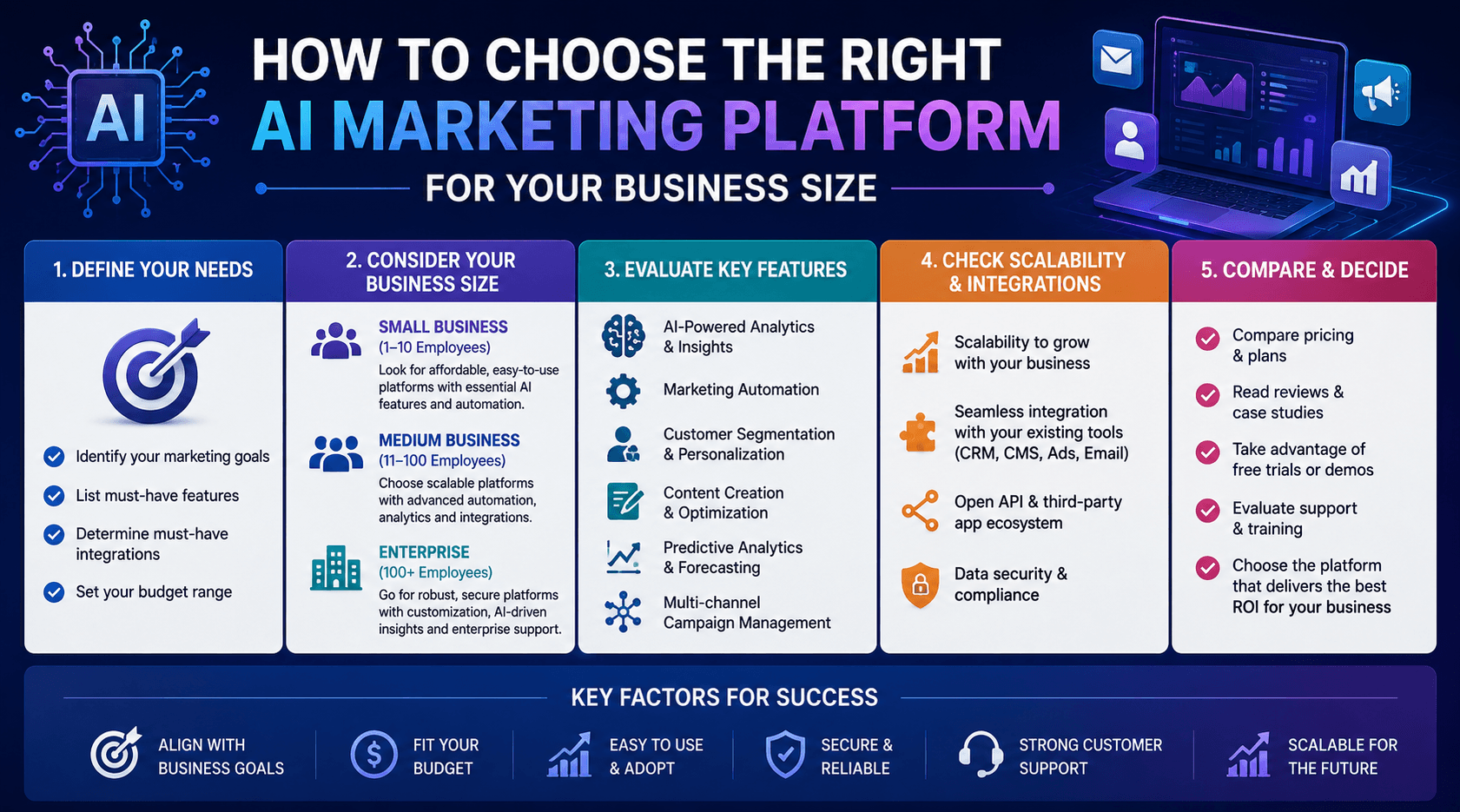
AI marketing platforms are revolutionizing how businesses attract and retain customers. The market is projected to grow from $47.32 billion in 2025 to $107.5 billion by 2028, highlighting the increasing importance of AI skills. Selecting the right platform is crucial; a mismatch can lead to wasted resources and confusion. Your business size significantly influences your platform needs. Startups require affordable, user-friendly options, while large companies need platforms with robust integration and advanced analytics. Understanding your company's needs, resources, and growth plans is essential for choosing a platform that aligns with your goals and scales with your business. For more insights, check out our guide on AI Marketing Trends.
Small Business AI Marketing Platforms (1-50 employees)
Small businesses need AI marketing platforms that are affordable, easy to use, and quick to set up. Budget constraints necessitate tools that deliver immediate value without requiring technical expertise. Platforms like Canva AI for visual content, ChatGPT for writing, and Klaviyo for email automation are ideal for teams with limited resources. These tools typically cost under $100 a month and can be managed by non-technical staff. Look for platforms with templates, pre-built workflows, and simple interfaces to automate repetitive tasks with minimal training. For more options, visit our page on Best AI Tools for Small Businesses.
AI Marketing Solutions for Medium-Sized Businesses (51-500 employees)
Medium-sized businesses require AI marketing tools that balance functionality and cost-effectiveness. With marketing teams in place, these businesses can allocate $500-$5,000 monthly for AI tools. Platforms like HubSpot, Adobe Experience Platform, and Salesforce Einstein offer features such as lead scoring, customer segmentation, and multi-channel campaign management. Integration with existing CRM systems and detailed analytics are crucial. Key features include user role management, workflow automation, and scalability for growing teams, alongside templates for quick setup and customization options. Explore our Medium Business Marketing Strategies for more tailored advice.
Core Categories of AI Marketing Tools by Function
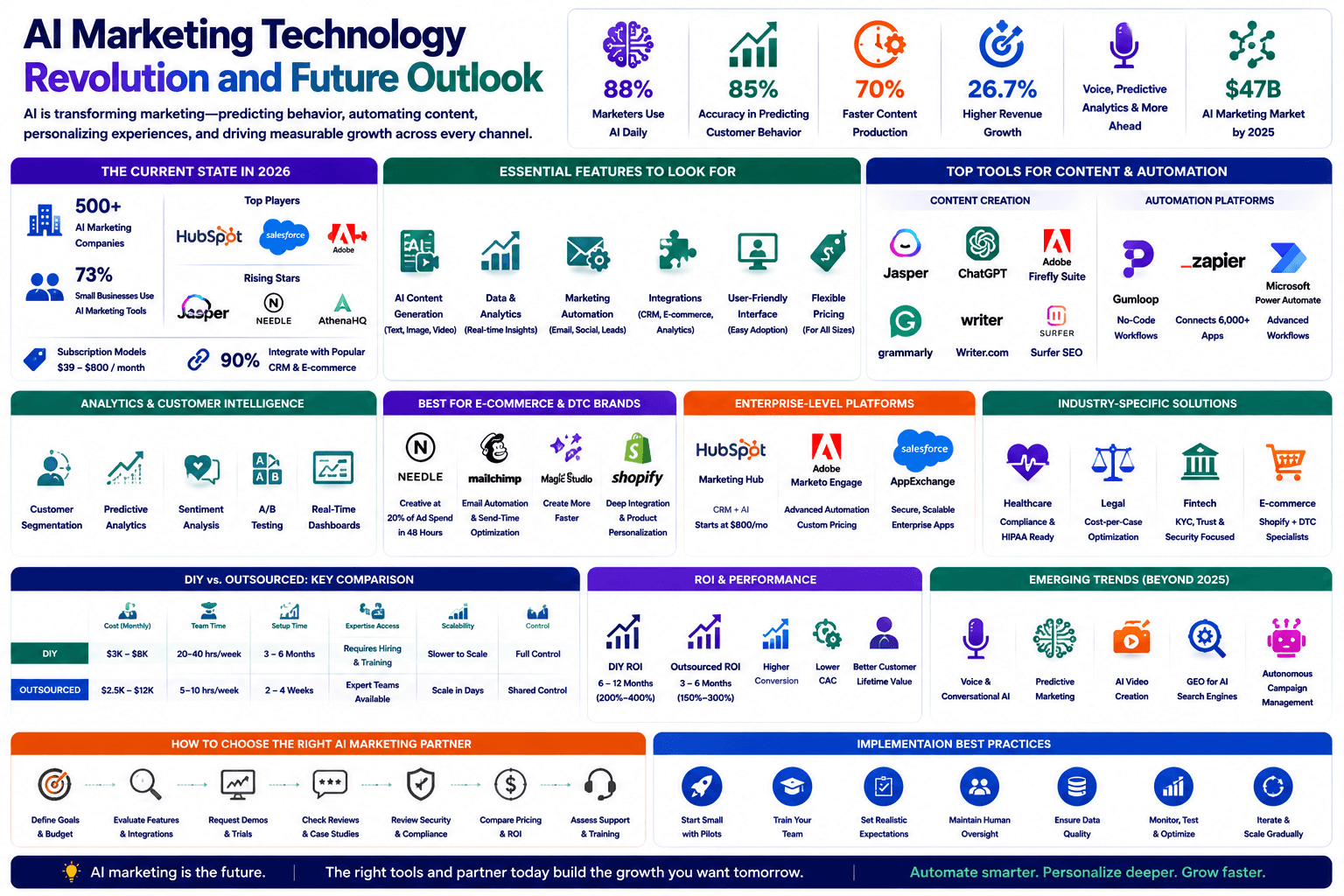
AI marketing tools fall into six main categories, each addressing different business needs. Analytics and insights tools like Google Analytics Intelligence provide predictive analytics and audience segmentation. Natural language processing tools such as ChatGPT and Jasper facilitate content creation and sentiment analysis. Media buying optimizers like Google Ads Smart Bidding automate campaign management and budget allocation. Creative generation tools like DALL-E and Canva AI efficiently produce visual content. Conversational AI platforms like Salesforce Einstein Bot handle customer interactions and lead qualification. Recommendation engines like Adobe Target offer personalized experiences based on user behavior.
Budget Considerations for Different Business Sizes
AI marketing platform budgets vary by company size. Small businesses typically spend $500-$5,000 monthly on basic tools. Medium-sized companies invest $5,000-$25,000 monthly on platforms with advanced features. Large companies often exceed $25,000 monthly for custom solutions. Consider the total cost, including setup, training, and maintenance. Higher usage can lead to discounts. Weigh the cost of delaying implementation against budget constraints. Start with essential features and expand as you see results. For a deeper dive into budgeting, check our Budgeting for AI Marketing guide.
Integration Requirements and Technical Capabilities
AI marketing platforms must integrate seamlessly with your existing technology. Small businesses need simple connections to CRM and email tools. Medium companies require more extensive integration with sales, analytics, and customer support systems. Large organizations need complex API links across multiple departments and legacy systems. Assess whether your team can manage custom integrations or needs user-friendly solutions. Consider data syncing, real-time updates, and data management across systems. Poor integration can create data silos and undermine your AI marketing efforts. Learn more about Integration Best Practices on our site.
Scalability and Growth Planning
Choose AI marketing tools that can grow with your business. Small businesses should select tools that accommodate more data and user accounts as teams expand. Medium companies need platforms supporting multiple departments and regional operations. Large organizations require solutions for global campaigns across diverse markets. Evaluate how pricing adapts with usage, whether the platform can handle traffic spikes, and if new features become available as you upgrade. Platforms with modular designs allow you to add capabilities without system overhauls. Plan for 2-3 years of growth to avoid costly changes and maintain the value of your AI marketing investment. For more on growth strategies, visit our Growth Planning Resources.
Data Security and Compliance Requirements
AI marketing platforms handle sensitive customer data, making security paramount. Small businesses need basic encryption and GDPR compliance. Medium companies require role-based access controls, audit trails, and certifications like SOC 2. Large companies need advanced security protocols, data residency controls, and compliance with regional regulations. Essential security features include data encryption at rest and in transit, regular security audits, backup systems, and clear data processing policies. Verify data storage locations, access permissions, and whether the platform uses your data for AI training. Opt for platforms that transparently explain data handling and offer data protection guarantees. For more information, check our Data Security Guidelines.
Implementation Timeline and Resource Allocation
The setup time for AI marketing tools depends on business size and platform complexity. Small businesses can typically implement simple tools in 2-4 weeks with minimal technical resources. Medium-sized companies might require 1-3 months for full platform integration, involving project managers and IT support. Large businesses often need 3-6 months due to complex setups and testing. Consider staff training, data migration, and ongoing maintenance. Plan for 20-30% more time than vendors estimate. Budget for training, possible consulting services, and temporary productivity dips during the transition. For tips on resource allocation, see our Implementation Strategies.
ROI Measurement and Performance Tracking
To measure the ROI of an AI marketing platform, track metrics aligned with your business goals. Small businesses should focus on basic metrics like cost per lead, conversion rates, and time saved from automation. Medium-sized companies can track detailed KPIs like customer lifetime value, attribution modeling, and campaign improvements. Large organizations need dashboards measuring cross-channel performance, predictive accuracy, and operational efficiency. Establish baseline measurements before starting and track progress monthly. Most businesses see a 15-25% improvement within six months. Use built-in analytics tools and integrate them with existing reporting systems for accurate ROI calculations. For more on performance tracking, check our ROI Measurement Techniques.
Common Mistakes to Avoid When Choosing AI Marketing Platforms
Many businesses choose platforms based on flashy demos rather than real functionality. Avoid tools that don't integrate with your current systems, as this can create data silos. Small businesses should not opt for enterprise-level solutions, which can be overly complex and costly. Resist purchasing multiple separate solutions when one comprehensive platform suffices. Ensure platforms comply with data security standards for your industry. Avoid vendors who can't provide clear timelines or training support. Don't choose based solely on price; consider the total cost, including setup, training, and ongoing maintenance. For a comprehensive list of pitfalls, visit our Common Mistakes in AI Marketing page.
Choose the right AI marketing platform for your business size. From startups to enterprise - budgets, features & implementation guide.
Choosing an AI Marketing Platform Based on Business Size
AI marketing platforms are revolutionizing how businesses attract and retain customers. The market is projected to grow from $47.32 billion in 2025 to $107.5 billion by 2028, highlighting the increasing importance of AI skills. Selecting the right platform is crucial; a mismatch can lead to wasted resources and confusion. Your business size significantly influences your platform needs. Startups require affordable, user-friendly options, while large companies need platforms with robust integration and advanced analytics. Understanding your company's needs, resources, and growth plans is essential for choosing a platform that aligns with your goals and scales with your business. For more insights, check out our guide on AI Marketing Trends.
Small Business AI Marketing Platforms (1-50 employees)
Small businesses need AI marketing platforms that are affordable, easy to use, and quick to set up. Budget constraints necessitate tools that deliver immediate value without requiring technical expertise. Platforms like Canva AI for visual content, ChatGPT for writing, and Klaviyo for email automation are ideal for teams with limited resources. These tools typically cost under $100 a month and can be managed by non-technical staff. Look for platforms with templates, pre-built workflows, and simple interfaces to automate repetitive tasks with minimal training. For more options, visit our page on Best AI Tools for Small Businesses.
AI Marketing Solutions for Medium-Sized Businesses (51-500 employees)
Medium-sized businesses require AI marketing tools that balance functionality and cost-effectiveness. With marketing teams in place, these businesses can allocate $500-$5,000 monthly for AI tools. Platforms like HubSpot, Adobe Experience Platform, and Salesforce Einstein offer features such as lead scoring, customer segmentation, and multi-channel campaign management. Integration with existing CRM systems and detailed analytics are crucial. Key features include user role management, workflow automation, and scalability for growing teams, alongside templates for quick setup and customization options. Explore our Medium Business Marketing Strategies for more tailored advice.
Core Categories of AI Marketing Tools by Function
AI marketing tools fall into six main categories, each addressing different business needs. Analytics and insights tools like Google Analytics Intelligence provide predictive analytics and audience segmentation. Natural language processing tools such as ChatGPT and Jasper facilitate content creation and sentiment analysis. Media buying optimizers like Google Ads Smart Bidding automate campaign management and budget allocation. Creative generation tools like DALL-E and Canva AI efficiently produce visual content. Conversational AI platforms like Salesforce Einstein Bot handle customer interactions and lead qualification. Recommendation engines like Adobe Target offer personalized experiences based on user behavior.
Budget Considerations for Different Business Sizes
AI marketing platform budgets vary by company size. Small businesses typically spend $500-$5,000 monthly on basic tools. Medium-sized companies invest $5,000-$25,000 monthly on platforms with advanced features. Large companies often exceed $25,000 monthly for custom solutions. Consider the total cost, including setup, training, and maintenance. Higher usage can lead to discounts. Weigh the cost of delaying implementation against budget constraints. Start with essential features and expand as you see results. For a deeper dive into budgeting, check our Budgeting for AI Marketing guide.
Integration Requirements and Technical Capabilities
AI marketing platforms must integrate seamlessly with your existing technology. Small businesses need simple connections to CRM and email tools. Medium companies require more extensive integration with sales, analytics, and customer support systems. Large organizations need complex API links across multiple departments and legacy systems. Assess whether your team can manage custom integrations or needs user-friendly solutions. Consider data syncing, real-time updates, and data management across systems. Poor integration can create data silos and undermine your AI marketing efforts. Learn more about Integration Best Practices on our site.
Scalability and Growth Planning
Choose AI marketing tools that can grow with your business. Small businesses should select tools that accommodate more data and user accounts as teams expand. Medium companies need platforms supporting multiple departments and regional operations. Large organizations require solutions for global campaigns across diverse markets. Evaluate how pricing adapts with usage, whether the platform can handle traffic spikes, and if new features become available as you upgrade. Platforms with modular designs allow you to add capabilities without system overhauls. Plan for 2-3 years of growth to avoid costly changes and maintain the value of your AI marketing investment. For more on growth strategies, visit our Growth Planning Resources.
Data Security and Compliance Requirements
AI marketing platforms handle sensitive customer data, making security paramount. Small businesses need basic encryption and GDPR compliance. Medium companies require role-based access controls, audit trails, and certifications like SOC 2. Large companies need advanced security protocols, data residency controls, and compliance with regional regulations. Essential security features include data encryption at rest and in transit, regular security audits, backup systems, and clear data processing policies. Verify data storage locations, access permissions, and whether the platform uses your data for AI training. Opt for platforms that transparently explain data handling and offer data protection guarantees. For more information, check our Data Security Guidelines.
Implementation Timeline and Resource Allocation
The setup time for AI marketing tools depends on business size and platform complexity. Small businesses can typically implement simple tools in 2-4 weeks with minimal technical resources. Medium-sized companies might require 1-3 months for full platform integration, involving project managers and IT support. Large businesses often need 3-6 months due to complex setups and testing. Consider staff training, data migration, and ongoing maintenance. Plan for 20-30% more time than vendors estimate. Budget for training, possible consulting services, and temporary productivity dips during the transition. For tips on resource allocation, see our Implementation Strategies.
ROI Measurement and Performance Tracking
To measure the ROI of an AI marketing platform, track metrics aligned with your business goals. Small businesses should focus on basic metrics like cost per lead, conversion rates, and time saved from automation. Medium-sized companies can track detailed KPIs like customer lifetime value, attribution modeling, and campaign improvements. Large organizations need dashboards measuring cross-channel performance, predictive accuracy, and operational efficiency. Establish baseline measurements before starting and track progress monthly. Most businesses see a 15-25% improvement within six months. Use built-in analytics tools and integrate them with existing reporting systems for accurate ROI calculations. For more on performance tracking, check our ROI Measurement Techniques.
Common Mistakes to Avoid When Choosing AI Marketing Platforms
Many businesses choose platforms based on flashy demos rather than real functionality. Avoid tools that don't integrate with your current systems, as this can create data silos. Small businesses should not opt for enterprise-level solutions, which can be overly complex and costly. Resist purchasing multiple separate solutions when one comprehensive platform suffices. Ensure platforms comply with data security standards for your industry. Avoid vendors who can't provide clear timelines or training support. Don't choose based solely on price; consider the total cost, including setup, training, and ongoing maintenance. For a comprehensive list of pitfalls, visit our Common Mistakes in AI Marketing page.
บล็อกอื่น ๆ
บล็อกอื่น ๆ
ตรวจสอบบล็อกโครงการอื่น ๆ ของเราที่มีข้อมูลเชิงลึกและข้อมูลที่เป็นประโยชน์สำหรับธุรกิจของคุณ
บล็อกอื่น ๆ
บล็อกอื่น ๆ
ตรวจสอบบล็อกโครงการอื่น ๆ ของเราที่มีข้อมูลเชิงลึกและข้อมูลที่เป็นประโยชน์สำหรับธุรกิจของคุณ