Our Three Step Process
26 พฤษภาคม 2569
Competitive Intelligence Software ROI: Complete CFO Guide to Market Value 2026
Our Three Step Process
26 พฤษภาคม 2569
Competitive Intelligence Software ROI: Complete CFO Guide to Market Value 2026
Master competitive intelligence software market ROI with proven frameworks. CFO guide to measuring CI value beyond cost savings.
Competitive Intelligence Software ROI: Beyond Traditional Metrics
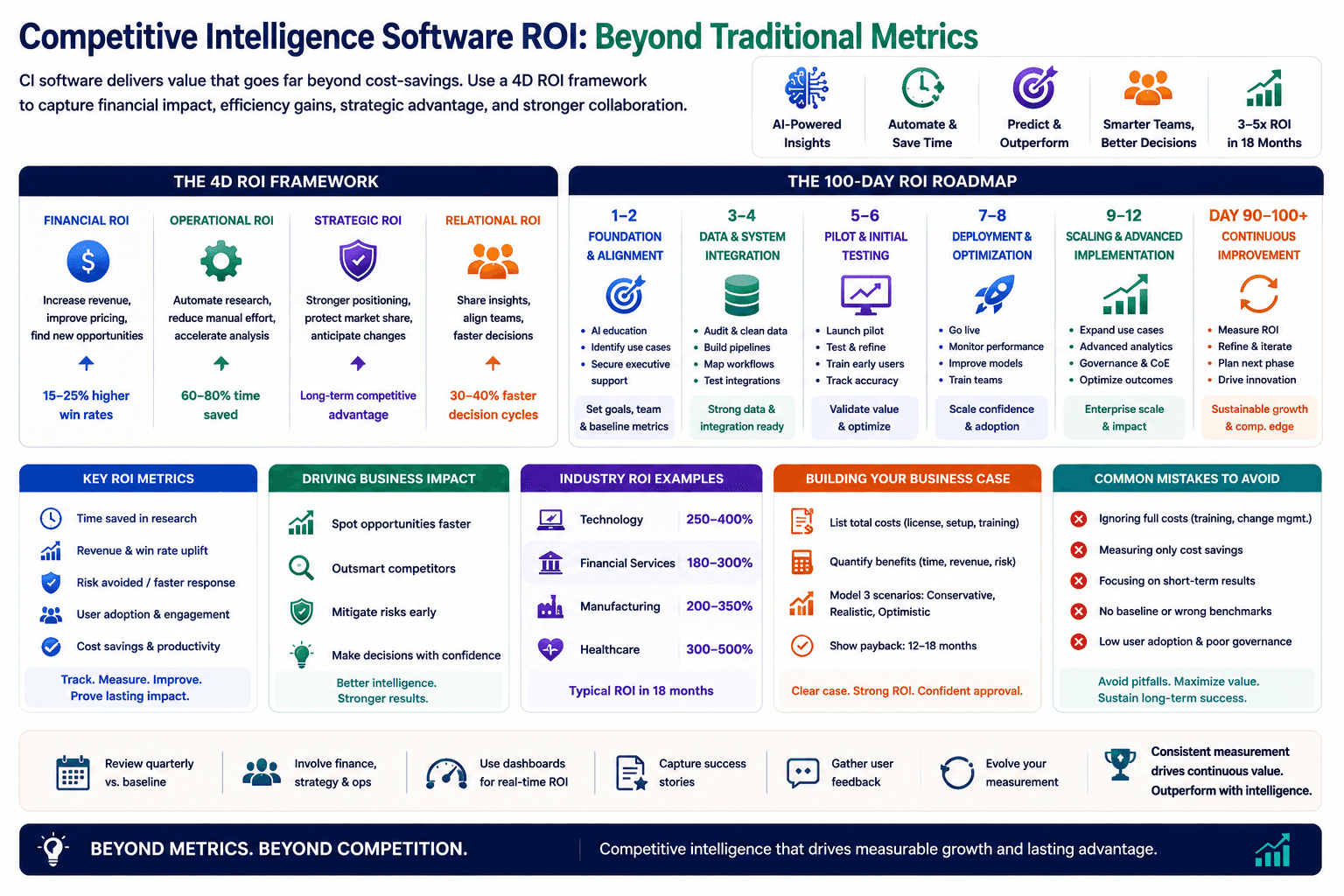
When calculating ROI for competitive intelligence software, it's essential to look beyond mere cost-savings. The market has evolved significantly, with AI-powered tools now offering substantial business impact. These tools automate data collection, monitor markets in real-time, and provide predictive insights. CFOs should adopt frameworks that measure both tangible returns and strategic value. Traditional ROI methods often miss out on benefits like enhanced market awareness, quicker decision-making, and reduced competitive blind spots that modern CI platforms provide. For more on the strategic advantages of CI software, visit our Strategic Insights.
The Four-Dimensional ROI Framework for CI Software
CFOs require a comprehensive approach to assess the value of competitive intelligence software across four key dimensions:
Financial ROI: Increase revenue through improved pricing strategies and market opportunities. Learn more about Financial Metrics.
Operational ROI: Save time with automated data collection and analysis. Explore our Operational Efficiency resources.
Strategic ROI: Enhance long-term competitive positioning and protect market share. Check out our Strategic Planning page for insights.
Relational ROI: Foster collaboration across departments and improve decision-making. Discover how to enhance Team Collaboration.
This framework encompasses both obvious and subtle benefits that traditional methods often overlook.
Establishing Baseline Metrics Before Implementation
Accurate ROI calculation begins with setting clear baseline metrics. Track the time spent on manual competitor research, the frequency of market analysis reports, and decision-making speed. Record current costs for external research services, consultant fees, and employee hours dedicated to intelligence gathering. Measure existing win rates, pricing accuracy, and the time required to launch new products. These baseline metrics will enable you to assess improvements post-implementation of competitive intelligence software. For more on setting effective metrics, visit our Metrics Guide.
Operational ROI: Measuring Efficiency and Time Savings
Competitive intelligence software delivers immediate operational benefits by automating research tasks. Analysts typically spend most of their time gathering data, but CI automation allows them to focus more on analysis. Track time saved in monitoring competitors, generating reports, and collecting data. Calculate cost savings by multiplying reduced manual hours by employee wages. Most organizations cut research time by 60-80%, enabling teams to concentrate on strategic analysis. For more on maximizing efficiency, see our Efficiency Tools.
Financial ROI: Revenue Growth Through Better Market Intelligence
Competitive intelligence software enhances revenue by facilitating quicker market reactions and smarter decisions. Companies using CI tools often see a 15-25% increase in win rates through improved competitor analysis. Track metrics such as increased market share, faster product launches, and refined pricing strategies. Measure revenue impact by comparing performance before and after CI implementation. Many companies achieve a 3-5x ROI within 18 months by strengthening market position and identifying competitive advantages. Learn more about Revenue Growth Strategies.
Strategic ROI: Long-term Competitive Advantages
The use of competitive intelligence software extends beyond immediate financial gains, helping companies secure a robust market position over time. These tools enable businesses to anticipate industry changes, identify new threats, and exploit competitor weaknesses. This insight leads to better market planning and timing. Consequently, companies often experience stronger brand positioning, improved innovation, and enhanced market leadership within 2-3 years of use. For insights on long-term strategies, visit our Long-Term Planning.
Relational ROI: Better Decision-Making and Teamwork
Competitive intelligence software transforms team dynamics by disseminating market insights across departments. Sales teams access competitor pricing data, marketing learns about campaigns, and product development sees feature comparisons. This shared information reduces internal disagreements and accelerates decision-making. Organizations typically make strategic decisions 30-40% faster when departments utilize the same competitive intelligence platform, resulting in improved teamwork and reduced miscommunication costs. Explore our Team Dynamics resources for more information.
Industry-Specific ROI Calculations for CI Software
Different industries experience varying ROI from competitive intelligence software. Technology companies often achieve 250-400% ROI in 18 months by accelerating product launches and optimizing prices. Financial services firms focus on regulatory compliance and risk assessment, seeing 180-300% returns. Manufacturing companies leverage it for supply chain intelligence and market positioning, averaging 200-350% ROI. Healthcare organizations analyze the competitive landscape for drug development, achieving 300-500% returns over longer periods due to extended development cycles. For industry-specific insights, check our Industry Solutions.
Building the Business Case: Cost-Benefit Analysis Framework
To construct a compelling business case, employ a clear cost-benefit analysis. List all ownership costs: software licenses, setup, training, and maintenance. Demonstrate benefits with measurable metrics like time saved, revenue growth, and risk reduction. Create three scenarios: conservative (150% ROI), realistic (250% ROI), and optimistic (400% ROI). Calculate payback periods, typically 12-18 months for investments in competitive intelligence software. Present results with clear financial forecasts and strategic alignment to secure executive approval. For more on building a business case, visit our Business Case Development.
Measuring Productivity Gains from CI Automation
Competitive intelligence software enhances productivity by automating data collection and analysis. Analysts typically spend 75% of their time on manual research, but automation can reduce this to under 10%. Calculate ROI by measuring time savings: if an analyst saves 20 hours weekly at $75/hour, that's $78,000 annually per person. Track metrics like report generation speed, data processing time, and research cycle reduction. These improvements allow teams to focus on strategic analysis rather than data gathering. For more on productivity metrics, see our Productivity Measurement.
Risk Mitigation and Opportunity Identification Value
Competitive intelligence software aids in early risk detection and opportunity identification. Measure its value by estimating costs avoided from competitive threats, regulatory changes, or market shifts. For example, catching a competitor's pricing strategy early might prevent a 15% market share loss, saving millions in revenue. Track how quickly threats are detected, opportunities converted, and decisions responded to. Demonstrate the value of CI software by quantifying losses avoided from missed market entries or delayed product launches. Explore our Risk Management resources for further insights.
Implementation Costs vs. Long-term Returns
Sum up costs for software licenses, training, integration, and maintenance. Compare these to expected returns over 3-5 years. Most competitive intelligence software offers a positive ROI in 18-24 months by saving research time and improving decisions. Consider scalability as your team expands. Be mindful of hidden costs like data feeds and API integrations. Long-term returns typically grow as teams become more adept at using market intelligence tools. For more on implementation strategies, visit our Implementation Guide.
Key Performance Indicators for CI Software Success
Track specific metrics to assess the impact of competitive intelligence software. Monitor time saved in market research tasks, the accuracy of competitor analysis, and the speed of threat identification. Measure improvements in decision-making cycles and the success rates of strategic initiatives. Key indicators include gains in analyst productivity, report generation time, data quality scores, and user adoption rates. Set benchmarks for market coverage and alert response times. Regularly review KPIs to ensure your CI investment delivers measurable business value and guides future improvements. For KPI tracking tips, see our KPI Tracking.
Common ROI Calculation Mistakes to Avoid
CFOs sometimes overlook costs like training, integration, and change management. Don't focus solely on cost savings; consider revenue opportunities as well. Avoid using short-term metrics for long-term investments. Don't attribute all performance gains to CI software without considering other factors. Use company-specific baselines instead of generic industry benchmarks. Remember intangible benefits like improved decision-making and risk reduction. Measure actual usage and adoption, not just software deployment. For more on avoiding common pitfalls, visit our ROI Mistakes.
Creating a Sustainable CI ROI Measurement Program
Review CI software performance quarterly against baseline metrics. Form teams from finance, strategy, and operations to verify ROI calculations. Use automated dashboards to display real-time productivity gains and decision impacts. Document case studies of successful decisions with clear outcomes. Gather user feedback to capture qualitative benefits. Conduct annual assessments to adjust measurement frameworks as the CI software market and organizational needs evolve. For more on sustainable measurement practices, see our Sustainable Measurement.
Master competitive intelligence software market ROI with proven frameworks. CFO guide to measuring CI value beyond cost savings.
Competitive Intelligence Software ROI: Beyond Traditional Metrics
When calculating ROI for competitive intelligence software, it's essential to look beyond mere cost-savings. The market has evolved significantly, with AI-powered tools now offering substantial business impact. These tools automate data collection, monitor markets in real-time, and provide predictive insights. CFOs should adopt frameworks that measure both tangible returns and strategic value. Traditional ROI methods often miss out on benefits like enhanced market awareness, quicker decision-making, and reduced competitive blind spots that modern CI platforms provide. For more on the strategic advantages of CI software, visit our Strategic Insights.
The Four-Dimensional ROI Framework for CI Software
CFOs require a comprehensive approach to assess the value of competitive intelligence software across four key dimensions:
Financial ROI: Increase revenue through improved pricing strategies and market opportunities. Learn more about Financial Metrics.
Operational ROI: Save time with automated data collection and analysis. Explore our Operational Efficiency resources.
Strategic ROI: Enhance long-term competitive positioning and protect market share. Check out our Strategic Planning page for insights.
Relational ROI: Foster collaboration across departments and improve decision-making. Discover how to enhance Team Collaboration.
This framework encompasses both obvious and subtle benefits that traditional methods often overlook.
Establishing Baseline Metrics Before Implementation
Accurate ROI calculation begins with setting clear baseline metrics. Track the time spent on manual competitor research, the frequency of market analysis reports, and decision-making speed. Record current costs for external research services, consultant fees, and employee hours dedicated to intelligence gathering. Measure existing win rates, pricing accuracy, and the time required to launch new products. These baseline metrics will enable you to assess improvements post-implementation of competitive intelligence software. For more on setting effective metrics, visit our Metrics Guide.
Operational ROI: Measuring Efficiency and Time Savings
Competitive intelligence software delivers immediate operational benefits by automating research tasks. Analysts typically spend most of their time gathering data, but CI automation allows them to focus more on analysis. Track time saved in monitoring competitors, generating reports, and collecting data. Calculate cost savings by multiplying reduced manual hours by employee wages. Most organizations cut research time by 60-80%, enabling teams to concentrate on strategic analysis. For more on maximizing efficiency, see our Efficiency Tools.
Financial ROI: Revenue Growth Through Better Market Intelligence
Competitive intelligence software enhances revenue by facilitating quicker market reactions and smarter decisions. Companies using CI tools often see a 15-25% increase in win rates through improved competitor analysis. Track metrics such as increased market share, faster product launches, and refined pricing strategies. Measure revenue impact by comparing performance before and after CI implementation. Many companies achieve a 3-5x ROI within 18 months by strengthening market position and identifying competitive advantages. Learn more about Revenue Growth Strategies.
Strategic ROI: Long-term Competitive Advantages
The use of competitive intelligence software extends beyond immediate financial gains, helping companies secure a robust market position over time. These tools enable businesses to anticipate industry changes, identify new threats, and exploit competitor weaknesses. This insight leads to better market planning and timing. Consequently, companies often experience stronger brand positioning, improved innovation, and enhanced market leadership within 2-3 years of use. For insights on long-term strategies, visit our Long-Term Planning.
Relational ROI: Better Decision-Making and Teamwork
Competitive intelligence software transforms team dynamics by disseminating market insights across departments. Sales teams access competitor pricing data, marketing learns about campaigns, and product development sees feature comparisons. This shared information reduces internal disagreements and accelerates decision-making. Organizations typically make strategic decisions 30-40% faster when departments utilize the same competitive intelligence platform, resulting in improved teamwork and reduced miscommunication costs. Explore our Team Dynamics resources for more information.
Industry-Specific ROI Calculations for CI Software
Different industries experience varying ROI from competitive intelligence software. Technology companies often achieve 250-400% ROI in 18 months by accelerating product launches and optimizing prices. Financial services firms focus on regulatory compliance and risk assessment, seeing 180-300% returns. Manufacturing companies leverage it for supply chain intelligence and market positioning, averaging 200-350% ROI. Healthcare organizations analyze the competitive landscape for drug development, achieving 300-500% returns over longer periods due to extended development cycles. For industry-specific insights, check our Industry Solutions.
Building the Business Case: Cost-Benefit Analysis Framework
To construct a compelling business case, employ a clear cost-benefit analysis. List all ownership costs: software licenses, setup, training, and maintenance. Demonstrate benefits with measurable metrics like time saved, revenue growth, and risk reduction. Create three scenarios: conservative (150% ROI), realistic (250% ROI), and optimistic (400% ROI). Calculate payback periods, typically 12-18 months for investments in competitive intelligence software. Present results with clear financial forecasts and strategic alignment to secure executive approval. For more on building a business case, visit our Business Case Development.
Measuring Productivity Gains from CI Automation
Competitive intelligence software enhances productivity by automating data collection and analysis. Analysts typically spend 75% of their time on manual research, but automation can reduce this to under 10%. Calculate ROI by measuring time savings: if an analyst saves 20 hours weekly at $75/hour, that's $78,000 annually per person. Track metrics like report generation speed, data processing time, and research cycle reduction. These improvements allow teams to focus on strategic analysis rather than data gathering. For more on productivity metrics, see our Productivity Measurement.
Risk Mitigation and Opportunity Identification Value
Competitive intelligence software aids in early risk detection and opportunity identification. Measure its value by estimating costs avoided from competitive threats, regulatory changes, or market shifts. For example, catching a competitor's pricing strategy early might prevent a 15% market share loss, saving millions in revenue. Track how quickly threats are detected, opportunities converted, and decisions responded to. Demonstrate the value of CI software by quantifying losses avoided from missed market entries or delayed product launches. Explore our Risk Management resources for further insights.
Implementation Costs vs. Long-term Returns
Sum up costs for software licenses, training, integration, and maintenance. Compare these to expected returns over 3-5 years. Most competitive intelligence software offers a positive ROI in 18-24 months by saving research time and improving decisions. Consider scalability as your team expands. Be mindful of hidden costs like data feeds and API integrations. Long-term returns typically grow as teams become more adept at using market intelligence tools. For more on implementation strategies, visit our Implementation Guide.
Key Performance Indicators for CI Software Success
Track specific metrics to assess the impact of competitive intelligence software. Monitor time saved in market research tasks, the accuracy of competitor analysis, and the speed of threat identification. Measure improvements in decision-making cycles and the success rates of strategic initiatives. Key indicators include gains in analyst productivity, report generation time, data quality scores, and user adoption rates. Set benchmarks for market coverage and alert response times. Regularly review KPIs to ensure your CI investment delivers measurable business value and guides future improvements. For KPI tracking tips, see our KPI Tracking.
Common ROI Calculation Mistakes to Avoid
CFOs sometimes overlook costs like training, integration, and change management. Don't focus solely on cost savings; consider revenue opportunities as well. Avoid using short-term metrics for long-term investments. Don't attribute all performance gains to CI software without considering other factors. Use company-specific baselines instead of generic industry benchmarks. Remember intangible benefits like improved decision-making and risk reduction. Measure actual usage and adoption, not just software deployment. For more on avoiding common pitfalls, visit our ROI Mistakes.
Creating a Sustainable CI ROI Measurement Program
Review CI software performance quarterly against baseline metrics. Form teams from finance, strategy, and operations to verify ROI calculations. Use automated dashboards to display real-time productivity gains and decision impacts. Document case studies of successful decisions with clear outcomes. Gather user feedback to capture qualitative benefits. Conduct annual assessments to adjust measurement frameworks as the CI software market and organizational needs evolve. For more on sustainable measurement practices, see our Sustainable Measurement.
บล็อกอื่น ๆ
บล็อกอื่น ๆ
ตรวจสอบบล็อกโครงการอื่น ๆ ของเราที่มีข้อมูลเชิงลึกและข้อมูลที่เป็นประโยชน์สำหรับธุรกิจของคุณ
บล็อกอื่น ๆ
บล็อกอื่น ๆ
ตรวจสอบบล็อกโครงการอื่น ๆ ของเราที่มีข้อมูลเชิงลึกและข้อมูลที่เป็นประโยชน์สำหรับธุรกิจของคุณ