Our Three Step Process
22 พฤษภาคม 2569
Google Algorithm Updates 2026: SEO Recovery Guide & Best Practices
Our Three Step Process
22 พฤษภาคม 2569
Google Algorithm Updates 2026: SEO Recovery Guide & Best Practices
Complete guide to recovering from Google algorithm updates. Learn SEO strategies, content optimization, and technical fixes for 2026.
Understanding Google Algorithm Updates and Their Impact
Google frequently updates its search algorithms, with major changes occurring every few months. These updates, such as those in March 2026 and December 2025, focus on content quality, user experience, and trustworthiness, rewarding helpful, people-first content while lowering the rank of thin or AI-generated content. If your rankings drop, it's likely because your content doesn't align with user expectations, not due to a penalty. Understanding this can guide your improvement efforts. For more on content quality, check our Content Quality Assessment and Recovery section.
Immediate Response Strategy When Rankings Drop
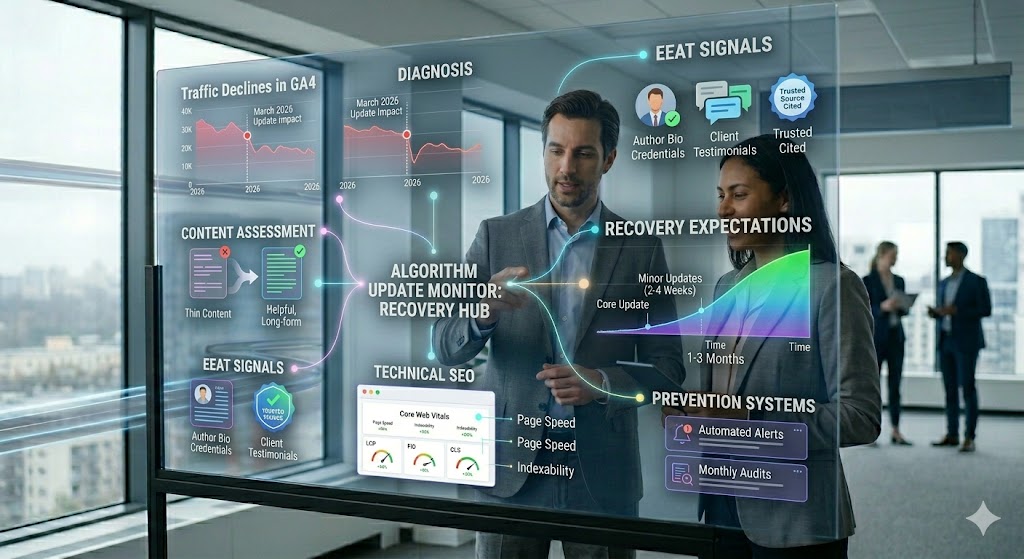
When you notice a drop in rankings, resist the urge to make immediate changes. First, check Google's Search Status Dashboard to confirm the update's completion. Wait a week before analyzing your data in Google Search Console and GA4. Look for declines in impressions, clicks, and keyword positions around update dates. Monitor traffic patterns for 2-3 weeks to determine if changes are temporary or due to the algorithm. Document which pages lost rankings and by how much to guide your recovery strategy. For a deeper dive into recovery tactics, visit our Technical SEO Recovery Tactics page.
Diagnosing Algorithm Update Damage
Use Google Search Console to identify pages that lost visibility. Compare traffic before and after the update, noting sudden drops in impressions and clicks across keywords. Employ rank tracking tools to observe changes in target term positions. Identify patterns in affected pages—consider content type, topic, or format similarities. Determine if drops occurred site-wide or in specific areas, helping you address content quality, technical problems, or EEAT issues. For more on improving your site's credibility, see our Building Long-term Resilience section.
Content Quality Assessment and Recovery
Assess your content for detail, accuracy, and user value. Remove pages with little information or combine similar content into comprehensive resources. Update outdated information with current data and new insights. Analyze user search intent with target keywords to understand their needs. Incorporate personal experiences, case studies, and unique insights. Ensure each page answers questions clearly with practical advice. Quality content that truly helps users will recover more quickly from algorithm changes. For additional strategies, refer to our Monitoring and Prevention Systems guide.
Technical SEO Recovery Tactics
Address technical issues that may exacerbate algorithm update effects. Focus on Core Web Vitals like page speed, mobile responsiveness, and layout stability. Resolve crawling errors in Google Search Console and ensure important pages are indexed. Optimize internal linking to distribute page authority effectively. Check for duplicate content and use canonical tags correctly. Improve site architecture for easier navigation. Fix broken links and redirect chains to enhance user experience, supporting content quality and speeding up recovery. For more insights on user experience, visit our User Experience Optimization Post-Update section.
Building Long-term Resilience
Enhance Experience, Expertise, Authoritativeness, and Trustworthiness to adapt to algorithm changes. Include detailed author bios with credentials and work history. Create thorough About and Contact pages with real business info. Cite trusted sources and original research. Display customer testimonials, case studies, and awards prominently. Link to social media profiles and professional networks. Regularly update content and display publication dates. Gain mentions on respected industry websites to bolster your site's credibility and expertise. For examples of successful recovery, check our Case Studies: Successful Recovery Examples.
Backlink Profile Cleanup and Recovery
Review your backlink profile with tools like Google Search Console to identify harmful links from spammy sites. Create a disavow file for these bad links to avoid penalties. Aim for quality links by guest posting on respected sites, creating valuable content, and networking with industry leaders. Remove or replace poor directory submissions and paid links. Monitor new backlinks to prevent future issues and maintain a clean profile. For tools to assist in this process, see our Tools and Resources for Recovery section.
User Experience Optimization Post-Update
Google emphasizes user experience in ranking content. Focus on improving Core Web Vitals like page loading speed, interactivity, and visual stability. Ensure your site performs well on mobile devices, as mobile-first indexing is crucial. Simplify navigation to retain visitors and reduce bounce rates. Use clear calls-to-action and improve readability with good formatting, headers, and white space. Analyze user behavior with Google Analytics to identify pages needing UX improvements for better search performance. For a comprehensive approach to SEO strategies, visit our Building Strong SEO Strategies page.
Recovery Timeline Expectations
Recovery from Google algorithm updates varies. Minor updates may show improvement in 2-4 weeks after changes. Core updates often take longer, typically 1-3 months or more. Recovery speed depends on how quickly you address content quality, technical issues, and EEAT signals. Some sites improve gradually, while others experience a sudden return in rankings. Monitor progress weekly with Google Search Console and avoid hasty changes during this period. For ongoing monitoring strategies, refer to our Monitoring and Prevention Systems.
Building Strong SEO Strategies
Develop robust SEO strategies by focusing on content that solves real problems. Diversify traffic sources with email, social media, and direct visits, not just Google. Establish expertise by thoroughly covering topics and publishing high-quality content regularly. Build relationships with industry experts for natural link building. Monitor competitors and adjust plans as needed. Maintain strong technical SEO with regular checks. Prioritize user satisfaction metrics like time spent on your site and engagement rates. For more on user experience, see our User Experience Optimization Post-Update.
Monitoring and Prevention Systems
Set up Google Search Console alerts to track ranking changes and indexing issues. Use SEO tools like SEMrush or Ahrefs to monitor keyword positions daily. Create automated reports for organic traffic patterns. Follow Google's official channels and SEO news sources for update announcements. Establish baseline metrics before updates occur. Monitor competitor performance during algorithm changes. Set up Core Web Vitals tracking through PageSpeed Insights. Conduct monthly content audits to catch quality issues early. Document all SEO changes to correlate with traffic fluctuations for future reference. For tools to assist in this process, see our Tools and Resources for Recovery.
Case Studies: Successful Recovery Examples
A health website rebounded from a June 2025 core update by adding medical professional bylines and citing peer-reviewed studies, regaining 80% of their traffic in three months. An e-commerce site faced spam penalties but recovered in two months by removing 15,000 low-quality product pages and consolidating similar content. A local business blog improved EEAT by highlighting owner credentials and customer testimonials, recovering from helpful content penalties in six weeks by creating authentic, experience-based content. For more insights on recovery strategies, check our Content Quality Assessment and Recovery section.
Tools and Resources for Recovery
Utilize Google Search Console to track ranking changes and identify technical issues. SEMrush and Ahrefs assist in monitoring keyword positions and backlink quality. Screaming Frog aids in technical audits. PageSpeed Insights measures Core Web Vitals improvements. Google Analytics 4 tracks traffic patterns and user behavior changes. Stay informed on algorithm updates through Search Engine Journal, Search Engine Land, and Google's official channels. Set up automated alerts for ranking changes to respond quickly. For ongoing monitoring strategies, refer to our Monitoring and Prevention Systems.
Future-Proofing Your SEO Strategy
Strengthen your SEO by prioritizing user-focused content over gaming algorithms. Leverage email marketing, social media, and direct visits for diverse traffic sources. Regularly audit content and remove low-quality pages. Enhance EEAT signals by showcasing author credentials and expert sources. Monitor competitors and industry trends. Create evergreen content that remains valuable over time. Develop internal links that support topic authority. Adhere to Google's guidelines and webmaster tips for steady, long-term growth. For more on building strong SEO strategies, visit our Building Strong SEO Strategies page.
Complete guide to recovering from Google algorithm updates. Learn SEO strategies, content optimization, and technical fixes for 2026.
Understanding Google Algorithm Updates and Their Impact
Google frequently updates its search algorithms, with major changes occurring every few months. These updates, such as those in March 2026 and December 2025, focus on content quality, user experience, and trustworthiness, rewarding helpful, people-first content while lowering the rank of thin or AI-generated content. If your rankings drop, it's likely because your content doesn't align with user expectations, not due to a penalty. Understanding this can guide your improvement efforts. For more on content quality, check our Content Quality Assessment and Recovery section.
Immediate Response Strategy When Rankings Drop
When you notice a drop in rankings, resist the urge to make immediate changes. First, check Google's Search Status Dashboard to confirm the update's completion. Wait a week before analyzing your data in Google Search Console and GA4. Look for declines in impressions, clicks, and keyword positions around update dates. Monitor traffic patterns for 2-3 weeks to determine if changes are temporary or due to the algorithm. Document which pages lost rankings and by how much to guide your recovery strategy. For a deeper dive into recovery tactics, visit our Technical SEO Recovery Tactics page.
Diagnosing Algorithm Update Damage
Use Google Search Console to identify pages that lost visibility. Compare traffic before and after the update, noting sudden drops in impressions and clicks across keywords. Employ rank tracking tools to observe changes in target term positions. Identify patterns in affected pages—consider content type, topic, or format similarities. Determine if drops occurred site-wide or in specific areas, helping you address content quality, technical problems, or EEAT issues. For more on improving your site's credibility, see our Building Long-term Resilience section.
Content Quality Assessment and Recovery
Assess your content for detail, accuracy, and user value. Remove pages with little information or combine similar content into comprehensive resources. Update outdated information with current data and new insights. Analyze user search intent with target keywords to understand their needs. Incorporate personal experiences, case studies, and unique insights. Ensure each page answers questions clearly with practical advice. Quality content that truly helps users will recover more quickly from algorithm changes. For additional strategies, refer to our Monitoring and Prevention Systems guide.
Technical SEO Recovery Tactics
Address technical issues that may exacerbate algorithm update effects. Focus on Core Web Vitals like page speed, mobile responsiveness, and layout stability. Resolve crawling errors in Google Search Console and ensure important pages are indexed. Optimize internal linking to distribute page authority effectively. Check for duplicate content and use canonical tags correctly. Improve site architecture for easier navigation. Fix broken links and redirect chains to enhance user experience, supporting content quality and speeding up recovery. For more insights on user experience, visit our User Experience Optimization Post-Update section.
Building Long-term Resilience
Enhance Experience, Expertise, Authoritativeness, and Trustworthiness to adapt to algorithm changes. Include detailed author bios with credentials and work history. Create thorough About and Contact pages with real business info. Cite trusted sources and original research. Display customer testimonials, case studies, and awards prominently. Link to social media profiles and professional networks. Regularly update content and display publication dates. Gain mentions on respected industry websites to bolster your site's credibility and expertise. For examples of successful recovery, check our Case Studies: Successful Recovery Examples.
Backlink Profile Cleanup and Recovery
Review your backlink profile with tools like Google Search Console to identify harmful links from spammy sites. Create a disavow file for these bad links to avoid penalties. Aim for quality links by guest posting on respected sites, creating valuable content, and networking with industry leaders. Remove or replace poor directory submissions and paid links. Monitor new backlinks to prevent future issues and maintain a clean profile. For tools to assist in this process, see our Tools and Resources for Recovery section.
User Experience Optimization Post-Update
Google emphasizes user experience in ranking content. Focus on improving Core Web Vitals like page loading speed, interactivity, and visual stability. Ensure your site performs well on mobile devices, as mobile-first indexing is crucial. Simplify navigation to retain visitors and reduce bounce rates. Use clear calls-to-action and improve readability with good formatting, headers, and white space. Analyze user behavior with Google Analytics to identify pages needing UX improvements for better search performance. For a comprehensive approach to SEO strategies, visit our Building Strong SEO Strategies page.
Recovery Timeline Expectations
Recovery from Google algorithm updates varies. Minor updates may show improvement in 2-4 weeks after changes. Core updates often take longer, typically 1-3 months or more. Recovery speed depends on how quickly you address content quality, technical issues, and EEAT signals. Some sites improve gradually, while others experience a sudden return in rankings. Monitor progress weekly with Google Search Console and avoid hasty changes during this period. For ongoing monitoring strategies, refer to our Monitoring and Prevention Systems.
Building Strong SEO Strategies
Develop robust SEO strategies by focusing on content that solves real problems. Diversify traffic sources with email, social media, and direct visits, not just Google. Establish expertise by thoroughly covering topics and publishing high-quality content regularly. Build relationships with industry experts for natural link building. Monitor competitors and adjust plans as needed. Maintain strong technical SEO with regular checks. Prioritize user satisfaction metrics like time spent on your site and engagement rates. For more on user experience, see our User Experience Optimization Post-Update.
Monitoring and Prevention Systems
Set up Google Search Console alerts to track ranking changes and indexing issues. Use SEO tools like SEMrush or Ahrefs to monitor keyword positions daily. Create automated reports for organic traffic patterns. Follow Google's official channels and SEO news sources for update announcements. Establish baseline metrics before updates occur. Monitor competitor performance during algorithm changes. Set up Core Web Vitals tracking through PageSpeed Insights. Conduct monthly content audits to catch quality issues early. Document all SEO changes to correlate with traffic fluctuations for future reference. For tools to assist in this process, see our Tools and Resources for Recovery.
Case Studies: Successful Recovery Examples
A health website rebounded from a June 2025 core update by adding medical professional bylines and citing peer-reviewed studies, regaining 80% of their traffic in three months. An e-commerce site faced spam penalties but recovered in two months by removing 15,000 low-quality product pages and consolidating similar content. A local business blog improved EEAT by highlighting owner credentials and customer testimonials, recovering from helpful content penalties in six weeks by creating authentic, experience-based content. For more insights on recovery strategies, check our Content Quality Assessment and Recovery section.
Tools and Resources for Recovery
Utilize Google Search Console to track ranking changes and identify technical issues. SEMrush and Ahrefs assist in monitoring keyword positions and backlink quality. Screaming Frog aids in technical audits. PageSpeed Insights measures Core Web Vitals improvements. Google Analytics 4 tracks traffic patterns and user behavior changes. Stay informed on algorithm updates through Search Engine Journal, Search Engine Land, and Google's official channels. Set up automated alerts for ranking changes to respond quickly. For ongoing monitoring strategies, refer to our Monitoring and Prevention Systems.
Future-Proofing Your SEO Strategy
Strengthen your SEO by prioritizing user-focused content over gaming algorithms. Leverage email marketing, social media, and direct visits for diverse traffic sources. Regularly audit content and remove low-quality pages. Enhance EEAT signals by showcasing author credentials and expert sources. Monitor competitors and industry trends. Create evergreen content that remains valuable over time. Develop internal links that support topic authority. Adhere to Google's guidelines and webmaster tips for steady, long-term growth. For more on building strong SEO strategies, visit our Building Strong SEO Strategies page.
บล็อกอื่น ๆ
บล็อกอื่น ๆ
ตรวจสอบบล็อกโครงการอื่น ๆ ของเราที่มีข้อมูลเชิงลึกและข้อมูลที่เป็นประโยชน์สำหรับธุรกิจของคุณ
บล็อกอื่น ๆ
บล็อกอื่น ๆ
ตรวจสอบบล็อกโครงการอื่น ๆ ของเราที่มีข้อมูลเชิงลึกและข้อมูลที่เป็นประโยชน์สำหรับธุรกิจของคุณ