Our Three Step Process
22 พฤษภาคม 2569
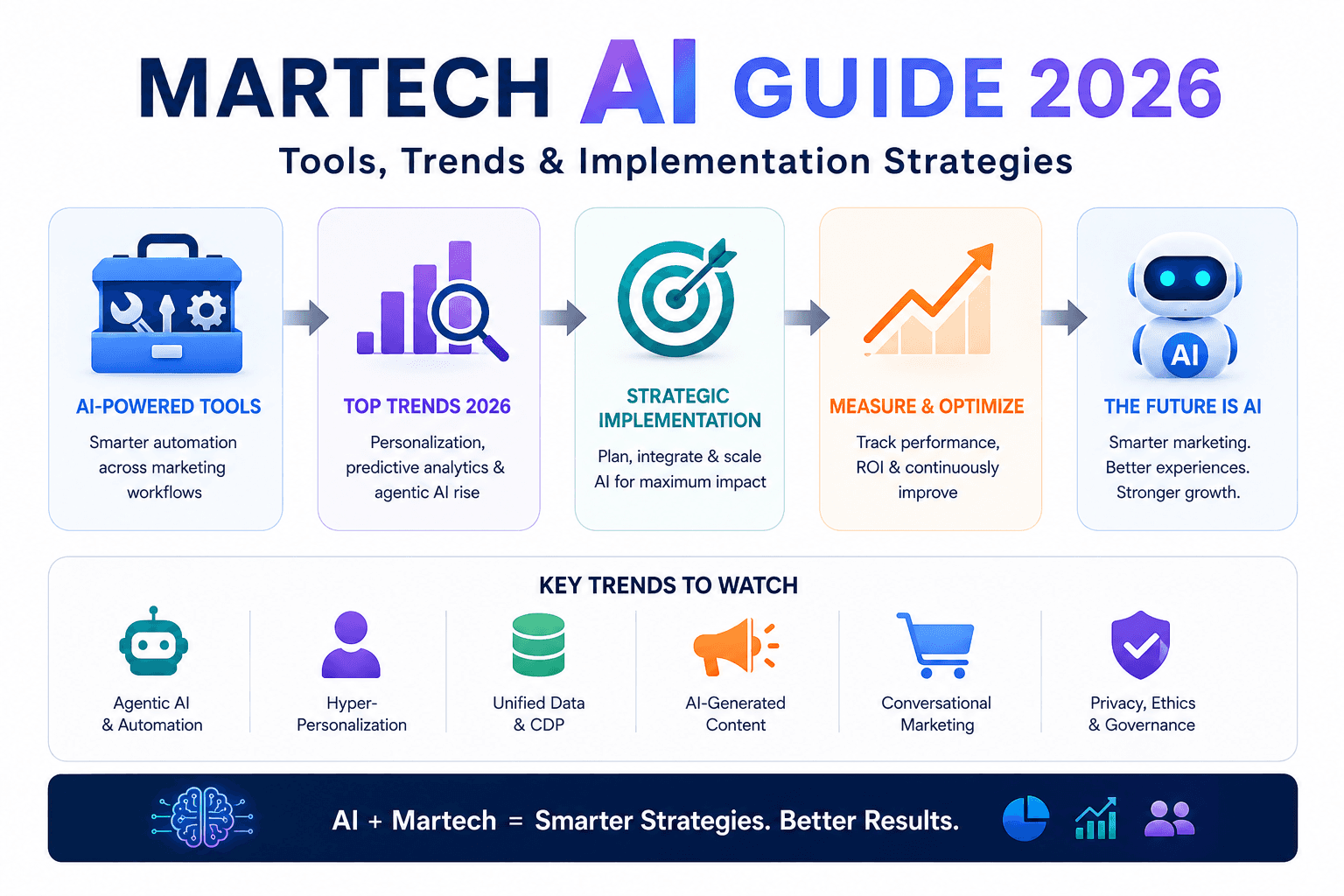
Martech AI Guide 2026: Tools, Trends & Implementation Strategies
Our Three Step Process
22 พฤษภาคม 2569
Martech AI Guide 2026: Tools, Trends & Implementation Strategies
Complete guide to martech AI in 2026. Discover AI marketing tools, implementation strategies, market trends, and privacy compliance.
AI's Current Impact on Marketing Technology
AI has fundamentally transformed marketing technology, elevating it from simple task automation to intelligent decision-making. Marketing teams now leverage AI to segment customers in real-time, predict trends, and customize content across platforms. Machine learning processes vast data sets to identify buying patterns, optimize ad spending, and forecast customer lifetime value. For more on how AI is reshaping marketing, check out our article on AI-Powered Marketing Tools for 2030.
In campaign management, AI dynamically adjusts bids, tests various ads, and personalizes messages based on user behavior. AI tools rapidly generate marketing copy, social media posts, and emails. Chatbots tackle complex inquiries, while recommendation engines enhance online sales. This AI-driven approach has made marketing more agile and data-centric, aligning closely with consumer preferences. Learn more about challenges in martech AI implementation to understand the hurdles organizations face.
The Five Martech Predictions That Became Reality
In 2020, experts forecasted five significant developments in martech by 2030. By 2026, these predictions have largely materialized. No Code Citizen Creators emerged as AI tools enabled marketers to craft campaigns without technical expertise. Platform Expansion and Cloud Integration accelerated, establishing cloud-based martech solutions as standard. The Martech Application Explosion doubled the number of tools, offering a plethora of specialized options. The shift From Big Data to Big Operations emphasized data management and decision-making over mere collection. Human-Machine Marketing Harmony became a reality, with AI assisting marketers and automating buyer-side tasks. These advancements have transformed theoretical concepts into practical applications, reshaping daily marketing operations. For insights on market growth, visit our page on Market Growth and Investment Opportunities.
AI-Powered Marketing Tools for 2030
By 2030, leading marketing teams will integrate five core AI tools into their workflows. Conversational AI Assistants will manage tasks like audience building and campaign briefing through intuitive chat interfaces. Unified Data and Identity Resolution will connect all customer interactions, providing real-time behavioral data for AI models while safeguarding privacy. Generative Content with Smart Guardrails will automate personalized marketing content creation, ensuring brand consistency and local relevance. Autonomous Campaign Orchestration will manage personalized message timing and conduct ongoing multi-channel tests. AI Governance and Transparency will ensure responsible AI use with bias checks, audit trails, and regulatory compliance. These tools will operate cohesively rather than as isolated components. For a deeper dive into the tools shaping the future, explore our section on Key Players Shaping the Martech AI Landscape.
Market Growth and Investment Opportunities
The martech AI sector presents robust investment opportunities. The market is projected to grow from $175.95 billion in 2025 to $296.88 billion by 2030, with an annual growth rate of 11.0%. This expansion is driven by AI integration, Customer Data Platforms, and digital transformations across industries.
Key investment areas include:
Generative AI platforms for personalized campaigns
Customer Data Platforms for comprehensive customer insights
Automation tools for streamlining marketing workflows
Real-time targeting solutions for retail and e-commerce
In 2024, the martech landscape expanded by 27.8%. Leading companies like Salesforce, HubSpot, and Adobe spearhead AI solutions. Demand for advanced martech AI tools is surging, particularly in retail, healthcare, and finance, where complex tasks require intelligent automation and personalization. For more on regional trends, see our article on Regional Martech AI Adoption Patterns.
Regional Martech AI Adoption Patterns
The Asia Pacific region leads in martech AI adoption and is poised for the fastest growth through 2030. China and India drive this momentum with digital innovations and mobile commerce. These markets prioritize AI for e-commerce and automated customer platforms.
North America maintains its leadership with strong adoption in retail and finance, utilizing advanced AI and analytics tools.
Europe emphasizes privacy-respecting martech AI, balancing personalization with data protection under GDPR guidelines.
Latin America and the Middle East are beginning to embrace martech AI, focusing on cost-effective tools for small businesses, with an emphasis on mobile-first solutions and social media automation. For insights on enterprise versus SMB needs, check out our page on Enterprise vs. SMB Martech AI Needs.
Enterprise vs. SMB Martech AI Needs
Large enterprises require sophisticated martech AI tools for extensive operations. They utilize advanced customer data systems, manage multiple channels, and enforce stringent AI governance. Investments are made in custom AI models, robust integration, and top-tier security.
Small and medium businesses seek affordable, user-friendly martech AI tools. They prefer all-in-one platforms with AI capabilities for tasks like email campaigns, social media scheduling, and basic customer segmentation. Cloud-based solutions that are easy to deploy are favored.
The primary distinction lies in complexity and customization. Large enterprises demand tailored AI solutions, while smaller businesses opt for ready-to-use tools. Both segments contribute to market growth, albeit with different adoption and spending patterns. For more on building a strategy, see our guide on Building Your 2030-Ready Martech AI Strategy.
Key Players Shaping the Martech AI Landscape
Major tech companies dominate the martech AI landscape with comprehensive platform offerings. Google excels with AI-driven advertising tools and analytics. Microsoft provides Azure-based marketing automation solutions. Salesforce enhances its Einstein AI features in customer relationship management and marketing clouds.
Adobe holds a strong position with its Experience Cloud and AI personalization tools. HubSpot offers user-friendly AI features for mid-market businesses, such as Campaign Assistant for content creation. Oracle and IBM deliver enterprise-level AI solutions for complex marketing tasks.
Emerging AI startups develop niche solutions for specific marketing needs. Larger platforms often acquire these startups, fostering innovation. This competitive landscape propels the development of smarter, more integrated martech AI tools for businesses of all sizes. For insights on privacy and compliance, visit our page on Privacy and Compliance in AI-Driven Marketing.
Challenges in Martech AI Implementation
Organizations encounter several challenges when implementing martech AI solutions. Data quality is a primary concern, as AI systems require clean, unified customer data from diverse sources. Many companies struggle with data silos that hinder effective AI training and utilization.
A lack of technical expertise is another barrier. Marketing teams often lack the skills to set up and optimize AI tools. Integrating new AI platforms with existing systems can be complex, leading to workflow disruptions.
Budget constraints also impact AI adoption, particularly for smaller businesses facing high costs. Privacy regulations introduce compliance challenges, necessitating careful data handling. Change management is crucial as teams may resist new AI processes. Organizations must plan, train, and adopt phased approaches to successfully deploy martech AI solutions. For more on overcoming these challenges, see our article on Challenges in Martech AI Implementation.
Privacy and Compliance in AI-Driven Marketing
Privacy laws like GDPR and CCPA impose stringent requirements on AI marketing systems. Companies must ensure AI respects customer consent and provides transparency in automated decisions.
When training AI models, collect only the necessary customer data to maintain AI effectiveness while respecting privacy. Consent management systems should integrate with AI tools to efficiently handle opt-out requests.
Cross-border data transfers for AI necessitate legal scrutiny. Companies face challenges when AI-driven marketing decisions impact customer rights. Regularly audit AI algorithms to identify and rectify bias or discrimination.
Incorporate privacy into AI marketing systems from the outset. Employ data encryption, access controls, and document AI decisions clearly to ensure compliance and build customer trust. For a comprehensive overview, refer to our guide on Building Your 2030-Ready Martech AI Strategy.
Building Your 2030-Ready Martech AI Strategy
Begin by assessing your current data infrastructure and identifying gaps in customer data collection. Invest in platforms with integrated AI capabilities. Focus on connecting customer interactions to establish a single source of truth for AI models.
Select martech vendors based on their AI roadmaps and integration capabilities. Choose tools that offer transparent AI decision-making and compliance features. Train your marketing team on AI tools and conversational data querying.
Start with small projects in content creation and audience segmentation, then expand to automated campaign management. Establish clear AI usage guidelines and monitor for bias. Plan for continuous AI model training and data quality improvement.
Treat AI as a foundational component of your infrastructure, not merely an add-on to your marketing processes. For further insights, explore our article on Key Players Shaping the Martech AI Landscape.
Complete guide to martech AI in 2026. Discover AI marketing tools, implementation strategies, market trends, and privacy compliance.
AI's Current Impact on Marketing Technology
AI has fundamentally transformed marketing technology, elevating it from simple task automation to intelligent decision-making. Marketing teams now leverage AI to segment customers in real-time, predict trends, and customize content across platforms. Machine learning processes vast data sets to identify buying patterns, optimize ad spending, and forecast customer lifetime value. For more on how AI is reshaping marketing, check out our article on AI-Powered Marketing Tools for 2030.
In campaign management, AI dynamically adjusts bids, tests various ads, and personalizes messages based on user behavior. AI tools rapidly generate marketing copy, social media posts, and emails. Chatbots tackle complex inquiries, while recommendation engines enhance online sales. This AI-driven approach has made marketing more agile and data-centric, aligning closely with consumer preferences. Learn more about challenges in martech AI implementation to understand the hurdles organizations face.
The Five Martech Predictions That Became Reality
In 2020, experts forecasted five significant developments in martech by 2030. By 2026, these predictions have largely materialized. No Code Citizen Creators emerged as AI tools enabled marketers to craft campaigns without technical expertise. Platform Expansion and Cloud Integration accelerated, establishing cloud-based martech solutions as standard. The Martech Application Explosion doubled the number of tools, offering a plethora of specialized options. The shift From Big Data to Big Operations emphasized data management and decision-making over mere collection. Human-Machine Marketing Harmony became a reality, with AI assisting marketers and automating buyer-side tasks. These advancements have transformed theoretical concepts into practical applications, reshaping daily marketing operations. For insights on market growth, visit our page on Market Growth and Investment Opportunities.
AI-Powered Marketing Tools for 2030
By 2030, leading marketing teams will integrate five core AI tools into their workflows. Conversational AI Assistants will manage tasks like audience building and campaign briefing through intuitive chat interfaces. Unified Data and Identity Resolution will connect all customer interactions, providing real-time behavioral data for AI models while safeguarding privacy. Generative Content with Smart Guardrails will automate personalized marketing content creation, ensuring brand consistency and local relevance. Autonomous Campaign Orchestration will manage personalized message timing and conduct ongoing multi-channel tests. AI Governance and Transparency will ensure responsible AI use with bias checks, audit trails, and regulatory compliance. These tools will operate cohesively rather than as isolated components. For a deeper dive into the tools shaping the future, explore our section on Key Players Shaping the Martech AI Landscape.
Market Growth and Investment Opportunities
The martech AI sector presents robust investment opportunities. The market is projected to grow from $175.95 billion in 2025 to $296.88 billion by 2030, with an annual growth rate of 11.0%. This expansion is driven by AI integration, Customer Data Platforms, and digital transformations across industries.
Key investment areas include:
Generative AI platforms for personalized campaigns
Customer Data Platforms for comprehensive customer insights
Automation tools for streamlining marketing workflows
Real-time targeting solutions for retail and e-commerce
In 2024, the martech landscape expanded by 27.8%. Leading companies like Salesforce, HubSpot, and Adobe spearhead AI solutions. Demand for advanced martech AI tools is surging, particularly in retail, healthcare, and finance, where complex tasks require intelligent automation and personalization. For more on regional trends, see our article on Regional Martech AI Adoption Patterns.
Regional Martech AI Adoption Patterns
The Asia Pacific region leads in martech AI adoption and is poised for the fastest growth through 2030. China and India drive this momentum with digital innovations and mobile commerce. These markets prioritize AI for e-commerce and automated customer platforms.
North America maintains its leadership with strong adoption in retail and finance, utilizing advanced AI and analytics tools.
Europe emphasizes privacy-respecting martech AI, balancing personalization with data protection under GDPR guidelines.
Latin America and the Middle East are beginning to embrace martech AI, focusing on cost-effective tools for small businesses, with an emphasis on mobile-first solutions and social media automation. For insights on enterprise versus SMB needs, check out our page on Enterprise vs. SMB Martech AI Needs.
Enterprise vs. SMB Martech AI Needs
Large enterprises require sophisticated martech AI tools for extensive operations. They utilize advanced customer data systems, manage multiple channels, and enforce stringent AI governance. Investments are made in custom AI models, robust integration, and top-tier security.
Small and medium businesses seek affordable, user-friendly martech AI tools. They prefer all-in-one platforms with AI capabilities for tasks like email campaigns, social media scheduling, and basic customer segmentation. Cloud-based solutions that are easy to deploy are favored.
The primary distinction lies in complexity and customization. Large enterprises demand tailored AI solutions, while smaller businesses opt for ready-to-use tools. Both segments contribute to market growth, albeit with different adoption and spending patterns. For more on building a strategy, see our guide on Building Your 2030-Ready Martech AI Strategy.
Key Players Shaping the Martech AI Landscape
Major tech companies dominate the martech AI landscape with comprehensive platform offerings. Google excels with AI-driven advertising tools and analytics. Microsoft provides Azure-based marketing automation solutions. Salesforce enhances its Einstein AI features in customer relationship management and marketing clouds.
Adobe holds a strong position with its Experience Cloud and AI personalization tools. HubSpot offers user-friendly AI features for mid-market businesses, such as Campaign Assistant for content creation. Oracle and IBM deliver enterprise-level AI solutions for complex marketing tasks.
Emerging AI startups develop niche solutions for specific marketing needs. Larger platforms often acquire these startups, fostering innovation. This competitive landscape propels the development of smarter, more integrated martech AI tools for businesses of all sizes. For insights on privacy and compliance, visit our page on Privacy and Compliance in AI-Driven Marketing.
Challenges in Martech AI Implementation
Organizations encounter several challenges when implementing martech AI solutions. Data quality is a primary concern, as AI systems require clean, unified customer data from diverse sources. Many companies struggle with data silos that hinder effective AI training and utilization.
A lack of technical expertise is another barrier. Marketing teams often lack the skills to set up and optimize AI tools. Integrating new AI platforms with existing systems can be complex, leading to workflow disruptions.
Budget constraints also impact AI adoption, particularly for smaller businesses facing high costs. Privacy regulations introduce compliance challenges, necessitating careful data handling. Change management is crucial as teams may resist new AI processes. Organizations must plan, train, and adopt phased approaches to successfully deploy martech AI solutions. For more on overcoming these challenges, see our article on Challenges in Martech AI Implementation.
Privacy and Compliance in AI-Driven Marketing
Privacy laws like GDPR and CCPA impose stringent requirements on AI marketing systems. Companies must ensure AI respects customer consent and provides transparency in automated decisions.
When training AI models, collect only the necessary customer data to maintain AI effectiveness while respecting privacy. Consent management systems should integrate with AI tools to efficiently handle opt-out requests.
Cross-border data transfers for AI necessitate legal scrutiny. Companies face challenges when AI-driven marketing decisions impact customer rights. Regularly audit AI algorithms to identify and rectify bias or discrimination.
Incorporate privacy into AI marketing systems from the outset. Employ data encryption, access controls, and document AI decisions clearly to ensure compliance and build customer trust. For a comprehensive overview, refer to our guide on Building Your 2030-Ready Martech AI Strategy.
Building Your 2030-Ready Martech AI Strategy
Begin by assessing your current data infrastructure and identifying gaps in customer data collection. Invest in platforms with integrated AI capabilities. Focus on connecting customer interactions to establish a single source of truth for AI models.
Select martech vendors based on their AI roadmaps and integration capabilities. Choose tools that offer transparent AI decision-making and compliance features. Train your marketing team on AI tools and conversational data querying.
Start with small projects in content creation and audience segmentation, then expand to automated campaign management. Establish clear AI usage guidelines and monitor for bias. Plan for continuous AI model training and data quality improvement.
Treat AI as a foundational component of your infrastructure, not merely an add-on to your marketing processes. For further insights, explore our article on Key Players Shaping the Martech AI Landscape.
บล็อกอื่น ๆ
บล็อกอื่น ๆ
ตรวจสอบบล็อกโครงการอื่น ๆ ของเราที่มีข้อมูลเชิงลึกและข้อมูลที่เป็นประโยชน์สำหรับธุรกิจของคุณ
บล็อกอื่น ๆ
บล็อกอื่น ๆ
ตรวจสอบบล็อกโครงการอื่น ๆ ของเราที่มีข้อมูลเชิงลึกและข้อมูลที่เป็นประโยชน์สำหรับธุรกิจของคุณ