Our Three Step Process
22 พฤษภาคม 2569
SEO vs PPC vs SEM: Complete Guide to Digital Marketing Channel Selection 2026
Our Three Step Process
22 พฤษภาคม 2569
SEO vs PPC vs SEM: Complete Guide to Digital Marketing Channel Selection 2026
Learn when to choose SEO, PPC, or SEM for your business. Compare costs, conversion rates, and ROI to optimize your digital marketing strategy.
AI's Impact on Digital Marketing Channel Selection
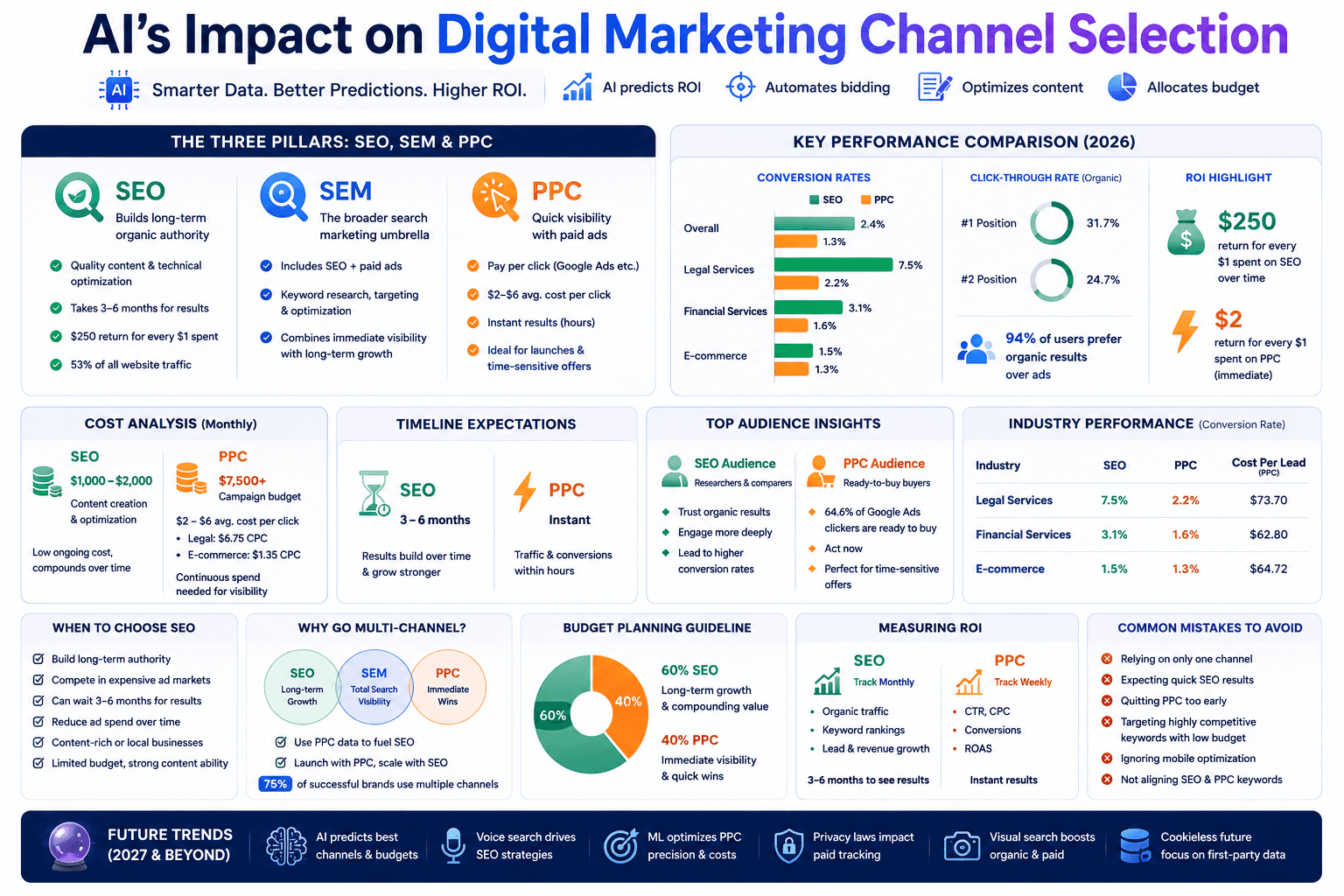
By 2026, AI has revolutionized how businesses select digital marketing channels such as SEO, SEM, and PPC. Machine learning now predicts which channels will yield the best ROI by analyzing industry data, competitor strategies, and user behavior. Automated bidding optimizes PPC campaigns in real-time, while AI-driven content tools accelerate SEO outcomes. Smart budgeting systems allocate resources across channels based on performance forecasts and conversion probabilities.
Understanding the Three Pillars: SEO, SEM, and PPC
SEO enhances a site's ranking in search results through content creation and technical optimization. SEM encompasses all search marketing efforts, both paid and unpaid. PPC involves paying for ads, where payment is made per click, such as with Google Ads. SEO builds authority over time, while PPC offers immediate visibility. SEM integrates both methods for a comprehensive search strategy.
SEO: Building Long-Term Organic Authority
SEO improves website rankings through quality content, keyword optimization, and technical adjustments. Although it requires time, typically 3-6 months, SEO provides substantial long-term value, with businesses earning $250 for every $1 spent. Organic search accounts for 53% of all website traffic, making it essential for sustained growth and trust-building.
SEM: The Broader Search Marketing Umbrella
SEM includes all strategies to enhance visibility on search engine results pages, combining organic SEO and paid ads. It involves keyword research, audience targeting, and performance optimization, merging immediate paid visibility with long-term organic growth for a robust search presence.
PPC: Quick Visibility with Paid Ads
PPC offers instant search visibility by placing ads above organic results, with costs ranging from $2 to $6 per click, depending on industry competition. For example, legal services average $6.75 per click, while e-commerce averages $1.35. PPC campaigns target specific demographics and regions, delivering results within hours, making it ideal for product launches and time-sensitive promotions.
Performance Metrics That Matter in 2026
SEO boasts a conversion rate of 2.4%, surpassing PPC's 1.3%. In legal services, SEO converts at 7.5% compared to PPC's 2.2%. Most users, 94%, prefer organic results over ads. A first-position organic listing achieves a 31.7% click-through rate, while the second position garners 24.7%. SEO provides a strong return, generating $250 for every dollar invested over time.
Cost Analysis: Budget Allocation Strategies
SEO typically costs between $1,000 and $2,000 monthly for content creation and optimization. PPC campaigns start at $7,500 monthly, with click costs ranging from $2 to $6. Legal services average $6.75 per click, while e-commerce clicks average $1.35. SEO requires an initial content investment but has low ongoing costs, whereas PPC demands continuous spending for visibility, necessitating careful budget planning for sustained campaigns.
Conversion Rates Across Different Channels
SEO generally has a higher conversion rate at 2.4% compared to PPC's 1.3%. In legal services, SEO converts at 7.5%, while PPC converts at 2.2%. Financial services see SEO converting at 3.1% versus PPC's 1.6%. In e-commerce, SEO and PPC show similar results, with SEO at 1.5% and PPC at 1.3%, making channel choice less critical for online retailers.
Timeline Expectations for Each Strategy
SEO requires 3-6 months to yield results, making it a long-term strategy. PPC provides immediate visibility, driving instant traffic and conversions. SEO's value grows over time as rankings improve with ongoing optimization, while PPC ceases to drive traffic once spending stops, making it a short-term approach.
Industry-Specific Performance Data
In legal services, SEO performs best, converting at 7.5%, while PPC converts at 2.2%. Financial services also favor SEO with a 2.2% conversion rate compared to PPC's 0.3%. E-commerce shows similar results for both, with SEO at 1.5% and PPC at 1.3%. The cost per lead varies: attorneys average $73.70, furniture $64.72, and insurance $62.80 through paid channels.
Target Audience Considerations
SEO appeals to buyers who research and compare options, trusting organic results and engaging more deeply, often leading to better conversion rates. PPC targets buyers ready to purchase, with 64.6% of Google Ads clickers prepared to buy. Understanding your audience's buying behavior helps in selecting the right channel for their decision-making and timing.
When to Choose SEO Over Paid Options
Opt for SEO if you aim to build long-term authority and compete in expensive ad markets. Choose SEO when you can wait 3-6 months for results, seek to reduce ad costs, or operate in fields where organic trust is crucial. It's ideal for content-rich businesses, local services, and companies with limited budgets but strong content creation capabilities.
The Case for an Integrated Multi-Channel Approach
Combining SEO, SEM, and PPC enhances visibility in search results. Use PPC data to identify high-converting keywords for SEO. Launch new products with PPC while building organic reach through SEO. This strategy captures immediate wins and supports long-term growth, with 75% of successful brands using multiple channels to effectively dominate search results.
Budget Planning Guidelines for Each Channel
Allocate $1,000-2,000 monthly for SEO content and optimization. Initiate PPC campaigns at around $7,500 monthly, with click costs ranging from $2 to $6. SEM budgets depend on keyword competition and industry specifics, such as legal services averaging $6.75 per click and e-commerce $1.35. Plan to allocate 60% of your budget to long-term SEO and 40% to PPC for immediate results to ensure balanced growth.
Measuring ROI Across Different Timeframes
SEO returns $250 for every $1 spent but requires 3-6 months to show results. PPC offers an immediate $2 return per $1 invested with instant visibility. Track PPC performance weekly using click-through rates and conversion data. Monitor SEO progress monthly through organic traffic growth and ranking improvements. Combine both metrics quarterly to assess overall search marketing effectiveness and adjust budget allocation.
Common Mistakes to Avoid
Relying on a single channel can limit growth. Some businesses expect quick SEO results or abandon PPC after a slow start. Avoid targeting highly competitive keywords without sufficient budget. Don't neglect mobile optimization for either strategy. Instead of halting campaigns during algorithm updates, adapt to the changes. Failing to align keyword strategies between SEO and PPC can squander opportunities for data sharing and improved results.
Future Trends Shaping Channel Selection
By 2027, AI will further transform how businesses choose between SEO, SEM, and PPC. Voice search will become crucial for SEO. Machine learning will enhance PPC precision and reduce costs. Privacy regulations will impact paid ad tracking. Visual search will benefit both organic and paid strategies. Businesses must prepare for a future without cookies and focus on collecting their own data.
Learn when to choose SEO, PPC, or SEM for your business. Compare costs, conversion rates, and ROI to optimize your digital marketing strategy.
AI's Impact on Digital Marketing Channel Selection
By 2026, AI has revolutionized how businesses select digital marketing channels such as SEO, SEM, and PPC. Machine learning now predicts which channels will yield the best ROI by analyzing industry data, competitor strategies, and user behavior. Automated bidding optimizes PPC campaigns in real-time, while AI-driven content tools accelerate SEO outcomes. Smart budgeting systems allocate resources across channels based on performance forecasts and conversion probabilities.
Understanding the Three Pillars: SEO, SEM, and PPC
SEO enhances a site's ranking in search results through content creation and technical optimization. SEM encompasses all search marketing efforts, both paid and unpaid. PPC involves paying for ads, where payment is made per click, such as with Google Ads. SEO builds authority over time, while PPC offers immediate visibility. SEM integrates both methods for a comprehensive search strategy.
SEO: Building Long-Term Organic Authority
SEO improves website rankings through quality content, keyword optimization, and technical adjustments. Although it requires time, typically 3-6 months, SEO provides substantial long-term value, with businesses earning $250 for every $1 spent. Organic search accounts for 53% of all website traffic, making it essential for sustained growth and trust-building.
SEM: The Broader Search Marketing Umbrella
SEM includes all strategies to enhance visibility on search engine results pages, combining organic SEO and paid ads. It involves keyword research, audience targeting, and performance optimization, merging immediate paid visibility with long-term organic growth for a robust search presence.
PPC: Quick Visibility with Paid Ads
PPC offers instant search visibility by placing ads above organic results, with costs ranging from $2 to $6 per click, depending on industry competition. For example, legal services average $6.75 per click, while e-commerce averages $1.35. PPC campaigns target specific demographics and regions, delivering results within hours, making it ideal for product launches and time-sensitive promotions.
Performance Metrics That Matter in 2026
SEO boasts a conversion rate of 2.4%, surpassing PPC's 1.3%. In legal services, SEO converts at 7.5% compared to PPC's 2.2%. Most users, 94%, prefer organic results over ads. A first-position organic listing achieves a 31.7% click-through rate, while the second position garners 24.7%. SEO provides a strong return, generating $250 for every dollar invested over time.
Cost Analysis: Budget Allocation Strategies
SEO typically costs between $1,000 and $2,000 monthly for content creation and optimization. PPC campaigns start at $7,500 monthly, with click costs ranging from $2 to $6. Legal services average $6.75 per click, while e-commerce clicks average $1.35. SEO requires an initial content investment but has low ongoing costs, whereas PPC demands continuous spending for visibility, necessitating careful budget planning for sustained campaigns.
Conversion Rates Across Different Channels
SEO generally has a higher conversion rate at 2.4% compared to PPC's 1.3%. In legal services, SEO converts at 7.5%, while PPC converts at 2.2%. Financial services see SEO converting at 3.1% versus PPC's 1.6%. In e-commerce, SEO and PPC show similar results, with SEO at 1.5% and PPC at 1.3%, making channel choice less critical for online retailers.
Timeline Expectations for Each Strategy
SEO requires 3-6 months to yield results, making it a long-term strategy. PPC provides immediate visibility, driving instant traffic and conversions. SEO's value grows over time as rankings improve with ongoing optimization, while PPC ceases to drive traffic once spending stops, making it a short-term approach.
Industry-Specific Performance Data
In legal services, SEO performs best, converting at 7.5%, while PPC converts at 2.2%. Financial services also favor SEO with a 2.2% conversion rate compared to PPC's 0.3%. E-commerce shows similar results for both, with SEO at 1.5% and PPC at 1.3%. The cost per lead varies: attorneys average $73.70, furniture $64.72, and insurance $62.80 through paid channels.
Target Audience Considerations
SEO appeals to buyers who research and compare options, trusting organic results and engaging more deeply, often leading to better conversion rates. PPC targets buyers ready to purchase, with 64.6% of Google Ads clickers prepared to buy. Understanding your audience's buying behavior helps in selecting the right channel for their decision-making and timing.
When to Choose SEO Over Paid Options
Opt for SEO if you aim to build long-term authority and compete in expensive ad markets. Choose SEO when you can wait 3-6 months for results, seek to reduce ad costs, or operate in fields where organic trust is crucial. It's ideal for content-rich businesses, local services, and companies with limited budgets but strong content creation capabilities.
The Case for an Integrated Multi-Channel Approach
Combining SEO, SEM, and PPC enhances visibility in search results. Use PPC data to identify high-converting keywords for SEO. Launch new products with PPC while building organic reach through SEO. This strategy captures immediate wins and supports long-term growth, with 75% of successful brands using multiple channels to effectively dominate search results.
Budget Planning Guidelines for Each Channel
Allocate $1,000-2,000 monthly for SEO content and optimization. Initiate PPC campaigns at around $7,500 monthly, with click costs ranging from $2 to $6. SEM budgets depend on keyword competition and industry specifics, such as legal services averaging $6.75 per click and e-commerce $1.35. Plan to allocate 60% of your budget to long-term SEO and 40% to PPC for immediate results to ensure balanced growth.
Measuring ROI Across Different Timeframes
SEO returns $250 for every $1 spent but requires 3-6 months to show results. PPC offers an immediate $2 return per $1 invested with instant visibility. Track PPC performance weekly using click-through rates and conversion data. Monitor SEO progress monthly through organic traffic growth and ranking improvements. Combine both metrics quarterly to assess overall search marketing effectiveness and adjust budget allocation.
Common Mistakes to Avoid
Relying on a single channel can limit growth. Some businesses expect quick SEO results or abandon PPC after a slow start. Avoid targeting highly competitive keywords without sufficient budget. Don't neglect mobile optimization for either strategy. Instead of halting campaigns during algorithm updates, adapt to the changes. Failing to align keyword strategies between SEO and PPC can squander opportunities for data sharing and improved results.
Future Trends Shaping Channel Selection
By 2027, AI will further transform how businesses choose between SEO, SEM, and PPC. Voice search will become crucial for SEO. Machine learning will enhance PPC precision and reduce costs. Privacy regulations will impact paid ad tracking. Visual search will benefit both organic and paid strategies. Businesses must prepare for a future without cookies and focus on collecting their own data.
บล็อกอื่น ๆ
บล็อกอื่น ๆ
ตรวจสอบบล็อกโครงการอื่น ๆ ของเราที่มีข้อมูลเชิงลึกและข้อมูลที่เป็นประโยชน์สำหรับธุรกิจของคุณ
บล็อกอื่น ๆ
บล็อกอื่น ๆ
ตรวจสอบบล็อกโครงการอื่น ๆ ของเราที่มีข้อมูลเชิงลึกและข้อมูลที่เป็นประโยชน์สำหรับธุรกิจของคุณ