Our Three Step Process
21 พฤษภาคม 2569
Video Maker AI ROI: How to Measure Success & Performance in 2026
Our Three Step Process
21 พฤษภาคม 2569
Video Maker AI ROI: How to Measure Success & Performance in 2026
Learn how to measure ROI for video maker AI tools. Discover key metrics, cost analysis, and performance tracking methods for AI-generated videos.
How AI Has Changed Video Marketing
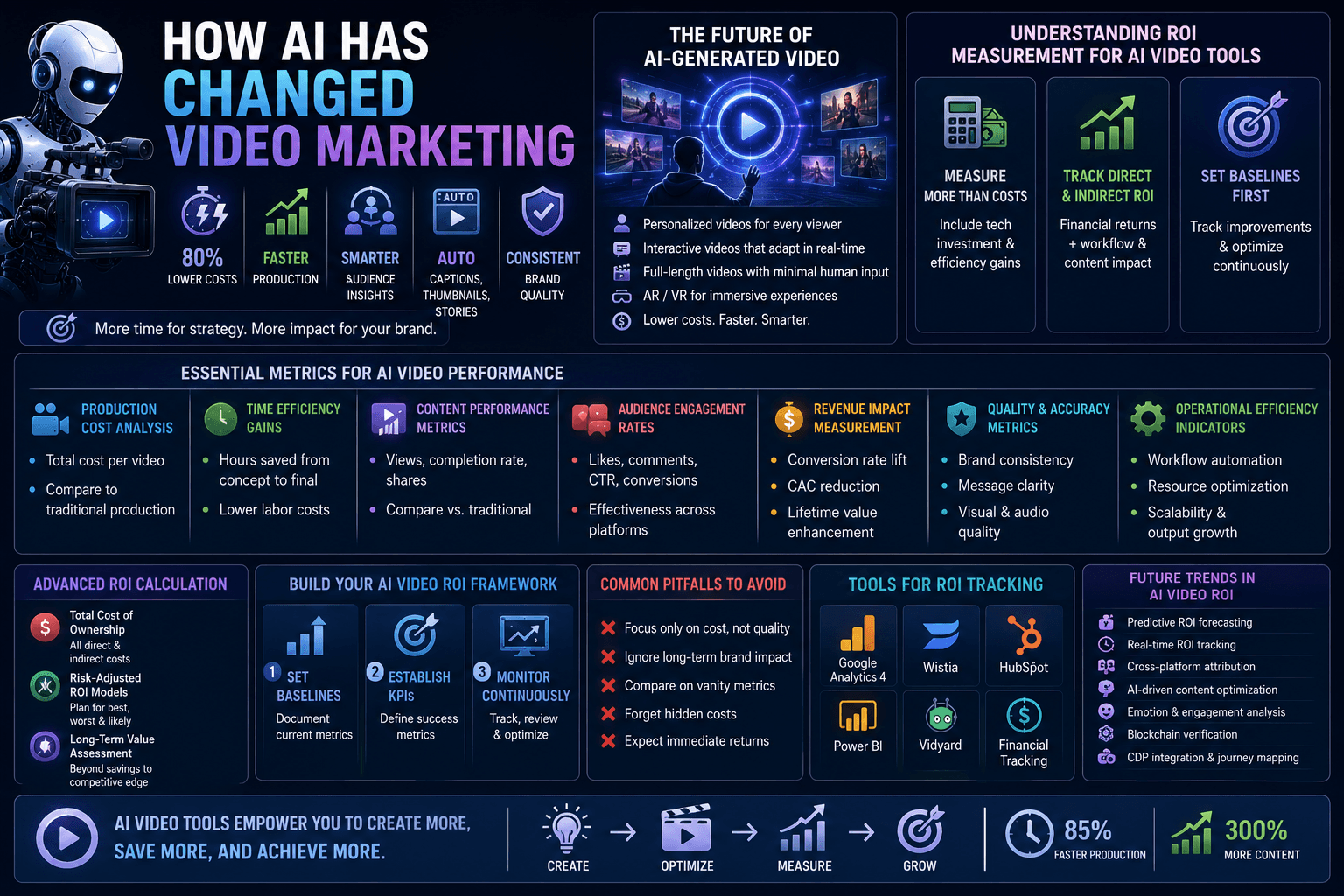
Artificial Intelligence (AI) has revolutionized video marketing by automating tasks that previously required significant time and expertise. AI video tools empower marketers to swiftly create high-quality content, reducing production costs by up to 80% while maintaining brand consistency. These tools leverage machine learning to discern audience preferences, select optimal video lengths, and automatically generate captions, thumbnails, and storylines. This transformation enables even small businesses to produce videos on par with larger companies, allowing marketers to allocate more resources to distribution and strategy rather than production. For more insights on video marketing strategies, check out our page on Effective Video Marketing Techniques.
The Future of AI-Generated Video Content
By 2030, AI video technology will have advanced significantly. AI tools will create videos tailored to individual viewer preferences, age, and habits in real-time. These tools will produce interactive videos that adapt based on viewer engagement. AI will facilitate the creation of full-length documentaries, training videos, and marketing campaigns with minimal human intervention. Additionally, AI will integrate with augmented reality and virtual reality to deliver immersive video experiences, simplifying video creation for everyone and further reducing costs and production time. Explore our section on Emerging Technologies in Video Production for more information.
Understanding ROI Measurement for AI Video Tools
Measuring ROI for AI-generated videos differs from traditional video metrics, which focus on costs and basic engagement. AI video ROI considers technology investment, efficiency gains, and content outcomes. It is essential to measure both direct financial returns and indirect benefits, such as faster workflows and scalable content. Establish clear baselines before implementing AI video tools to accurately track improvements. This approach helps businesses justify AI investments and refine video marketing strategies for optimal returns. For a deeper dive into ROI strategies, visit our page on Maximizing Marketing ROI.
Essential Metrics for AI Video Performance
Production Cost Analysis
Evaluate the total cost per video, including software, computing resources, and human oversight. Compare these costs to traditional video production to determine savings.
Time Efficiency Gains
Assess the reduction in production time from concept to final video. AI video tools typically shorten production cycles from weeks to hours, reducing labor costs.
Content Performance Metrics
Monitor view rates, completion rates, and social shares to evaluate content quality. AI-generated videos should match or surpass the performance of traditional content. For more on measuring content performance, see our article on Content Performance Metrics.
Audience Engagement Rates
Track likes, comments, click-through rates, and conversion actions to gauge audience response and content effectiveness across platforms and demographics.
Revenue Impact Measurement
Conversion Rate Improvements
Analyze how AI-generated videos drive actions such as purchases, sign-ups, or downloads. Compare conversion rates before and after implementing AI tools to assess direct revenue impact.
Customer Acquisition Cost Reduction
Calculate the cost per new customer acquired through AI video campaigns versus traditional methods. Lower production costs typically result in reduced acquisition expenses.
Lifetime Value Enhancement
Examine how AI videos influence long-term customer relationships. Personalized video content often boosts customer retention and repeat purchases, directly impacting customer lifetime value and revenue growth. For insights on customer retention strategies, check out our page on Enhancing Customer Lifetime Value.
Quality and Accuracy Metrics
Brand Consistency Scores
Ensure AI-generated videos adhere to brand guidelines for colors, fonts, and tone. Use a scoring system to evaluate consistency.
Message Clarity Assessment
Utilize surveys and feedback forms to determine if viewers comprehend your message. Track whether AI-created content effectively communicates your intended message.
Visual Quality Standards
Assess video resolution, audio clarity, and overall production quality. Compare AI-generated content to professional videos to ensure they meet audience expectations and brand standards.
Operational Efficiency Indicators
Workflow Automation Benefits
Measure how AI video tools reduce manual tasks like editing and content approval. Determine the percentage of workflows automated versus those requiring manual input.
Resource Allocation Optimization
Evaluate how AI shifts your team's focus from production tasks to strategy and creative planning. Calculate hours saved per video project and reallocate resources to more valuable activities.
Scalability Measurements
Assess your ability to produce more videos without increasing staff or budget. Track video output, production capacity, and cost per video as you scale operations with AI video tools. For more on scaling operations, see our guide on Scaling Your Marketing Efforts.
Advanced ROI Calculation Methods
Total Cost of Ownership Analysis
Account for all costs associated with AI video tools, including software licenses, training, data storage, and maintenance. Consider hidden costs like quality checks and content updates.
Risk-Adjusted ROI Models
Factor in risks such as failures, underperforming content, and technological changes. Use various scenarios to predict best, worst, and likely outcomes for AI video investments.
Long-term Value Assessment
Consider benefits extending beyond immediate savings. Evaluate how AI video tools enhance brand consistency, accelerate market response, and build long-term competitive advantages.
Building Your AI Video ROI Framework
Setting Performance Baselines
Document current video production costs, timelines, and performance metrics before adopting AI tools. Note manual production expenses, time spent per video, and existing engagement rates.
Establishing KPIs
Define clear success metrics for AI video implementation. Focus on reducing production costs, saving time, increasing content output, and boosting audience engagement.
Continuous Monitoring Systems
Implement automated tracking to measure performance over time. Compare AI-generated video results with those produced by humans. Regularly review ROI trends and adjust strategies based on data.
Common Measurement Pitfalls to Avoid
Avoid focusing solely on cost reduction without considering quality declines or changes in audience response. Don't rely on short-term metrics without considering long-term brand effects. Avoid comparing AI video tools using superficial metrics like video count instead of real business results. Consider hidden costs like training time, quality checks, and content updates. Remember the learning curve when calculating ROI and avoid expecting immediate returns. Use metrics tailored to AI video performance to capture the unique benefits of automated content creation.
Tools and Technologies for ROI Tracking
Modern tools like Google Analytics 4 and Adobe Analytics effectively track video performance. AI video platforms often feature ROI dashboards to monitor costs and time savings. Tools like Tableau and Power BI visualize video performance data across channels. Platforms like HubSpot and Marketo track conversions from AI-generated videos. Tools such as Wistia and Vidyard provide detailed engagement metrics. Financial tracking software integrates with AI video tools to calculate costs and measure efficiency gains. For a comprehensive look at analytics tools, visit our page on Top Analytics Tools for Marketers.
Future Trends in AI Video ROI Measurement
By 2027, ROI measurement for AI-generated videos will advance. Predictive analytics will forecast video success before creation. Real-time ROI tracking will provide instant feedback on content effectiveness. Cross-platform models will more clearly link video views to conversions. AI tools will automatically adjust video content based on data. Emotion recognition will evaluate viewer engagement and feelings. Blockchain will accurately verify view counts and engagement metrics. Integration with customer data platforms will map the journey from watching a video to making a purchase. For more on future trends in marketing technology, see our article on Future Trends in Marketing Technology.
How AI Has Changed Video Marketing
Artificial Intelligence (AI) has revolutionized video marketing by automating tasks that previously required significant time and expertise. AI video tools empower marketers to swiftly create high-quality content, reducing production costs by up to 80% while maintaining brand consistency. These tools leverage machine learning to discern audience preferences, select optimal video lengths, and automatically generate captions, thumbnails, and storylines. This transformation enables even small businesses to produce videos on par with larger companies, allowing marketers to allocate more resources to distribution and strategy rather than production. For more insights on video marketing strategies, check out our page on Effective Video Marketing Techniques.
The Future of AI-Generated Video Content
By 2030, AI video technology will have advanced significantly. AI tools will create videos tailored to individual viewer preferences, age, and habits in real-time. These tools will produce interactive videos that adapt based on viewer engagement. AI will facilitate the creation of full-length documentaries, training videos, and marketing campaigns with minimal human intervention. Additionally, AI will integrate with augmented reality and virtual reality to deliver immersive video experiences, simplifying video creation for everyone and further reducing costs and production time. Explore our section on Emerging Technologies in Video Production for more information.
Understanding ROI Measurement for AI Video Tools
Measuring ROI for AI-generated videos differs from traditional video metrics, which focus on costs and basic engagement. AI video ROI considers technology investment, efficiency gains, and content outcomes. It is essential to measure both direct financial returns and indirect benefits, such as faster workflows and scalable content. Establish clear baselines before implementing AI video tools to accurately track improvements. This approach helps businesses justify AI investments and refine video marketing strategies for optimal returns. For a deeper dive into ROI strategies, visit our page on Maximizing Marketing ROI.
Essential Metrics for AI Video Performance
Production Cost Analysis
Evaluate the total cost per video, including software, computing resources, and human oversight. Compare these costs to traditional video production to determine savings.
Time Efficiency Gains
Assess the reduction in production time from concept to final video. AI video tools typically shorten production cycles from weeks to hours, reducing labor costs.
Content Performance Metrics
Monitor view rates, completion rates, and social shares to evaluate content quality. AI-generated videos should match or surpass the performance of traditional content. For more on measuring content performance, see our article on Content Performance Metrics.
Audience Engagement Rates
Track likes, comments, click-through rates, and conversion actions to gauge audience response and content effectiveness across platforms and demographics.
Revenue Impact Measurement
Conversion Rate Improvements
Analyze how AI-generated videos drive actions such as purchases, sign-ups, or downloads. Compare conversion rates before and after implementing AI tools to assess direct revenue impact.
Customer Acquisition Cost Reduction
Calculate the cost per new customer acquired through AI video campaigns versus traditional methods. Lower production costs typically result in reduced acquisition expenses.
Lifetime Value Enhancement
Examine how AI videos influence long-term customer relationships. Personalized video content often boosts customer retention and repeat purchases, directly impacting customer lifetime value and revenue growth. For insights on customer retention strategies, check out our page on Enhancing Customer Lifetime Value.
Quality and Accuracy Metrics
Brand Consistency Scores
Ensure AI-generated videos adhere to brand guidelines for colors, fonts, and tone. Use a scoring system to evaluate consistency.
Message Clarity Assessment
Utilize surveys and feedback forms to determine if viewers comprehend your message. Track whether AI-created content effectively communicates your intended message.
Visual Quality Standards
Assess video resolution, audio clarity, and overall production quality. Compare AI-generated content to professional videos to ensure they meet audience expectations and brand standards.
Operational Efficiency Indicators
Workflow Automation Benefits
Measure how AI video tools reduce manual tasks like editing and content approval. Determine the percentage of workflows automated versus those requiring manual input.
Resource Allocation Optimization
Evaluate how AI shifts your team's focus from production tasks to strategy and creative planning. Calculate hours saved per video project and reallocate resources to more valuable activities.
Scalability Measurements
Assess your ability to produce more videos without increasing staff or budget. Track video output, production capacity, and cost per video as you scale operations with AI video tools. For more on scaling operations, see our guide on Scaling Your Marketing Efforts.
Advanced ROI Calculation Methods
Total Cost of Ownership Analysis
Account for all costs associated with AI video tools, including software licenses, training, data storage, and maintenance. Consider hidden costs like quality checks and content updates.
Risk-Adjusted ROI Models
Factor in risks such as failures, underperforming content, and technological changes. Use various scenarios to predict best, worst, and likely outcomes for AI video investments.
Long-term Value Assessment
Consider benefits extending beyond immediate savings. Evaluate how AI video tools enhance brand consistency, accelerate market response, and build long-term competitive advantages.
Building Your AI Video ROI Framework
Setting Performance Baselines
Document current video production costs, timelines, and performance metrics before adopting AI tools. Note manual production expenses, time spent per video, and existing engagement rates.
Establishing KPIs
Define clear success metrics for AI video implementation. Focus on reducing production costs, saving time, increasing content output, and boosting audience engagement.
Continuous Monitoring Systems
Implement automated tracking to measure performance over time. Compare AI-generated video results with those produced by humans. Regularly review ROI trends and adjust strategies based on data.
Common Measurement Pitfalls to Avoid
Avoid focusing solely on cost reduction without considering quality declines or changes in audience response. Don't rely on short-term metrics without considering long-term brand effects. Avoid comparing AI video tools using superficial metrics like video count instead of real business results. Consider hidden costs like training time, quality checks, and content updates. Remember the learning curve when calculating ROI and avoid expecting immediate returns. Use metrics tailored to AI video performance to capture the unique benefits of automated content creation.
Tools and Technologies for ROI Tracking
Modern tools like Google Analytics 4 and Adobe Analytics effectively track video performance. AI video platforms often feature ROI dashboards to monitor costs and time savings. Tools like Tableau and Power BI visualize video performance data across channels. Platforms like HubSpot and Marketo track conversions from AI-generated videos. Tools such as Wistia and Vidyard provide detailed engagement metrics. Financial tracking software integrates with AI video tools to calculate costs and measure efficiency gains. For a comprehensive look at analytics tools, visit our page on Top Analytics Tools for Marketers.
Future Trends in AI Video ROI Measurement
By 2027, ROI measurement for AI-generated videos will advance. Predictive analytics will forecast video success before creation. Real-time ROI tracking will provide instant feedback on content effectiveness. Cross-platform models will more clearly link video views to conversions. AI tools will automatically adjust video content based on data. Emotion recognition will evaluate viewer engagement and feelings. Blockchain will accurately verify view counts and engagement metrics. Integration with customer data platforms will map the journey from watching a video to making a purchase. For more on future trends in marketing technology, see our article on Future Trends in Marketing Technology.
Learn how to measure ROI for video maker AI tools. Discover key metrics, cost analysis, and performance tracking methods for AI-generated videos.
How AI Has Changed Video Marketing
Artificial Intelligence (AI) has revolutionized video marketing by automating tasks that previously required significant time and expertise. AI video tools empower marketers to swiftly create high-quality content, reducing production costs by up to 80% while maintaining brand consistency. These tools leverage machine learning to discern audience preferences, select optimal video lengths, and automatically generate captions, thumbnails, and storylines. This transformation enables even small businesses to produce videos on par with larger companies, allowing marketers to allocate more resources to distribution and strategy rather than production. For more insights on video marketing strategies, check out our page on Effective Video Marketing Techniques.
The Future of AI-Generated Video Content
By 2030, AI video technology will have advanced significantly. AI tools will create videos tailored to individual viewer preferences, age, and habits in real-time. These tools will produce interactive videos that adapt based on viewer engagement. AI will facilitate the creation of full-length documentaries, training videos, and marketing campaigns with minimal human intervention. Additionally, AI will integrate with augmented reality and virtual reality to deliver immersive video experiences, simplifying video creation for everyone and further reducing costs and production time. Explore our section on Emerging Technologies in Video Production for more information.
Understanding ROI Measurement for AI Video Tools
Measuring ROI for AI-generated videos differs from traditional video metrics, which focus on costs and basic engagement. AI video ROI considers technology investment, efficiency gains, and content outcomes. It is essential to measure both direct financial returns and indirect benefits, such as faster workflows and scalable content. Establish clear baselines before implementing AI video tools to accurately track improvements. This approach helps businesses justify AI investments and refine video marketing strategies for optimal returns. For a deeper dive into ROI strategies, visit our page on Maximizing Marketing ROI.
Essential Metrics for AI Video Performance
Production Cost Analysis
Evaluate the total cost per video, including software, computing resources, and human oversight. Compare these costs to traditional video production to determine savings.
Time Efficiency Gains
Assess the reduction in production time from concept to final video. AI video tools typically shorten production cycles from weeks to hours, reducing labor costs.
Content Performance Metrics
Monitor view rates, completion rates, and social shares to evaluate content quality. AI-generated videos should match or surpass the performance of traditional content. For more on measuring content performance, see our article on Content Performance Metrics.
Audience Engagement Rates
Track likes, comments, click-through rates, and conversion actions to gauge audience response and content effectiveness across platforms and demographics.
Revenue Impact Measurement
Conversion Rate Improvements
Analyze how AI-generated videos drive actions such as purchases, sign-ups, or downloads. Compare conversion rates before and after implementing AI tools to assess direct revenue impact.
Customer Acquisition Cost Reduction
Calculate the cost per new customer acquired through AI video campaigns versus traditional methods. Lower production costs typically result in reduced acquisition expenses.
Lifetime Value Enhancement
Examine how AI videos influence long-term customer relationships. Personalized video content often boosts customer retention and repeat purchases, directly impacting customer lifetime value and revenue growth. For insights on customer retention strategies, check out our page on Enhancing Customer Lifetime Value.
Quality and Accuracy Metrics
Brand Consistency Scores
Ensure AI-generated videos adhere to brand guidelines for colors, fonts, and tone. Use a scoring system to evaluate consistency.
Message Clarity Assessment
Utilize surveys and feedback forms to determine if viewers comprehend your message. Track whether AI-created content effectively communicates your intended message.
Visual Quality Standards
Assess video resolution, audio clarity, and overall production quality. Compare AI-generated content to professional videos to ensure they meet audience expectations and brand standards.
Operational Efficiency Indicators
Workflow Automation Benefits
Measure how AI video tools reduce manual tasks like editing and content approval. Determine the percentage of workflows automated versus those requiring manual input.
Resource Allocation Optimization
Evaluate how AI shifts your team's focus from production tasks to strategy and creative planning. Calculate hours saved per video project and reallocate resources to more valuable activities.
Scalability Measurements
Assess your ability to produce more videos without increasing staff or budget. Track video output, production capacity, and cost per video as you scale operations with AI video tools. For more on scaling operations, see our guide on Scaling Your Marketing Efforts.
Advanced ROI Calculation Methods
Total Cost of Ownership Analysis
Account for all costs associated with AI video tools, including software licenses, training, data storage, and maintenance. Consider hidden costs like quality checks and content updates.
Risk-Adjusted ROI Models
Factor in risks such as failures, underperforming content, and technological changes. Use various scenarios to predict best, worst, and likely outcomes for AI video investments.
Long-term Value Assessment
Consider benefits extending beyond immediate savings. Evaluate how AI video tools enhance brand consistency, accelerate market response, and build long-term competitive advantages.
Building Your AI Video ROI Framework
Setting Performance Baselines
Document current video production costs, timelines, and performance metrics before adopting AI tools. Note manual production expenses, time spent per video, and existing engagement rates.
Establishing KPIs
Define clear success metrics for AI video implementation. Focus on reducing production costs, saving time, increasing content output, and boosting audience engagement.
Continuous Monitoring Systems
Implement automated tracking to measure performance over time. Compare AI-generated video results with those produced by humans. Regularly review ROI trends and adjust strategies based on data.
Common Measurement Pitfalls to Avoid
Avoid focusing solely on cost reduction without considering quality declines or changes in audience response. Don't rely on short-term metrics without considering long-term brand effects. Avoid comparing AI video tools using superficial metrics like video count instead of real business results. Consider hidden costs like training time, quality checks, and content updates. Remember the learning curve when calculating ROI and avoid expecting immediate returns. Use metrics tailored to AI video performance to capture the unique benefits of automated content creation.
Tools and Technologies for ROI Tracking
Modern tools like Google Analytics 4 and Adobe Analytics effectively track video performance. AI video platforms often feature ROI dashboards to monitor costs and time savings. Tools like Tableau and Power BI visualize video performance data across channels. Platforms like HubSpot and Marketo track conversions from AI-generated videos. Tools such as Wistia and Vidyard provide detailed engagement metrics. Financial tracking software integrates with AI video tools to calculate costs and measure efficiency gains. For a comprehensive look at analytics tools, visit our page on Top Analytics Tools for Marketers.
Future Trends in AI Video ROI Measurement
By 2027, ROI measurement for AI-generated videos will advance. Predictive analytics will forecast video success before creation. Real-time ROI tracking will provide instant feedback on content effectiveness. Cross-platform models will more clearly link video views to conversions. AI tools will automatically adjust video content based on data. Emotion recognition will evaluate viewer engagement and feelings. Blockchain will accurately verify view counts and engagement metrics. Integration with customer data platforms will map the journey from watching a video to making a purchase. For more on future trends in marketing technology, see our article on Future Trends in Marketing Technology.
บล็อกอื่น ๆ
บล็อกอื่น ๆ
ตรวจสอบบล็อกโครงการอื่น ๆ ของเราที่มีข้อมูลเชิงลึกและข้อมูลที่เป็นประโยชน์สำหรับธุรกิจของคุณ
บล็อกอื่น ๆ
บล็อกอื่น ๆ
ตรวจสอบบล็อกโครงการอื่น ๆ ของเราที่มีข้อมูลเชิงลึกและข้อมูลที่เป็นประโยชน์สำหรับธุรกิจของคุณ